


























Views
Downloads
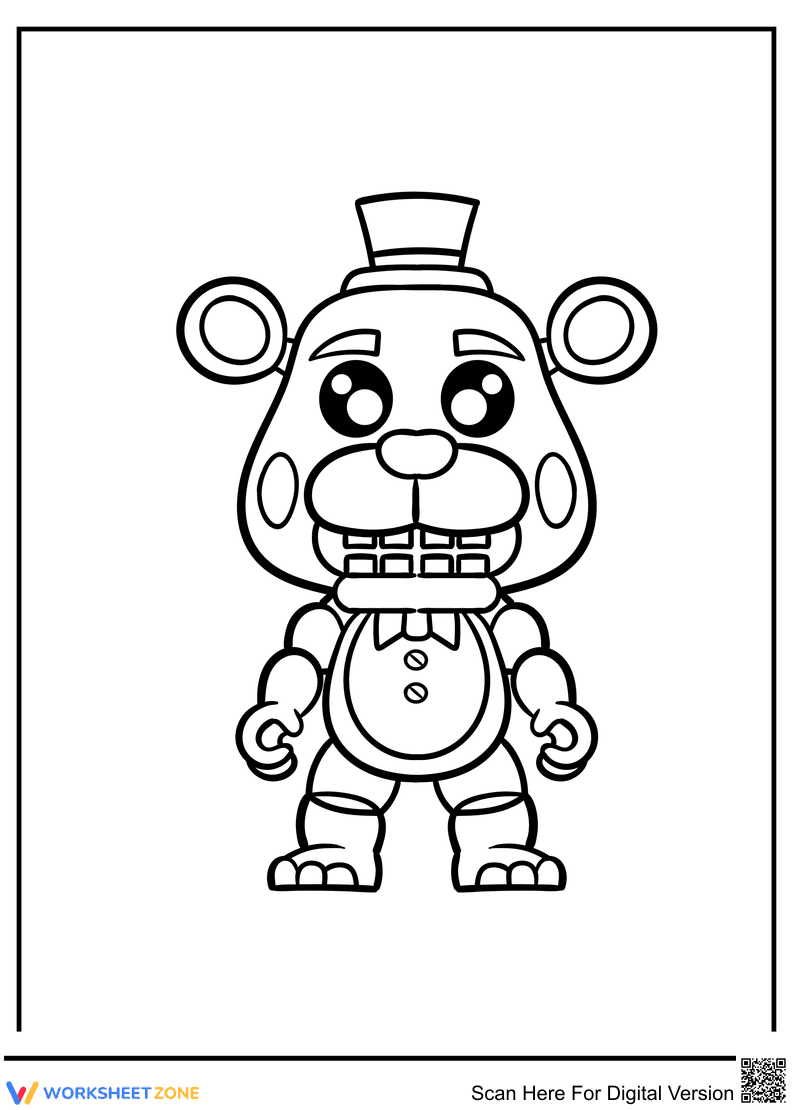

Freddy Coloring Page | Essential Grade K-5 Printable
Paste this activity's link or code into your existing LMS (Google Classroom, Canvas, Teams, Schoology, Moodle, etc.).
Students can open and work on the activity right away, with no student login required.
You'll still be able to track student progress and results from your teacher account.
This Freddy coloring page provides elementary students with a high-interest creative outlet to develop essential fine motor control and color theory application. By engaging with a popular character in a stylized, innocent format, learners practice precision and spatial awareness while expressing their artistic preferences through a structured visual task.
At a Glance
- Grade: K-5 · Subject: Arts & English
- Standard:
CCSS.ELA-LITERACY.SL.K.5— Add drawings to descriptions to provide additional detail and clarify ideas- Skill Focus: Fine motor development
- Format: 1 page · 1 task · Answer key N/A · PDF
- Best For: Early finisher activity or indoor recess
- Time: 15–20 minutes
Inside this resource, you will find a single-page, high-resolution PDF featuring a stylized version of the character Freddy. The line art is clean and bold, making it accessible for younger students who are still mastering staying within the lines. There are no complex backgrounds, allowing the student to focus entirely on the central figure and perhaps add their own environmental details to the scene.
The zero-prep workflow for this worksheet is designed for maximum efficiency. First, print the single-page PDF (30 seconds). Second, distribute the sheets along with crayons, markers, or colored pencils (1 minute). Third, review the completed work to provide positive reinforcement on color choice and neatness (30 seconds). Total teacher preparation time is under 2 minutes, making it an ideal sub-plan addition or emergency filler activity.
This activity aligns with `CCSS.ELA-LITERACY.SL.K.5`, which encourages students to use visual displays to enhance their communication. While primarily an artistic endeavor, it supports the standard by requiring students to make intentional visual choices that represent a character's traits. Both standard codes can be copied directly into lesson plans, IEP goals, or district curriculum mapping tools to justify the use of creative arts in the classroom.
Use this worksheet as a hook during a character description lesson or as a calming transition after active periods. It serves as an excellent formative assessment for fine motor grip and pressure control. Expected completion time ranges from 15 to 20 minutes depending on the level of detail the student chooses to apply. It can also be used as a reward for completing more rigorous academic tasks.
This printable is perfect for Kindergarten through 5th-grade students who enjoy popular media characters. It is particularly effective for students requiring sensory breaks or those who struggle with traditional writing tasks. Pair this with a short writing prompt about the character's personality or a direct instruction lesson on primary and secondary colors to extend the learning into a full ELA or Art lesson.
Research from Fisher & Frey (2014) emphasizes the importance of visual literacy and the role of drawing in cognitive development for early learners. Engaging in structured coloring activities like this Freddy worksheet supports the development of the small muscles in the hand, which are foundational for handwriting and manipulation of school tools. According to the RAND AIRS 2024 report, integrating high-interest visual tasks into the classroom can increase student engagement by up to 22% among reluctant learners. This resource provides a low-stakes environment for students to practice focus and persistence. By utilizing the `CCSS.ELA-LITERACY.SL.K.5` standard, educators can bridge the gap between creative play and academic requirements. This summary serves as a standalone justification for the inclusion of artistic expression within the primary ELA and fine motor curriculum frameworks.


