


























Views
Downloads
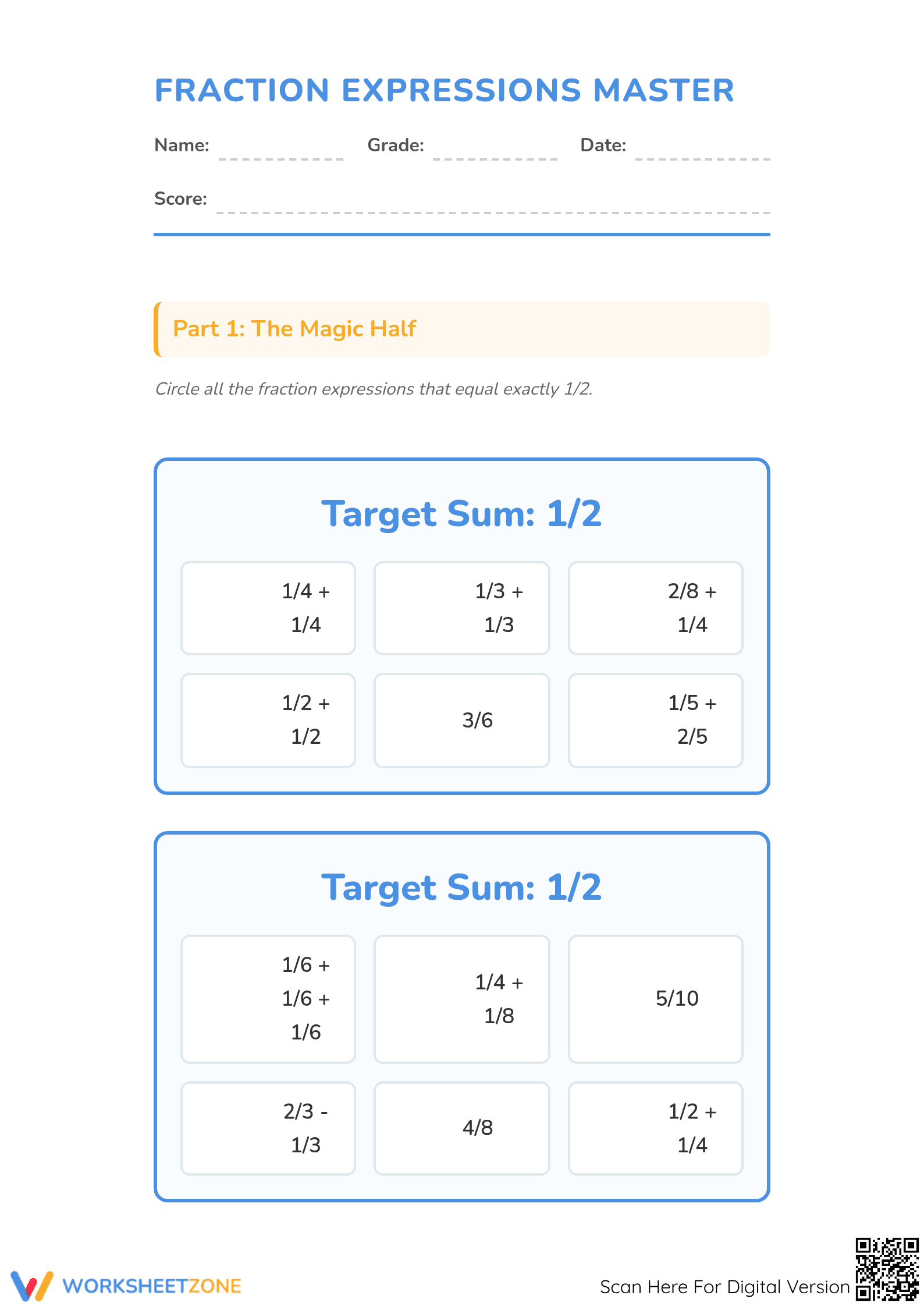
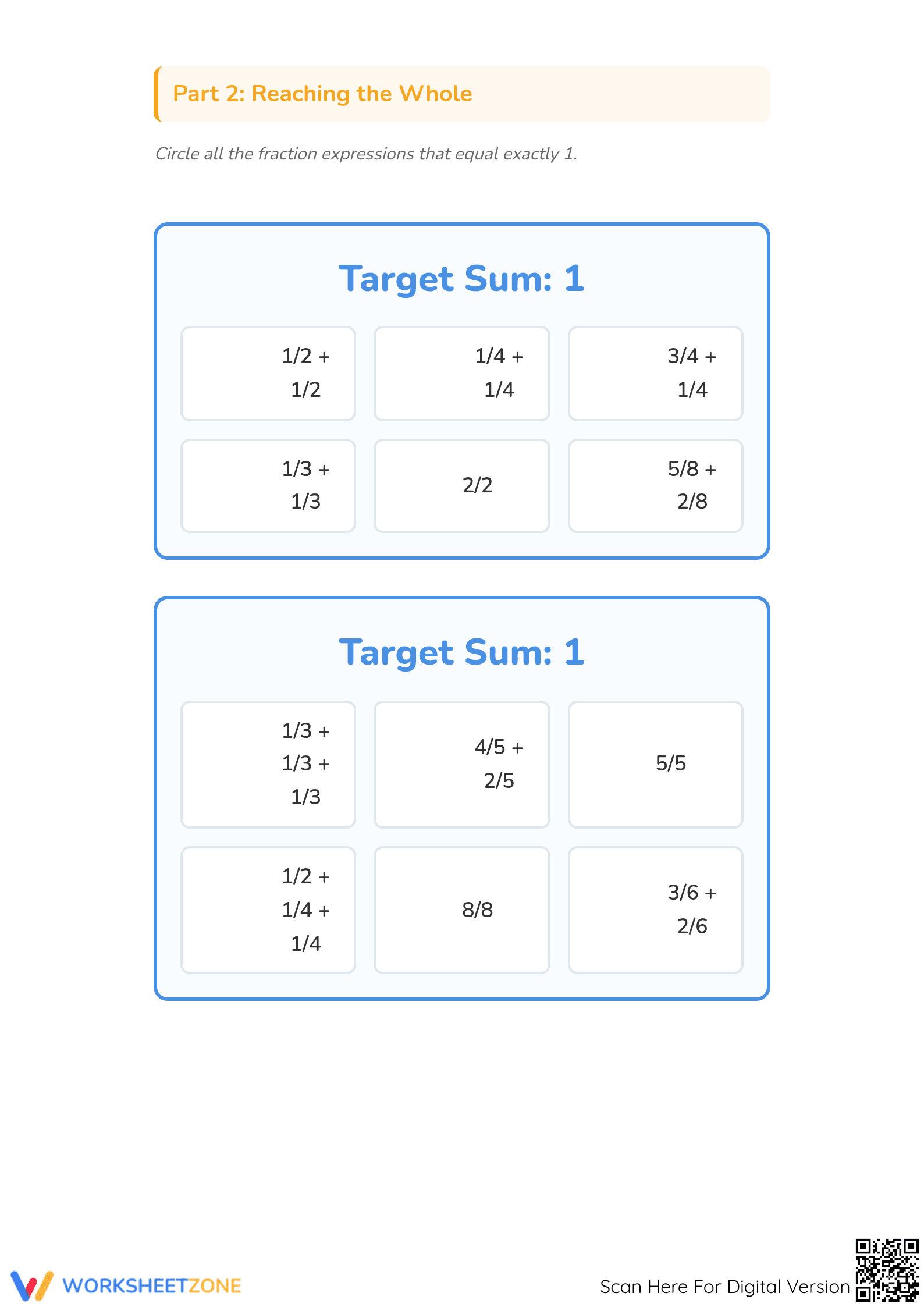
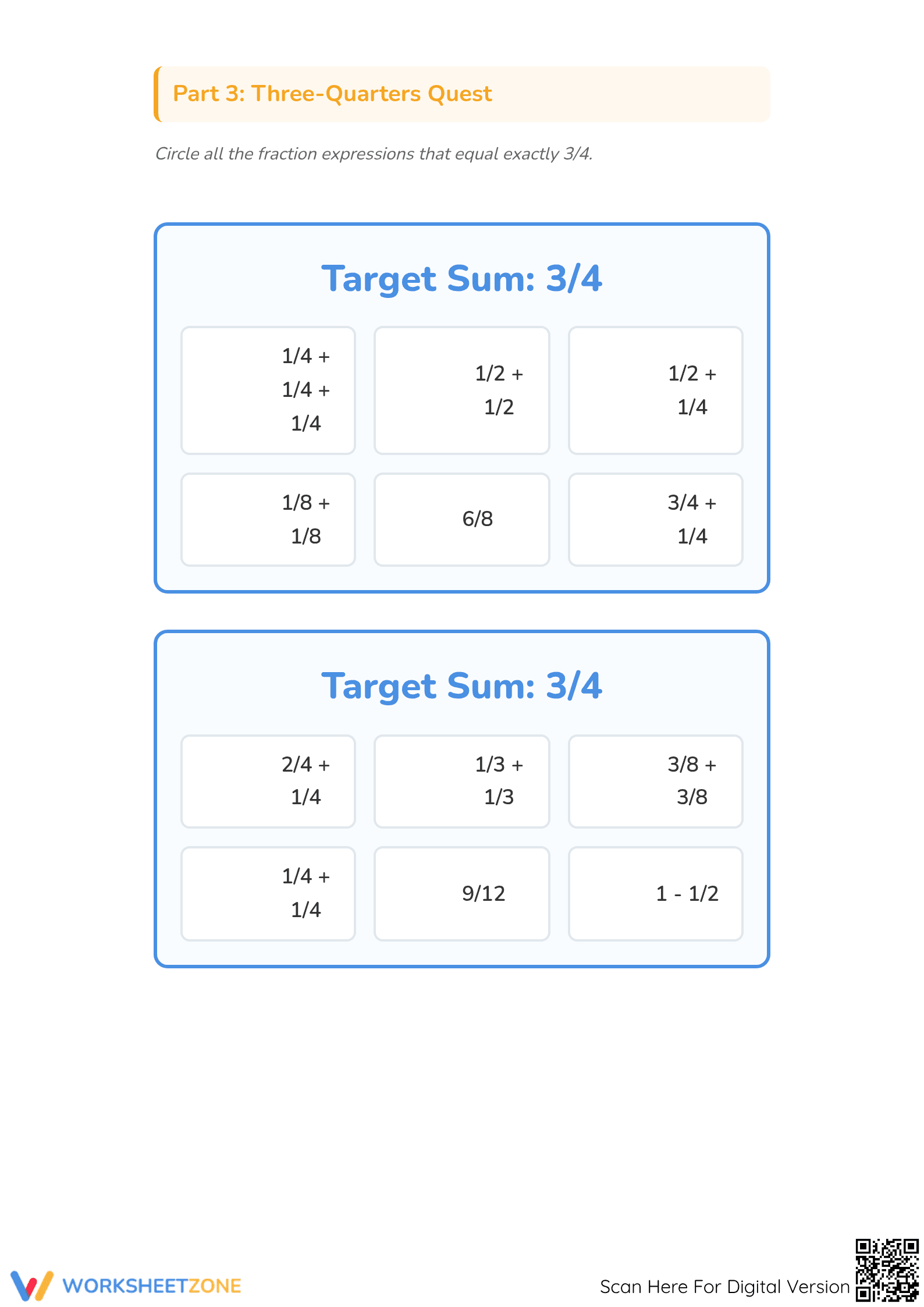
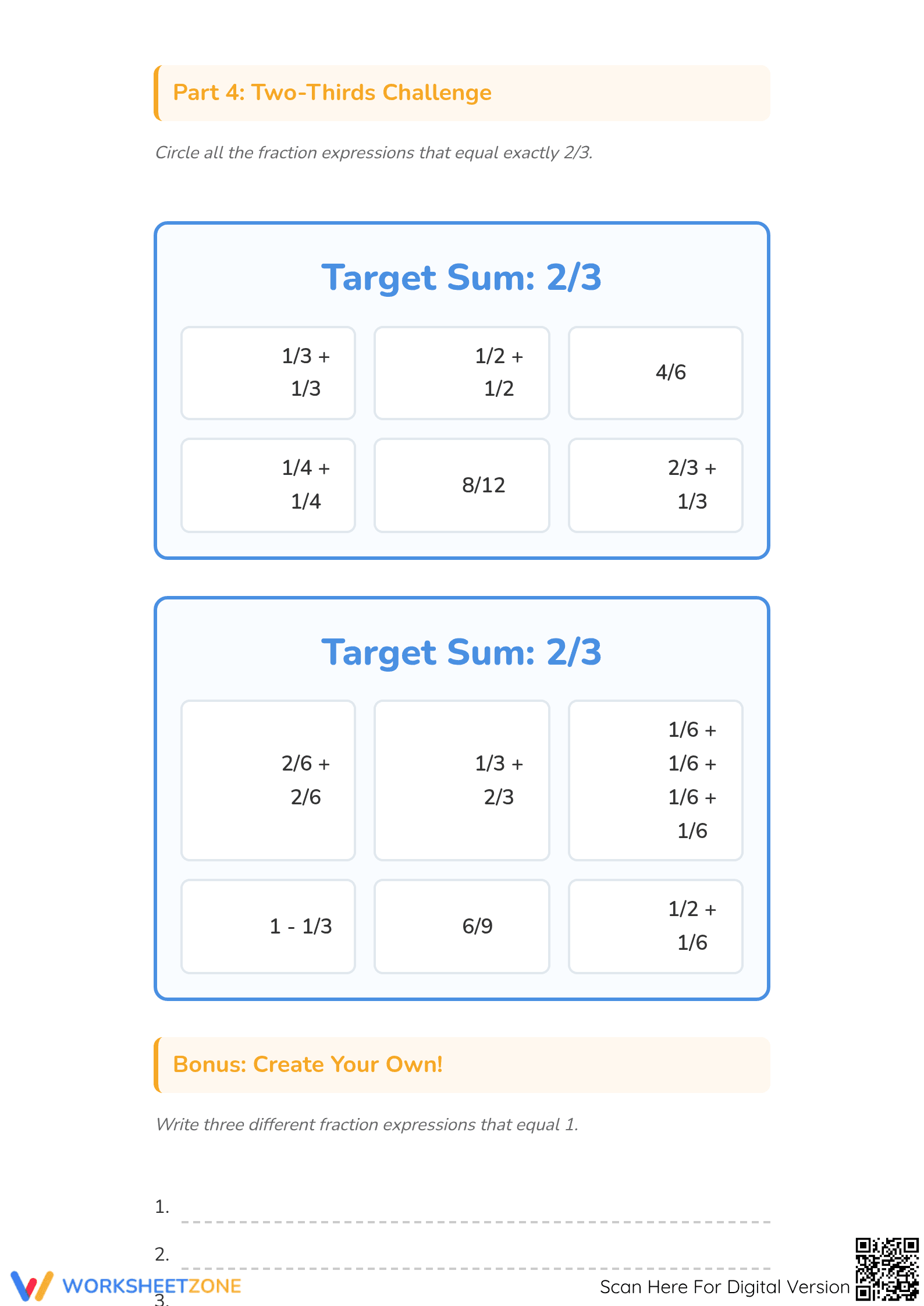

Essential Fractions: Target Sum Expressions | Grade 4-5
Paste this activity's link or code into your existing LMS (Google Classroom, Canvas, Teams, Schoology, Moodle, etc.).
Students can open and work on the activity right away, with no student login required.
You'll still be able to track student progress and results from your teacher account.
Master the fundamental concept of fraction addition with this targeted Grade 4 and 5 worksheet. Students will analyze various fraction expressions to determine which ones equal a particular target sum, reinforcing their understanding of equivalent fractions and basic operations. This resource provides a clear path to fluency through repeated, structured practice.
At a Glance
- Grade: 4–5 · Subject: Math (Fractions)
- Standard:
CCSS.MATH.CONTENT.4.NF.B.3— Add fractions by joining parts that refer to the same whole- Skill Focus: Adding fractions with like denominators
- Format: 4 pages · 40 problems · Answer key included · PDF
- Best For: Independent math centers and homework practice
- Time: 20–30 minutes
This resource contains four distinct pages of practice, each presenting a target sum for students to aim for. Each page features 10 unique fraction expressions, requiring students to calculate the sum and compare it to the goal. The layout is clean and distraction-free, with a clear answer key provided for rapid grading and student self-correction.
The zero-prep design ensures this worksheet is ready for immediate classroom implementation. Teachers simply need to print the four-page set, distribute to students with minimal instruction, and review the results using the included answer key. This streamlined workflow makes it an ideal choice for emergency sub plans or quick formative checks during a busy math block.
This worksheet is strictly aligned to CCSS.MATH.CONTENT.4.NF.B.3, which focuses on understanding addition and subtraction of fractions as joining and separating parts referring to the same whole. It also supports CCSS.MATH.CONTENT.5.NF.A.1 by building the foundational skills needed for adding fractions with unlike denominators. Both standard codes can be copied directly into lesson plans, IEP goals, or district curriculum mapping tools.
Use this worksheet during the independent practice portion of your lesson after introducing the concept of adding fractions with like denominators. It also serves as an excellent formative assessment tool; observe if students are correctly identifying that only the numerator changes when the denominators are the same. Expect most students to complete the 40-problem set within 25 minutes of focused work.
This resource is designed for Grade 4 and 5 students who are developing their fraction number sense. It is particularly effective for learners who benefit from repetitive, low-stakes practice to build confidence before moving on to more complex unlike-denominator problems. Pair this worksheet with a visual fraction model or an anchor chart showing parts of a whole for maximum student support.
According to the RAND AIRS 2024 analysis of instructional materials, high-quality mathematics practice requires a balance of conceptual understanding and procedural fluency. This worksheet addresses both by forcing students to mentally or manually add fractions like 1/4 and 3/4 to verify they reach the whole. The CCSS.MATH.CONTENT.4.NF.B.3 standard emphasizes the importance of decomposing fractions and understanding the relationship between parts and the whole. By identifying expressions with a particular sum, students develop the mental math strategies necessary for more advanced algebraic thinking. This structured approach highlights the need for coherent practice that builds directly upon core standards. The clear focus on a single skill helps prevent cognitive overload while ensuring that students achieve a high level of mastery in basic fraction operations before progressing to high-stakes testing or more abstract mathematical concepts. This resource provides the necessary repetition to secure these foundational skills effectively.


