




























Views
Downloads
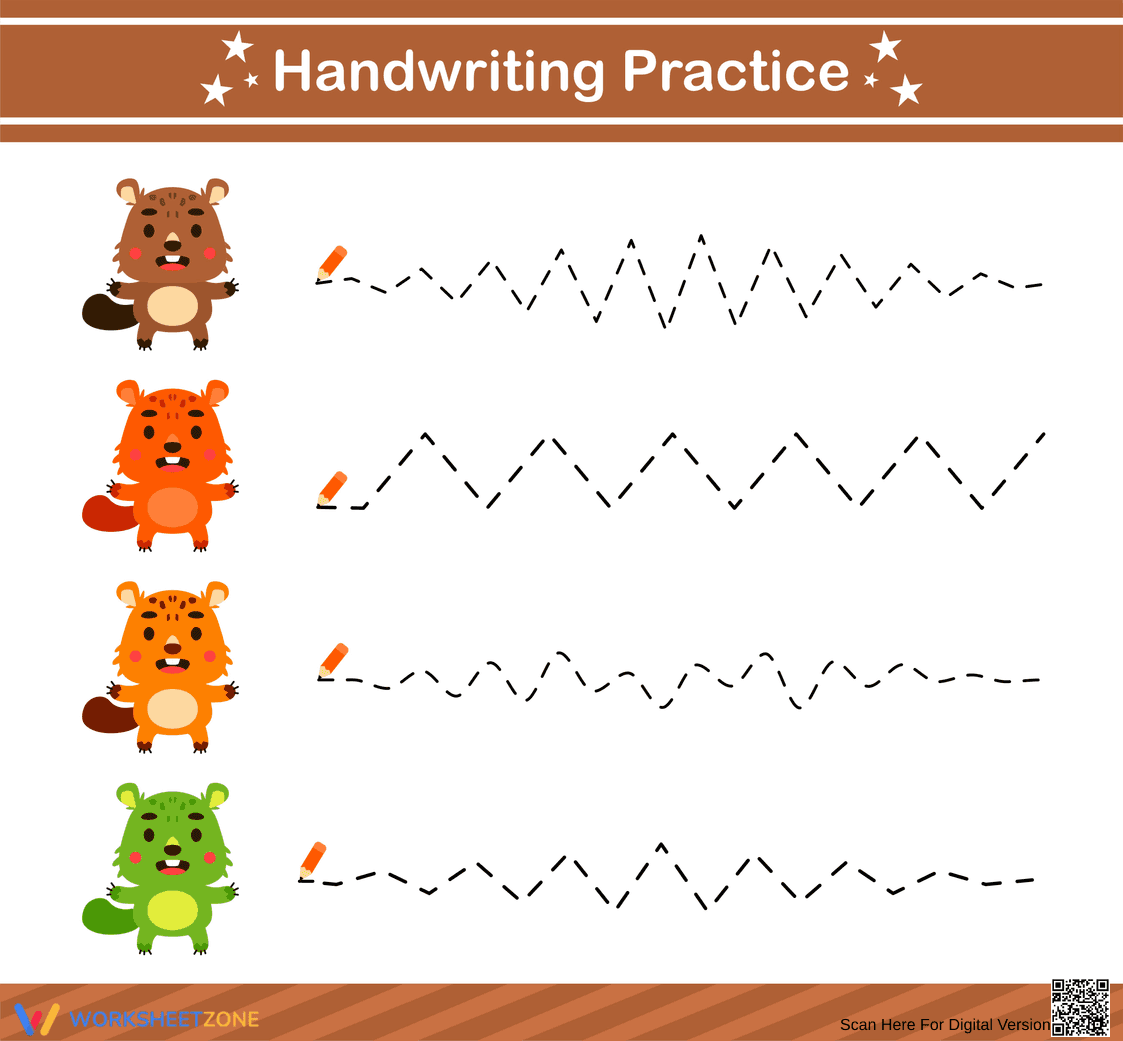

Printable Line Tracing Worksheet | PreK & K

Paste this activity's link or code into your existing LMS (Google Classroom, Canvas, Teams, Schoology, Moodle, etc.).
Students can open and work on the activity right away, with no student login required.
You'll still be able to track student progress and results from your teacher account.
This foundational pre-writing worksheet helps early learners develop essential fine motor control by tracing continuous zig-zag lines. By guiding their pencils along the dashed paths from each forest animal, students build the hand-eye coordination and grip strength required for future letter formation and handwriting success.
At a Glance
- Grade: PreK & K · Subject: Handwriting
- Standard:
CCSS.ELA-LITERACY.L.K.1.A— Form basic strokes and print letters- Skill Focus: Fine motor control and line tracing
- Format: 1 page · 4 problems · No answer key needed · PDF
- Best For: Morning work or literacy centers
- Time: 5–10 minutes
This single-page resource features four distinct zig-zag tracing paths, each paired with a friendly forest animal character to maintain student engagement. A helpful pencil icon marks the starting point for each line, promoting correct left-to-right progression. The dashed lines provide clear visual boundaries, allowing young learners to practice continuous pencil movement without the frustration of complex letter shapes.
This resource requires zero teacher setup.
- Print (1 minute): Simply generate the PDF and print a class set. The high-contrast dashed lines reproduce perfectly in black and white.
- Distribute (1 minute): Hand out the sheets along with thick pencils or crayons suitable for early learners.
- Review (1 minute): Demonstrate the left-to-right motion on the board, then let students work independently.
With prep time under three minutes, it is perfect for sub plans.
This activity aligns with foundational writing expectations, specifically supporting CCSS.ELA-LITERACY.L.K.1.A: Print many upper- and lowercase letters. While students are not yet forming specific letters, mastering these continuous zig-zag strokes is a mandatory prerequisite for writing letters like A, M, N, V, W, and Z. Both standard codes can be copied directly into lesson plans, IEP goals, or district curriculum mapping tools.
Use this tracing practice as a calming morning "do now" activity. It also functions perfectly within a dedicated fine motor or literacy center. Before direct instruction on letter formation, use this sheet to assess pencil grip and stroke confidence. As a formative assessment tip, observe whether students lift their pencils at the points of the zig-zags or maintain a continuous line. Most students will complete the four paths within a 5 to 10-minute timeframe.
This worksheet is primarily designed for preschool and kindergarten students who are developing their pre-writing abilities. It serves as an excellent intervention tool for first graders who still struggle with pencil control or require occupational therapy support. For differentiation, provide thicker markers for students needing less resistance, or standard pencils for those ready for a challenge. Pair this activity with a read-aloud about forest animals to create a cohesive thematic lesson.
Developing strong fine motor skills through targeted tracing activities is a critical step in early childhood education. This worksheet directly supports CCSS.ELA-LITERACY.L.K.1.A by helping students form basic strokes and print letters. According to Fisher & Frey (2014), explicit practice with pre-writing shapes significantly improves later handwriting legibility and writing stamina. When young learners engage in structured tracing tasks, they build the necessary muscle memory and hand-eye coordination required for complex letter formation. By isolating the zig-zag stroke, this resource reduces cognitive load, allowing students to focus entirely on their physical pencil control. Educators can rely on this evidence-based approach to ensure their students establish the foundational motor pathways necessary for long-term academic success in written communication.


