


























Views
Downloads
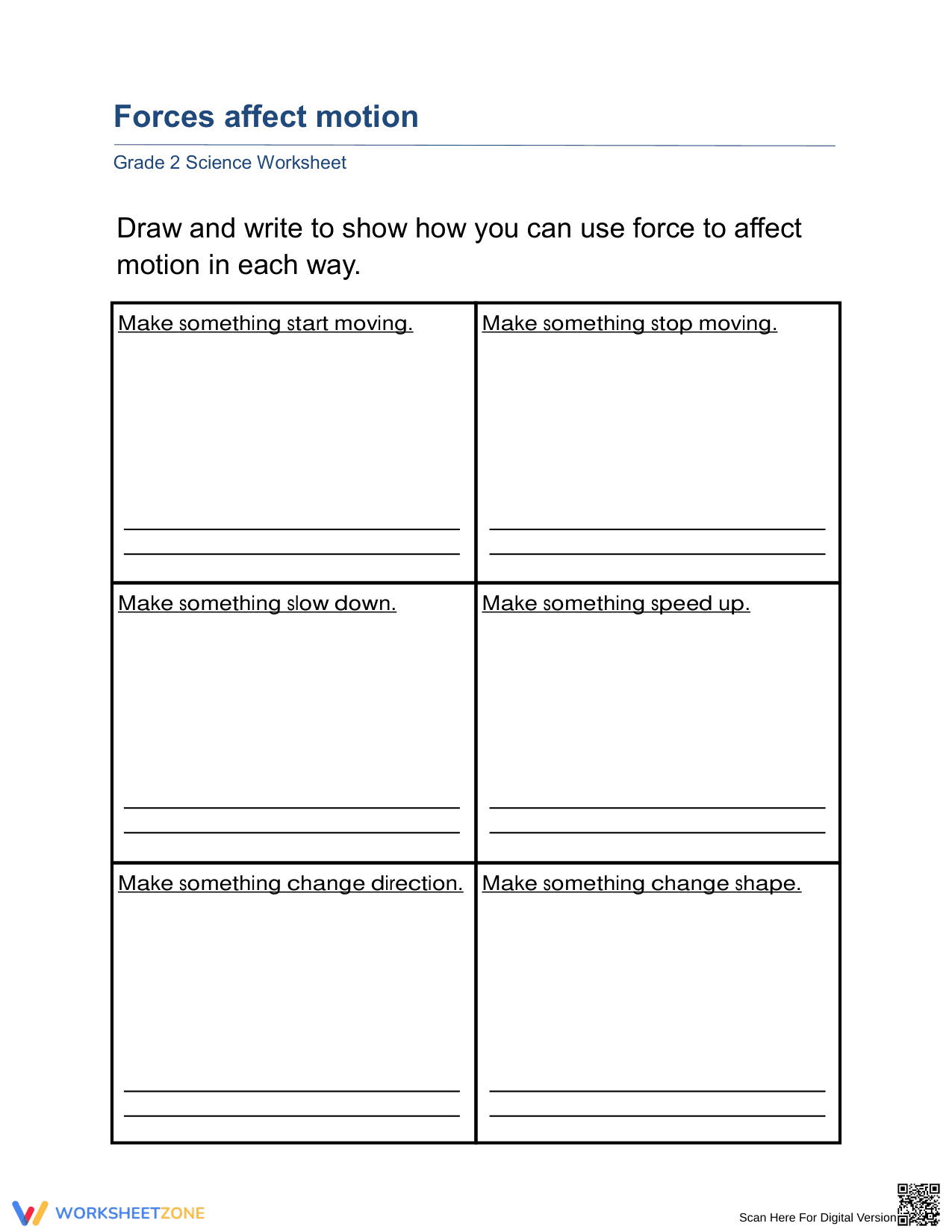

Printable Grade 2 Forces Affect Motion Drawing Worksheet
Paste this activity's link or code into your existing LMS (Google Classroom, Canvas, Teams, Schoology, Moodle, etc.).
Students can open and work on the activity right away, with no student login required.
You'll still be able to track student progress and results from your teacher account.
Understand how forces change the world with this engaging drawing and writing activity. This worksheet helps second-grade students visualize the relationship between applied force and motion through six scenarios. Students demonstrate understanding by illustrating physical changes, bridging the gap between abstract concepts and concrete observations of the physical world.
At a Glance
- Grade: 2 · Subject: Science
- Standard:
3-PS2-1— Plan and conduct an investigation to show how forces affect object motion- Skill Focus: Effects of forces on motion
- Format: 1 page · 6 problems · Answer key included · PDF
- Best For: Independent practice or formative science assessment
- Time: 15–20 minutes
This single-page PDF features six task boxes prompting students to demonstrate force effects. The worksheet includes space for drawing and writing explanations for starting motion, stopping motion, slowing down, speeding up, changing direction, and changing shape. A full answer key provides teachers with clear examples of expected student responses.
The zero-prep workflow is designed for maximum classroom efficiency. Printing takes less than a minute for a full class set. Distribution is immediate, and self-explanatory instructions mean students begin working with zero teacher setup. Reviewing work is streamlined by the six-box layout, allowing for total teacher preparation time of under two minutes. This makes it an ideal choice for unexpected substitute plans or quick lesson transitions during a busy science unit.
This resource is primarily aligned with 3-PS2-1: "Plan and conduct an investigation to provide evidence of the effects of balanced and unbalanced forces on the motion of an object." By drawing and writing about force effects, the worksheet serves as a recorded investigation. Both standard codes can be copied directly into lesson plans, IEP goals, or district curriculum mapping tools.
Use this worksheet as a mid-lesson check after direct instruction on pushes and pulls. It serves as an excellent formative assessment; observe students as they work to identify anyone struggling to differentiate between "changing direction" and "changing shape." Most second graders complete the drawing and writing components within a 20-minute science block or use it as a helpful homework reinforcement activity.
This resource is designed for elementary students in grades 1-3, specifically the Grade 2 science curriculum. It is effective for visual learners who benefit from illustrating concepts. For students needing support, provide sentence frames for the writing portion. Advanced learners can label the specific "push" or "pull" in their drawings. This pairs naturally with introductory units on physics or mechanics.
Scientific literacy in early elementary grades relies heavily on the ability to translate observed physical phenomena into multiple modes of representation. According to Fisher & Frey (2014), the integration of drawing and writing in science helps students encode complex concepts like force and motion more effectively than text-only instruction. This worksheet targets the 3-PS2-1 standard by requiring students to provide visual evidence of how forces act as the primary mechanism for changing an object's state of rest or motion. Research from ScienceDirect (2024) suggests that structured, multimodal practice in the K-5 "Forces and Motion" domain significantly improves long-term retention of Newton's basic principles. By explicitly prompting students to represent starting, stopping, and changing direction, this resource ensures comprehensive coverage of the fundamental physical science standards required for grade-level mastery in modern US educational frameworks.


