




























Views
Downloads
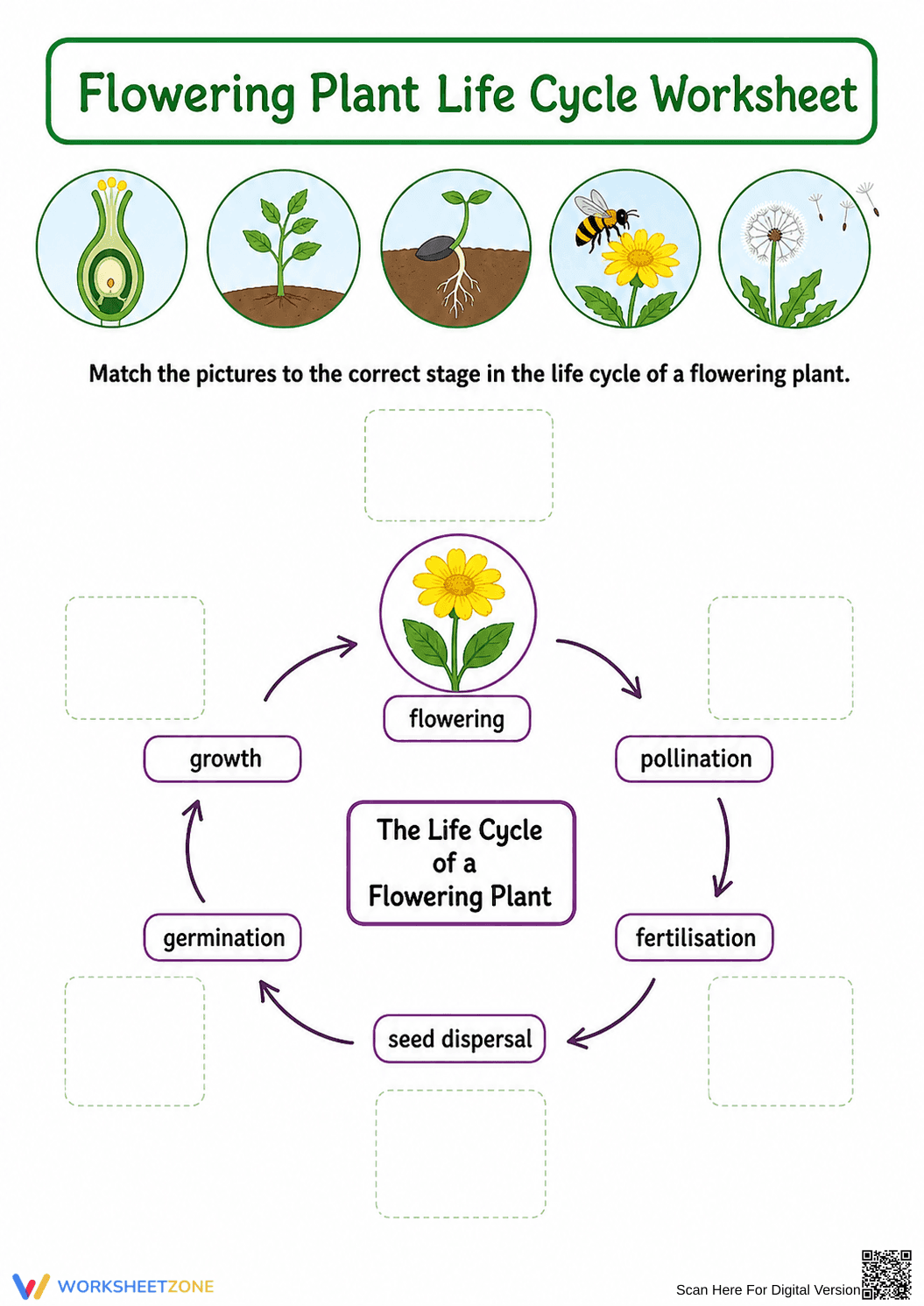

Grade 6 Plant Life Cycle — Printable No-Prep Worksheet

Paste this activity's link or code into your existing LMS (Google Classroom, Canvas, Teams, Schoology, Moodle, etc.).
Students can open and work on the activity right away, with no student login required.
You'll still be able to track student progress and results from your teacher account.
This foundational science worksheet helps students master the stages of a flowering plant's life cycle. By matching visual representations to scientific terms like germination and pollination, learners build essential biology vocabulary and conceptualize how plant structures ensure continuous growth.
At a Glance
- Grade: 6 · Subject: Science
- Standard:
MS-LS1-4— Explain how specialized plant structures affect reproduction probability.- Skill Focus: Plant Life Cycle Stages
- Format: 1 page · 6 problems · Answer key included · PDF
- Best For: Independent practice or review
- Time: 10–15 minutes
Inside this single-page resource, educators will find a clear diagram illustrating the continuous life cycle of a flowering plant. The activity features six matching tasks where students connect detailed illustrations to their corresponding scientific labels. The worksheet covers flowering, pollination, fertilization, seed dispersal, germination, and growth. A complete answer key is provided.
Zero-Prep Workflow
This resource requires under two minutes of total teacher preparation time.
- Print (1 minute): Download the PDF and print.
- Distribute (1 minute): Hand out the worksheets. No complex instructions needed.
- Review (3 minutes): Use the included answer key to quickly check student work.
Because it is self-explanatory, this worksheet makes an excellent addition to any sub plan.
Standards Alignment
This worksheet aligns with Next Generation Science Standard MS-LS1-4: Use argument based on empirical evidence to support an explanation for how specialized plant structures affect the probability of successful reproduction. By identifying pollination and seed dispersal, students build foundational knowledge of reproductive mechanisms. Both standard codes can be copied directly into lesson plans, IEP goals, or district curriculum mapping tools.
How to Use It
Use it as a formative assessment after direct instruction on plant biology to gauge understanding of reproductive events. Alternatively, assign it as an independent warm-up activity before exploring ecosystem dynamics. As students work, observe whether they correctly distinguish between closely related stages like pollination and fertilization. Expected completion time is 10 to 15 minutes.
Who It's For
Designed for Grade 6 science students building foundational life science knowledge. The strong visual supports make it accessible for English Language Learners and students who benefit from visual aids. It pairs perfectly with a hands-on seed germination lab or an anchor chart on plant anatomy.
Mastering the sequence of biological processes is a critical component of middle school science education. This resource directly supports NGSS MS-LS1-4 by helping students explain how specialized plant structures affect reproduction probability through the identification of key life cycle stages. According to a ScienceDirect TpT Analysis (2024), integrating visual matching tasks with scientific vocabulary significantly improves long-term retention of complex biological cycles compared to traditional text-only instruction. By requiring learners to connect concrete illustrations of pollination, fertilization, and germination with abstract terminology, this worksheet reinforces the cognitive pathways essential for robust scientific literacy. The structured, cyclical diagram format further aids in schema development, allowing students to accurately visualize the continuous nature of plant reproduction. This evidence-based instructional approach ensures that foundational concepts are firmly established before students progress to more advanced topics in genetics, heredity, and ecosystem dynamics.


