




























Views
Downloads

Flower Power Worksheet | Essential Grade 3-4 Science

Paste this activity's link or code into your existing LMS (Google Classroom, Canvas, Teams, Schoology, Moodle, etc.).
Students can open and work on the activity right away, with no student login required.
You'll still be able to track student progress and results from your teacher account.
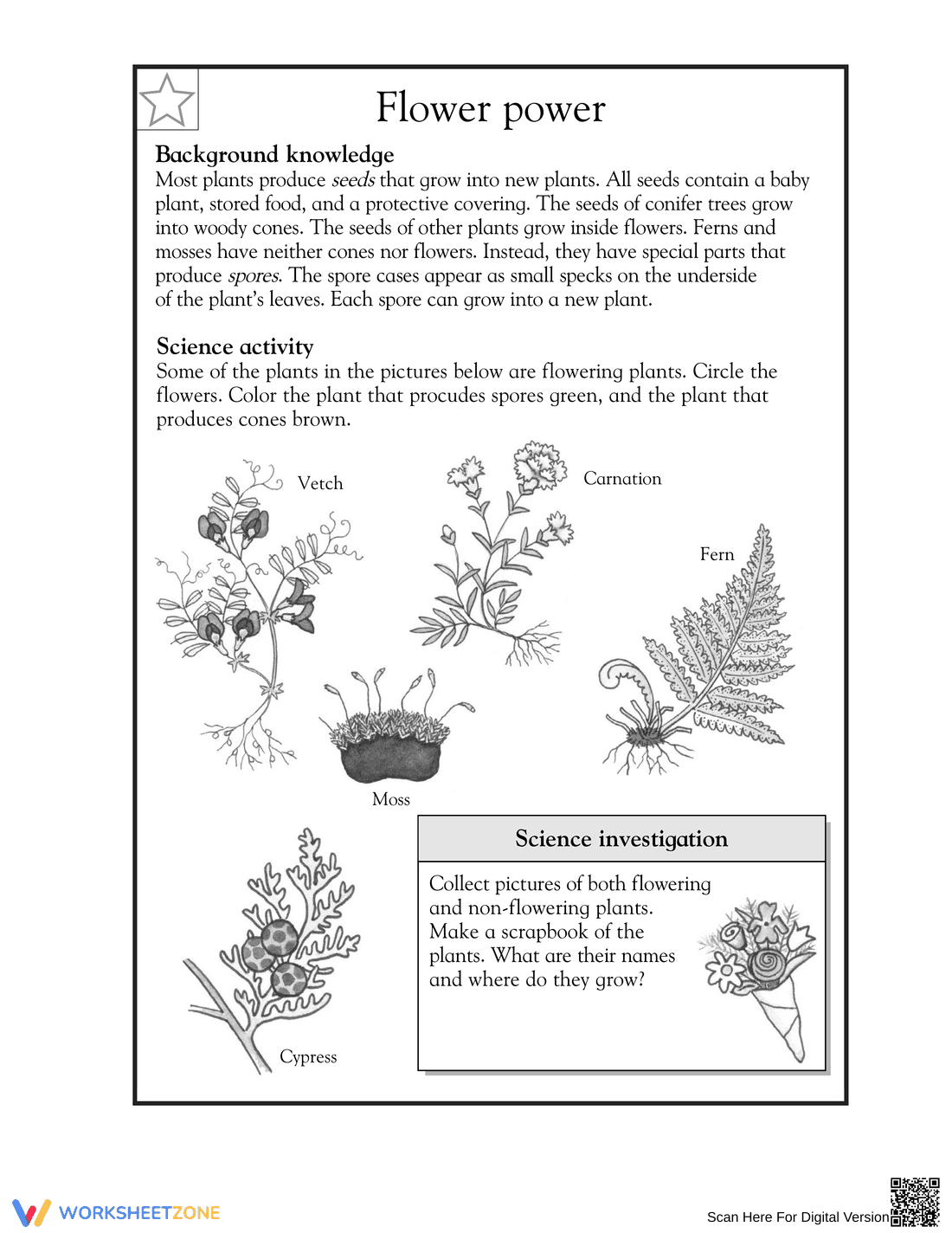
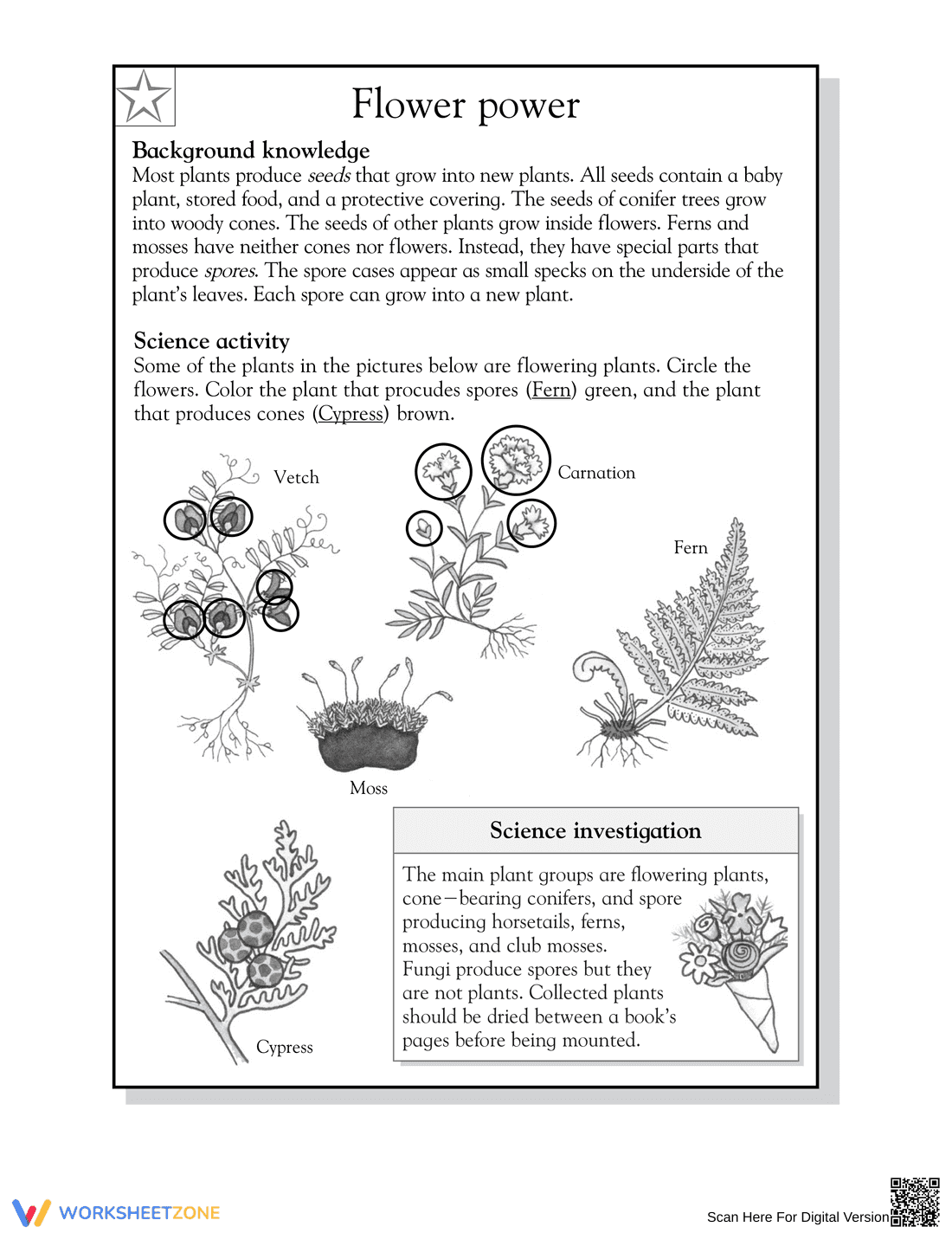
This Flower Power worksheet helps Grade 3 and 4 students classify plants based on their reproductive structures. By identifying flowering plants, conifers, and spore-producers, learners understand how different species begin their life cycles. It transforms complex botanical concepts into a clear, engaging coloring activity that builds scientific literacy.
At a Glance
- Grade: 3–4 · Subject: Living Things
- Standard:
4-LS1-1— Identify structures that support survival, growth, and reproduction in plants- Skill Focus: Plant classification by reproductive structures
- Format: 1 page · 5 identification tasks · Answer key included · PDF
- Best For: Introduction to botany and plant life cycles
- Time: 20–30 minutes
Inside is a self-contained instructional page with "Background Knowledge" to anchor student learning. The main activity features five detailed botanical illustrations—including vetch, carnation, fern, moss, and cypress—for students to classify. A "Science Investigation" extension prompt encourages real-world application, while the answer key provides immediate feedback for learners.
The zero-prep workflow is designed for teacher efficiency. First, print the single-page worksheet (30 seconds). Next, distribute copies for a guided or independent session (1 minute). Finally, use the answer key to review findings during station rotations (1 minute). Total preparation time is under two minutes, making it ideal for sub plans.
Aligned to standard `4-LS1-1`, this resource helps students identify plant structures that support reproduction. By focusing on flowers, cones, and spores, students recognize diverse structural adaptations. Both standard codes can be copied directly into lesson plans, IEP goals, or district curriculum mapping tools to ensure rigorous instructional alignment.
Use this as a formative assessment after a lesson on plant groups. Assign it to check comprehension of reproductive structures. Tip: watch for students struggling to distinguish between fern spores and flower seeds; this indicates a need for closer visual inspection. Completion takes approximately 25 minutes of active learning.
Designed for Grade 3-4 students, this resource supports visual learners through coloring and identification. It scaffolds technical vocabulary like "conifer" and "spore" with clear illustrations, benefiting English Language Learners. It pairs naturally with a classroom garden walk where students can observe these biological structures in their natural environment.
According to a ScienceDirect TpT Analysis, science worksheets integrating background reading with classification tasks improve long-term retention of biological taxonomies in elementary students. This resource targets the 4-LS1-1 standard by requiring learners to use structural evidence—spores, cones, or petals—to categorize organisms. By bridging abstract reproductive concepts with observable traits, the worksheet supports scientific inquiry skills defined by the NGSS framework. This structured approach ensures students understand the functional purpose of botanical structures in ecological survival. Educators can rely on this validated design to meet rigorous district standards while maintaining student engagement through clear objectives and varied task demands. The inclusion of a science investigation ensures that classroom learning extends into real-world observation and data collection.


