


























Views
Downloads

Flower Dissection Mat | Essential Grade 9-11 Biology
Paste this activity's link or code into your existing LMS (Google Classroom, Canvas, Teams, Schoology, Moodle, etc.).
Students can open and work on the activity right away, with no student login required.
You'll still be able to track student progress and results from your teacher account.
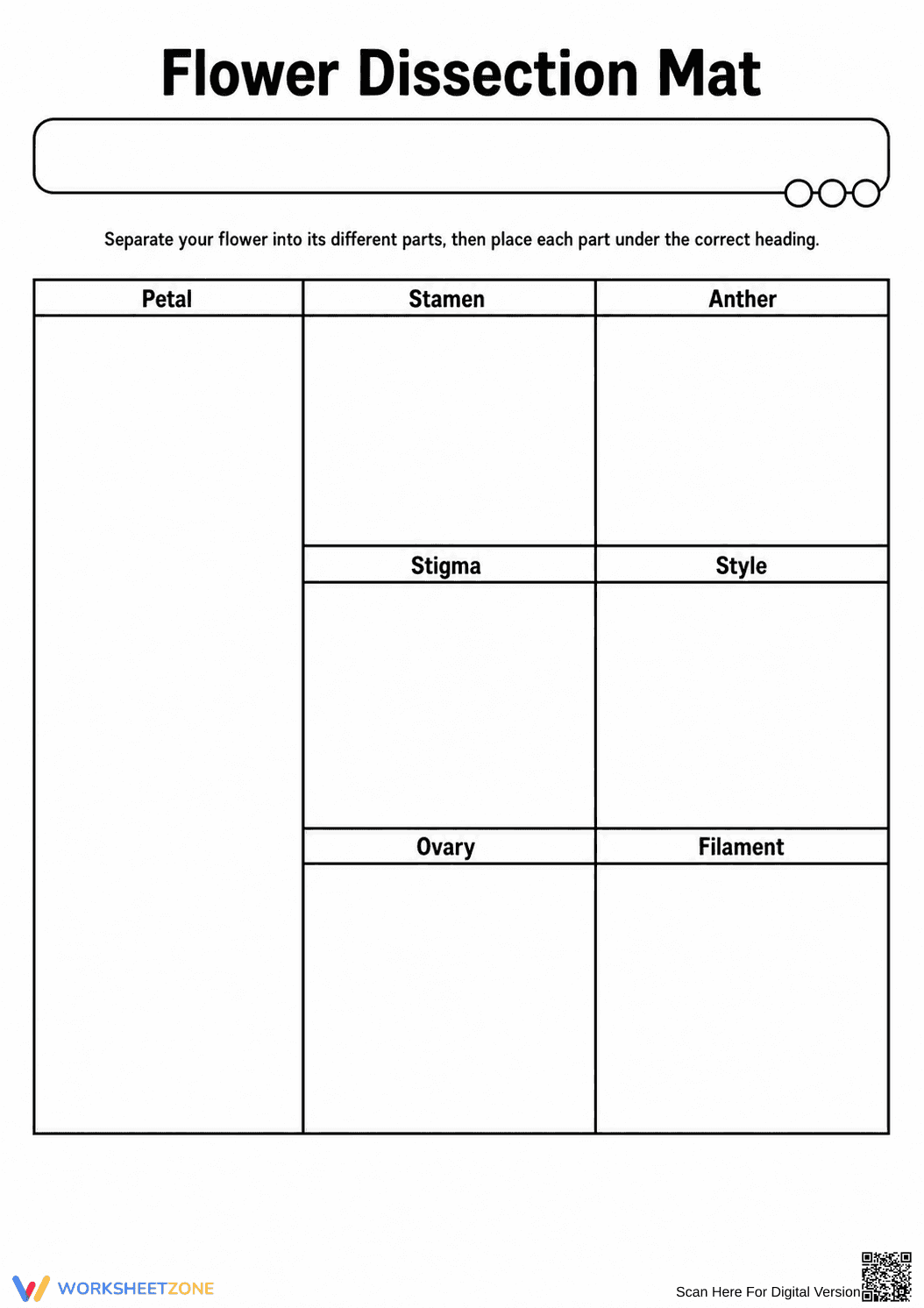
This Grade 9-11 flower dissection mat provides a structured workspace for students to isolate and identify reproductive and vegetative floral structures. By physically separating components like the anther, stigma, and ovary, learners bridge the gap between theoretical diagrams and biological reality. This resource ensures organized data collection during hands-on laboratory investigations.
At a Glance
- Grade: 9-11 · Subject: Biology
- Standard:
HS-LS1-2— Develop and use a model to illustrate hierarchical organization of interacting systems- Skill Focus: Flower Anatomy Identification
- Format: 1 page · 7 anatomical zones · Lab Mat · PDF
- Best For: Hands-on laboratory dissection activities
- Time: 20–30 minutes
This single-page PDF features a high-contrast layout designed for wet-lab environments. It includes seven dedicated sorting zones for the Petal, Stamen, Anther, Stigma, Style, Ovary, and Filament. The clear, bold typography ensures readability even when the mat is covered with biological specimens. A dedicated header allows for student names or specimen identification, making it easy to collect and grade.
This resource is designed for immediate classroom implementation. First, print the required number of mats (1 minute). Second, distribute the mats alongside fresh specimens like lilies or alstroemeria (1 minute). Third, students perform the dissection and place parts in the corresponding boxes for instant visual verification. Total teacher preparation time is under 2 minutes, making it an ideal choice for busy lab days or emergency sub plans.
This worksheet aligns with `HS-LS1-2`, which requires students to develop and use models to illustrate the hierarchical organization of interacting systems that provide specific functions within multicellular organisms. By identifying the specific reproductive organs of a plant, students visualize how individual structures contribute to the larger system of plant reproduction. This standard code can be copied directly into lesson plans, IEP goals, or district curriculum mapping tools.
Use this mat during the "Explore" phase of a 5E lesson cycle on plant biology. It serves as a primary data collection tool where students can glue or tape specimens directly onto the paper for a permanent lab record. As a formative assessment, walk around the lab and check the placement of the filament and style to ensure students distinguish between male and female reproductive stalks. Expected completion time is 25 minutes.
This mat is tailored for high school biology students and introductory botany courses. It provides the necessary scaffolding for English Language Learners (ELLs) by providing clear vocabulary labels for physical objects. Pair this resource with a microscope for closer inspection of the pollen found on the anthers or the ovules within the ovary to extend the learning experience.
According to the RAND AIRS 2024 report on science instructional materials, hands-on modeling and physical manipulation of biological specimens significantly increase long-term retention of anatomical terminology compared to passive diagram labeling. This flower dissection mat facilitates the HS-LS1-2 standard by providing a physical framework for students to organize their observations of plant systems. By categorizing the 7 distinct floral parts, students engage in active scientific inquiry that mirrors professional botanical practices. Research from Fisher & Frey (2014) suggests that structured graphic organizers used during lab work help students transition from concrete observation to abstract conceptual understanding of biological functions. This resource provides a high-utility, low-barrier entry point for complex anatomical studies, ensuring that all learners can participate in meaningful scientific discovery within a standard 30-minute lab window.


