


























Views
Downloads

Printable Beginning Sounds Worksheet | Kindergarten
Paste this activity's link or code into your existing LMS (Google Classroom, Canvas, Teams, Schoology, Moodle, etc.).
Students can open and work on the activity right away, with no student login required.
You'll still be able to track student progress and results from your teacher account.
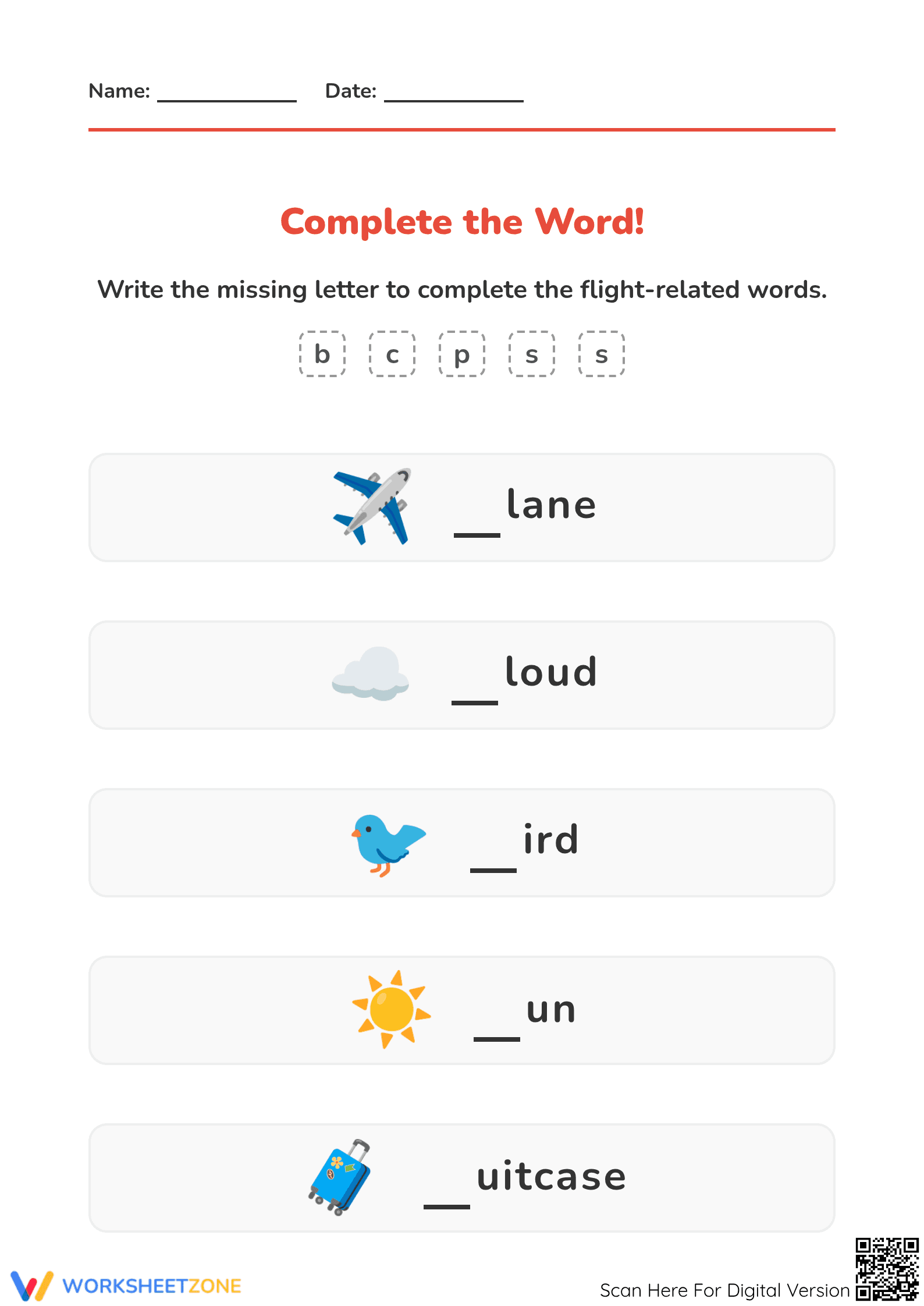
This foundational phonics worksheet helps Kindergarten students master beginning sounds by matching initial consonants to familiar flight-themed images. By identifying the missing first letter for words like "plane" and "sun," early readers strengthen their letter-sound correspondence and phonemic awareness in a highly visual, engaging format.
At a Glance
- Grade: Kindergarten · Subject: ELA
- Standard:
CCSS.ELA-LITERACY.RF.K.2.D— Isolate and pronounce initial sounds in spoken words- Skill Focus: Beginning Sounds
- Format: 1 page · 5 problems · Answer key included · PDF
- Best For: Independent practice or morning work
- Time: 10–15 minutes
Inside this single-page resource, educators will find five highly visual fill-in-the-blank problems centered around a fun aviation theme. Students use a provided dashed-line word bank containing the letters b, c, p, s, and s to complete the words corresponding to colorful pictures of a plane, cloud, bird, sun, and suitcase. A complete answer key is included to ensure fast and accurate grading.
Zero-Prep Workflow
- Print (1 minute): Simply print the single-page PDF. The clear layout and built-in word bank mean no additional materials or cutting are required.
- Distribute (1 minute): Hand out the worksheet during morning work, literacy centers, or as a quick transition activity.
- Review (2 minutes): Use the included answer key to quickly check student responses or project it on the board for self-correction.
With teacher prep under two minutes, this is ideal for sub plans.
Standards Alignment
This worksheet aligns with primary standard CCSS.ELA-LITERACY.RF.K.2.D, requiring students to isolate and pronounce the initial, medial vowel, and final sounds (phonemes) in three-phoneme words. The core task focuses heavily on isolating that critical initial phoneme. Both standard codes can be copied directly into lesson plans, IEP goals, or district curriculum mapping tools.
How to Use It
This activity works exceptionally well as an independent literacy center station after direct instruction on initial consonant sounds. It can also be utilized as a quick morning work assignment to activate prior knowledge as students settle into the classroom. As a formative assessment tip, observe students while they work to see if they are vocalizing the sounds of the pictures before selecting a letter from the word bank. Expected completion time ranges from 10 to 15 minutes.
Who It's For
This resource is designed primarily for Kindergarten students developing early phonics and phonemic awareness skills. The visual supports and limited word bank provide excellent differentiation for English Language Learners or students needing extra scaffolding to identify initial sounds. It pairs perfectly with a whole-group anchor chart activity focusing on the letters B, C, P, and S.
Mastering initial phonemes is a critical stepping stone in early literacy development. By practicing with targeted resources aligned to CCSS.ELA-LITERACY.RF.K.2.D, students learn to isolate and pronounce initial sounds in spoken words, building the essential foundation for decoding and spelling. According to a recent EdReports 2024 analysis, instructional materials that explicitly connect visual representations with phonemic isolation tasks significantly improve early reading outcomes in Kindergarten classrooms. When young learners consistently practice matching specific letters to the beginning sounds of familiar, everyday objects, they develop much stronger neural pathways for automatic word recognition. This targeted, repetition-based practice ensures that foundational phonics skills are fully solidified before students are asked to move on to more complex blending and segmenting tasks. This sets the stage for long-term reading fluency.


