


























Views
Downloads
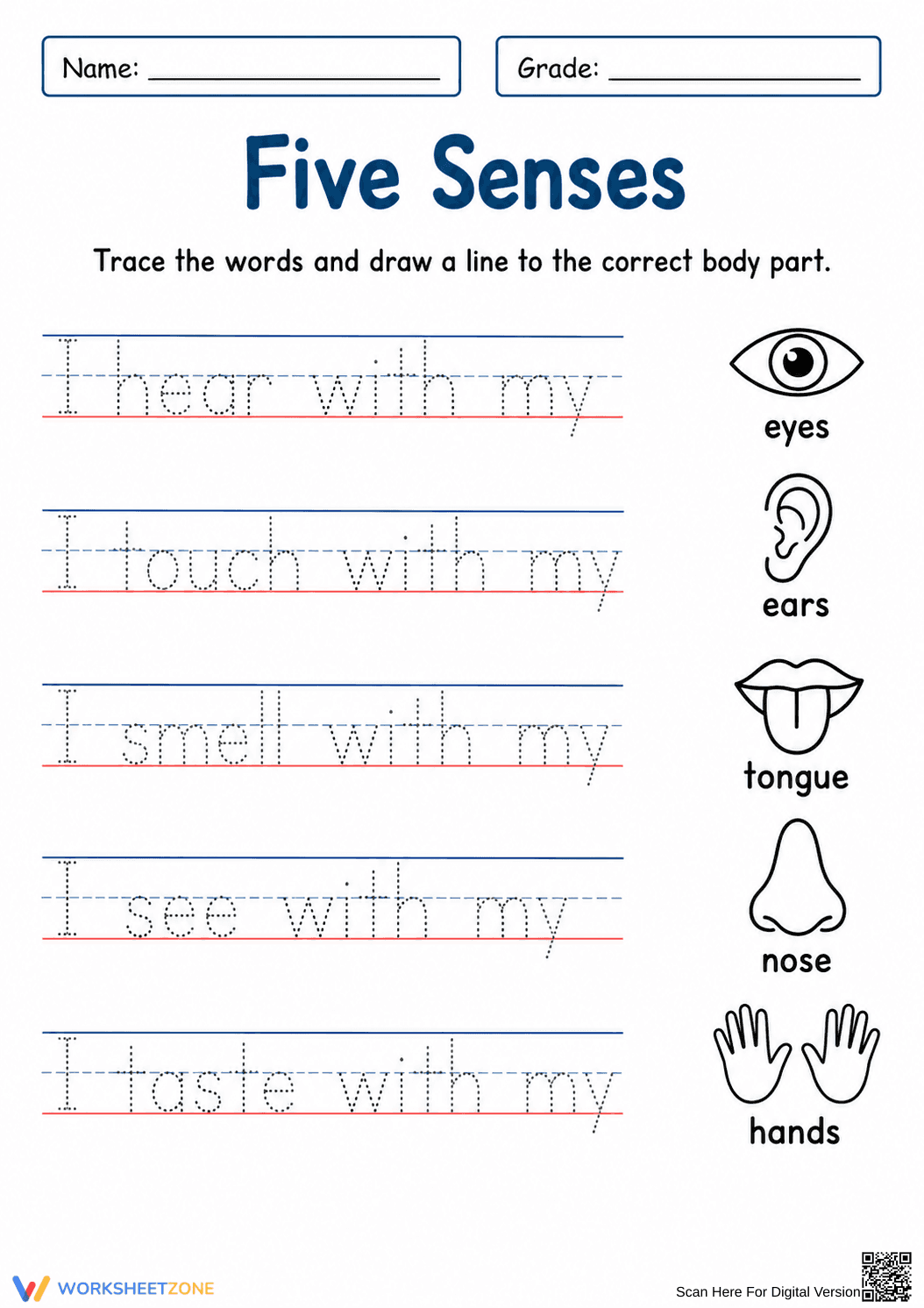

Grade K Five Senses — Printable No-Prep Worksheet
Paste this activity's link or code into your existing LMS (Google Classroom, Canvas, Teams, Schoology, Moodle, etc.).
Students can open and work on the activity right away, with no student login required.
You'll still be able to track student progress and results from your teacher account.
This foundational Grade K worksheet helps early learners connect their five senses to specific body parts while practicing essential handwriting skills. Students trace simple, predictable sentences and draw lines to matching illustrations, reinforcing both science vocabulary and fine motor development in one engaging activity.
At a Glance
- Grade: K · Subject: Science
- Standard:
CCSS.ELA-LITERACY.L.K.1.A— Print many upper- and lowercase letters- Skill Focus: Five senses and tracing
- Format: 1 page · 5 problems · No answer key · PDF
- Best For: Independent practice or centers
- Time: 10–15 minutes
Inside this single-page resource, educators will find five structured tasks that combine literacy and basic biology. Each row features a dotted-line sentence for students to trace, such as "I taste with my," followed by a column of clear, recognizable icons representing the eyes, ears, tongue, nose, and hands. Students must physically draw a line connecting the traced sentence to the correct sensory organ, providing a tactile way to demonstrate comprehension.
This resource is designed for immediate classroom implementation with a streamlined, zero-prep workflow:
- Print (1 minute): Download the PDF and print copies. The design is ink-friendly.
- Distribute (1 minute): Hand out sheets and pencils. Visual instructions make the task clear.
- Review (3 minutes): Check student work by glancing at the drawn lines and traced letters. Total teacher prep time is under two minutes, making it an ideal sub plan.
This activity aligns with CCSS.ELA-LITERACY.L.K.1.A, which requires students to print many upper- and lowercase letters. By tracing the predictable text, students practice letter formation while simultaneously engaging with core science concepts regarding human anatomy and sensory perception. Both standard codes can be copied directly into lesson plans, IEP goals, or district curriculum mapping tools.
Teachers can utilize this worksheet during morning work to establish a calm, focused start to the day, or as a dedicated science center activity following a read-aloud about the five senses. As a formative assessment tip, observe students while they trace to ensure they are using a proper pencil grip and forming letters from top to bottom. The entire activity has an expected completion time range of 10 to 15 minutes, keeping young learners engaged without causing fatigue.
This printable is primarily designed for Kindergarten students, though it serves as excellent remedial practice for first graders needing fine motor support or English Language Learners building basic vocabulary. To differentiate for students needing extra scaffolding, teachers can highlight the dotted lines with a marker before distribution. It pairs perfectly with a classroom anchor chart displaying the five senses and their corresponding body parts.
Integrating cross-curricular activities in early childhood education significantly reinforces both literacy and content-area knowledge. This resource targets CCSS.ELA-LITERACY.L.K.1.A, helping students print many upper- and lowercase letters through guided tracing. According to a recent EdReports 2024 analysis, instructional materials that combine fine motor practice with foundational science concepts increase student retention of vocabulary by providing multiple modalities for learning. When young learners physically trace words related to their senses and draw connecting lines to visual representations, they build stronger neural pathways linking the written word to its real-world meaning. This dual-focus approach ensures that instructional minutes are maximized, allowing educators to address handwriting standards while simultaneously assessing basic biological comprehension. By utilizing structured, predictable text, teachers can foster independence in early readers, setting a strong foundation for future academic success.


