


























Views
Downloads
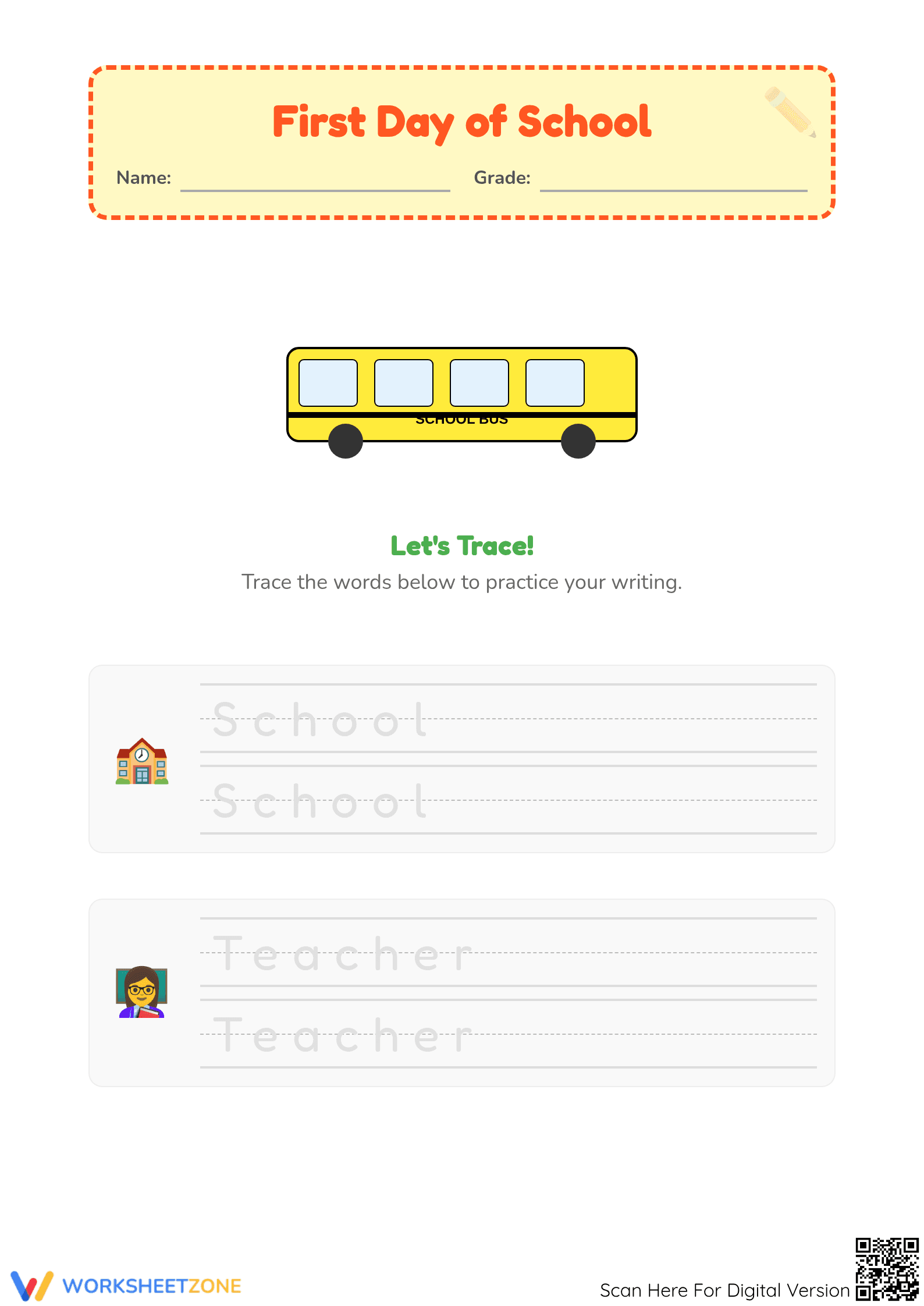


Grade K Handwriting — Printable No-Prep Worksheet
Paste this activity's link or code into your existing LMS (Google Classroom, Canvas, Teams, Schoology, Moodle, etc.).
Students can open and work on the activity right away, with no student login required.
You'll still be able to track student progress and results from your teacher account.
This Grade K handwriting worksheet gives students essential practice with fine motor skills and letter formation to build early writing confidence. By tracing familiar back-to-school vocabulary words and completing a creative drawing prompt, young learners develop pencil control while celebrating their first days in the classroom.
At a Glance
- Grade: K · Subject: ELA
- Standard:
CCSS.ELA-LITERACY.L.K.1.A— Print many upper- and lowercase letters- Skill Focus: Handwriting and word tracing
- Format: 3 pages · 7 problems · No answer key · PDF
- Best For: Morning work or independent practice
- Time: 15–20 minutes
Inside this three-page packet, educators will find six structured word-tracing tasks featuring common school-themed vocabulary like "School," "Teacher," "Pencil," and "Friend." Each word includes dotted guidelines to support proper letter proportion and spacing. The final page features an open-ended drawing prompt where students illustrate an item from their own school bag, providing a creative brain break that still reinforces fine motor control.
Implementing this resource requires absolutely zero teacher setup.
- Print (1 minute): Simply download the PDF and print the three-page bundle for each student.
- Distribute (1 minute): Hand out the packets along with pencils or crayons as students arrive.
- Review (0 minutes): The intuitive tracing format means students can begin working immediately with no complex instructions.
With a total prep time of under two minutes, this activity is an ideal emergency sub plan or a reliable morning work routine during the busy first week of school.
Aligned to CCSS.ELA-LITERACY.L.K.1.A, this resource ensures students practice printing many upper- and lowercase letters accurately. The guided tracing lines help establish the foundational muscle memory required for independent writing later in the year. Both standard codes can be copied directly into lesson plans, IEP goals, or district curriculum mapping tools.
This worksheet is highly versatile for early childhood classrooms. Use it as a calming morning arrival activity to help students transition smoothly into the school day before direct instruction begins. Alternatively, assign it during literacy centers to keep students engaged in meaningful independent work. As a formative assessment tip, observe students' pencil grip and stroke direction while they trace, which can inform future small-group handwriting interventions. Expect students to complete the packet in 15 to 20 minutes.
This resource is designed primarily for Kindergarten and early first-grade students who are developing foundational handwriting skills. It serves as an excellent baseline assessment for general education classrooms. For students needing extra support, teachers can provide textured writing tools or highlight the tracing lines in a brighter color. Pair this activity with a read-aloud about the first day of school to build context around the vocabulary words.
Developing automaticity in letter formation is a critical precursor to expressive writing and overall literacy success. Standard CCSS.ELA-LITERACY.L.K.1.A requires students to print many upper- and lowercase letters, a skill that directly impacts their cognitive load during composition tasks. According to Fisher & Frey (2014), providing structured, repetitive practice with immediate visual feedback—such as tracing on guided lines—significantly improves early learners' fine motor precision and letter recognition. When students do not have to expend excessive mental energy on the physical act of writing, they can better focus on phonics, spelling, and idea generation. This targeted tracing worksheet offers the exact type of low-stakes, high-repetition practice necessary to build that foundational muscle memory, ensuring young learners are prepared for more complex literacy demands as the school year progresses.


