


























Views
Downloads

Letter G Printable Worksheet | Grade K ELA
Paste this activity's link or code into your existing LMS (Google Classroom, Canvas, Teams, Schoology, Moodle, etc.).
Students can open and work on the activity right away, with no student login required.
You'll still be able to track student progress and results from your teacher account.
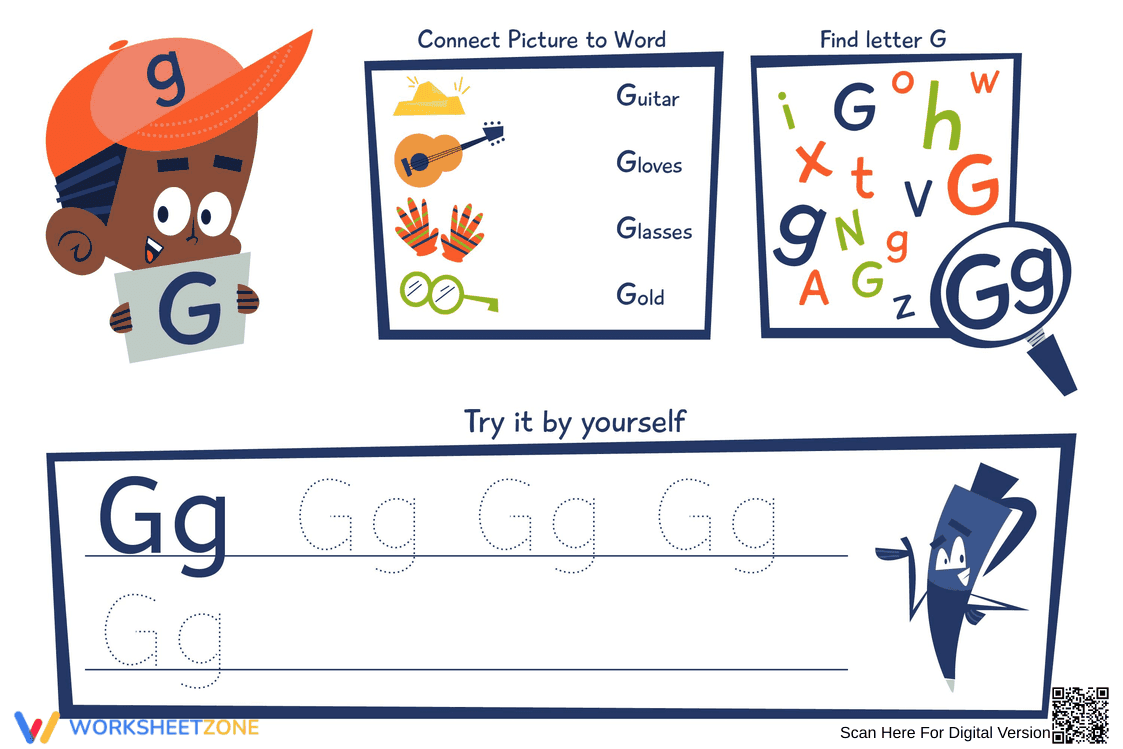
This foundational Grade K ELA worksheet helps students master the letter G through targeted visual discrimination, phonics matching, and handwriting practice. By connecting initial sounds to familiar images and tracing letter forms, early learners build the essential literacy skills required for fluent reading and writing development.
At a Glance
- Grade: K · Subject: ELA
- Standard:
CCSS.ELA-LITERACY.RF.K.1.D— Recognize and name all upper- and lowercase letters- Skill Focus: Letter recognition and tracing
- Format: 1 page · 3 task types · No answer key · PDF
- Best For: Independent morning work
- Time: 10–15 minutes
This single-page resource features three distinct task types designed to reinforce letter knowledge. Students begin by drawing lines to connect pictures of words starting with G—like guitar and glasses—to their corresponding text. Next, a visual search activity challenges them to identify and circle both uppercase and lowercase Gs mixed among other letters. Finally, the bottom section provides guided tracing lines for practicing proper letter formation, followed by blank space for independent writing attempts.
Zero-Prep Workflow
This resource is designed for immediate classroom implementation with minimal teacher setup.
- Print (1 minute): Download the PDF and print copies. The black-and-white design saves ink.
- Distribute (1 minute): Hand out sheets and pencils.
- Review (1 minute): Model one example from each section on the board.
With prep time under three minutes, this is perfect for sub plans or quick transitions.
Standards Alignment
This activity is directly aligned to CCSS.ELA-LITERACY.RF.K.1.D, requiring students to recognize and name all upper- and lowercase letters of the alphabet. It also supports foundational handwriting expectations by having students form letters correctly on guided lines. Both standard codes can be copied directly into lesson plans, IEP goals, or district curriculum mapping tools.
How to Use It
Deploy this worksheet during morning arrival as a focused bell-ringer activity to settle students into the daily routine. It takes approximately 10 to 15 minutes to complete, making it an ideal independent task while the teacher takes attendance. Alternatively, use it as a follow-up activity after direct instruction on the letter G. As a formative assessment observation tip, watch how students grip their pencils during the tracing section and note whether they start their letter strokes from the top or bottom.
Who It's For
This printable is crafted for Kindergarten and early first-grade students developing their foundational phonics and handwriting abilities. It serves as an excellent intervention tool for learners who need extra repetition with visual discrimination between similarly shaped letters. Pair this worksheet with a tactile alphabet anchor chart or a read-aloud book that heavily features the target letter to reinforce the sound-symbol connection.
Mastering early alphabet skills, such as those practiced in this resource, is a critical predictor of future reading success. According to a comprehensive EdReports 2024 analysis on foundational literacy, explicit instruction in letter recognition and formation significantly improves decoding fluency in later grades. By aligning with CCSS.ELA-LITERACY.RF.K.1.D, which asks students to recognize and name all upper- and lowercase letters, this worksheet provides the targeted repetition necessary for cognitive automaticity. When young learners practice identifying the letter G among distractors and physically tracing its shape, they strengthen the neural pathways connecting visual symbols to phonetic sounds. This multisensory approach ensures that students do not just memorize shapes, but actively internalize the fundamental building blocks of written language, setting a strong, evidence-based foundation for comprehensive literacy development across all future academic subjects.


