


























Views
Downloads

Printable Cursive Letter Z Worksheet | Grade 1-2
Paste this activity's link or code into your existing LMS (Google Classroom, Canvas, Teams, Schoology, Moodle, etc.).
Students can open and work on the activity right away, with no student login required.
You'll still be able to track student progress and results from your teacher account.
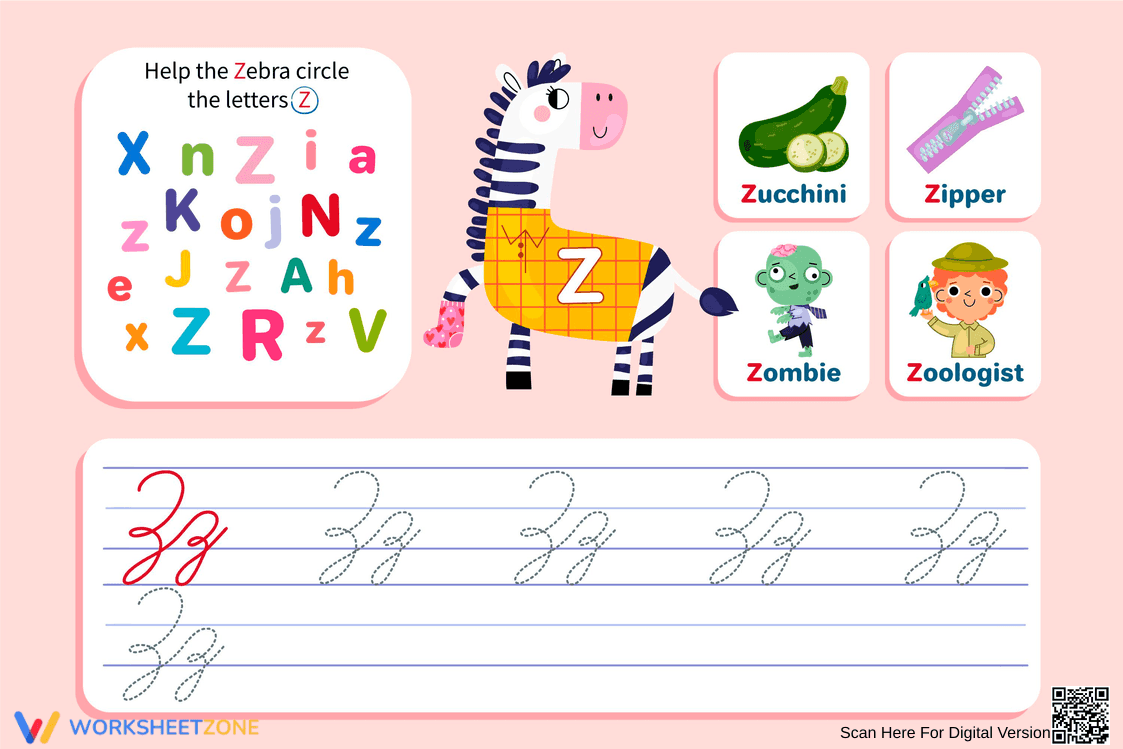
This foundational handwriting worksheet helps early elementary students master the cursive letter Z. By combining letter recognition tasks with guided tracing practice, learners develop fine motor control and cursive fluency. The engaging zebra theme keeps students focused while they build essential penmanship skills for future writing success.
At a Glance
- Grade: 1 · Subject: English
- Standard:
CCSS.ELA-LITERACY.L.1.1.A— Print all upper- and lowercase letters- Skill Focus: Cursive letter Z tracing and identification
- Format: 1 page · 10 problems · Answer key included · PDF
- Best For: Independent practice and morning work
- Time: 10–15 minutes
This single-page resource features three distinct activity zones to reinforce letter mastery. First, students search a jumbled letter bank to find and circle the target letter. Next, they review four illustrated vocabulary words (Zucchini, Zipper, Zombie, Zoologist) to build phonetic awareness. Finally, the bottom section provides six guided tracing models, followed by blank baseline space for independent cursive writing practice. An answer key is included.
Zero-Prep Workflow
- Print (1 minute): Download the PDF and print. The design ensures clear reproduction.
- Distribute (1 minute): Hand out the worksheets. The intuitive layout means students can begin immediately without extensive modeling.
- Review (1 minute): Use the answer key to check the identification section, then scan the tracing lines to assess stroke direction.
Total teacher preparation time is under two minutes, making this an ideal activity for sub plans.
Standards Alignment
This handwriting activity aligns with CCSS.ELA-LITERACY.L.1.1.A, requiring students to print all upper- and lowercase letters. While the standard explicitly mentions printing, this worksheet extends the foundational skill into cursive letter formation, supporting state-specific cursive mandates. Both standard codes can be copied directly into lesson plans, IEP goals, or district curriculum mapping tools.
How to Use It
This worksheet serves as an excellent morning work activity before direct instruction begins. Alternatively, it functions perfectly as a quiet literacy center station. As students complete the tracing section, teachers should observe their pencil grip and stroke direction—specifically checking that they start the cursive Z from the correct baseline point. Expected completion time ranges from 10 to 15 minutes.
Who It's For
This resource is designed primarily for first and second-grade students transitioning from print to cursive handwriting. The visual scaffolds, such as the dotted tracing lines and vocabulary pictures, provide necessary support for students who struggle with fine motor control or letter recall. It pairs naturally with a direct instruction lesson on cursive stroke families or a classroom anchor chart displaying the full cursive alphabet.
Developing fluent handwriting is a critical component of early literacy that directly impacts later writing composition and cognitive load. This worksheet targets CCSS.ELA-LITERACY.L.1.1.A, helping students print all upper- and lowercase letters, adapted here for cursive mastery. According to Fisher & Frey (2014), providing structured, repetitive practice with immediate visual feedback is essential for moving handwriting skills from conscious effort to automaticity. When students no longer have to expend working memory on letter formation, they can dedicate more cognitive resources to idea generation, vocabulary selection, and sentence structure. By combining visual identification tasks with guided motor practice, this resource supports the neurological pathways required for fluent writing. Regular, focused practice sessions have been shown to significantly improve both legibility and writing speed in early elementary learners.


