




























Views
Downloads

Grade 3 Plant Life Cycle — Printable No-Prep Worksheet

Paste this activity's link or code into your existing LMS (Google Classroom, Canvas, Teams, Schoology, Moodle, etc.).
Students can open and work on the activity right away, with no student login required.
You'll still be able to track student progress and results from your teacher account.
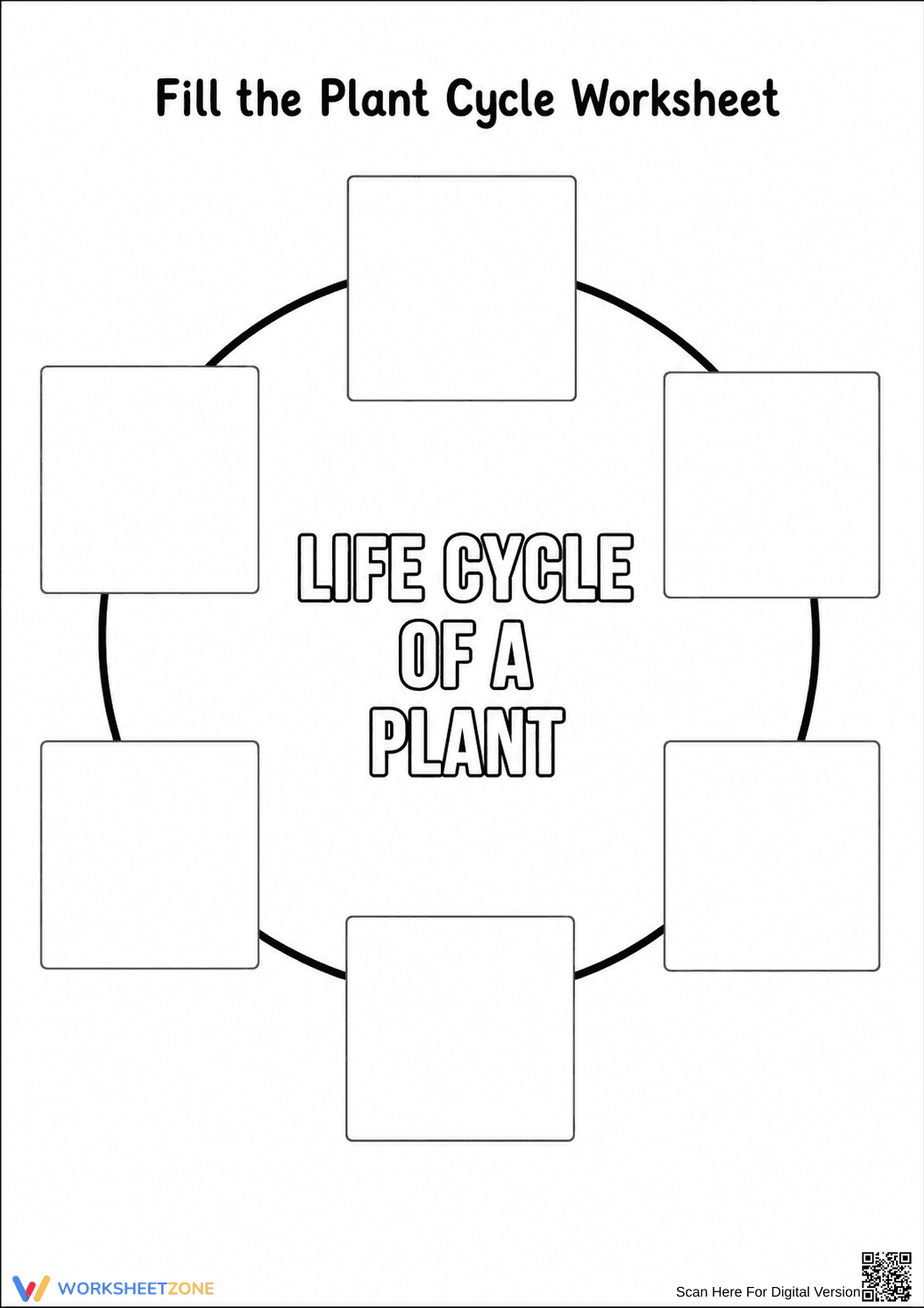
This printable graphic organizer helps students visualize and sequence the stages of a plant's life cycle. By filling in six interconnected boxes, learners actively model how a seed transforms into a mature, reproducing plant. This open-ended format encourages students to demonstrate their understanding through drawing, labeling, or writing.
At a Glance
- Grade: 3 · Subject: Science
- Standard:
3-LS1-1— Develop models to describe organism life cycles- Skill Focus: Sequencing plant life stages
- Format: 1 page · 6 tasks · No answer key · PDF
- Best For: Independent practice or assessment
- Time: 15–20 minutes
Inside this single-page download, educators will find a clean, circular diagram featuring six blank boxes connected by a continuous line. This emphasizes the cyclical nature of growth and reproduction. Because the boxes are completely blank, the worksheet offers maximum flexibility; students can sketch the stages, write descriptive sentences, or combine both methods to show their scientific knowledge.
This resource is designed for immediate classroom implementation with a streamlined workflow:
- Print (1 minute): The black-and-white design ensures quick reproduction.
- Distribute (1 minute): Hand out the graphic organizer alongside colored pencils.
- Review (3 minutes): Briefly explain the six stages and let students begin.
With under two minutes of total teacher prep time, this activity is an excellent addition to any emergency sub plan.
This activity aligns with Next Generation Science Standard 3-LS1-1: Develop models to describe that organisms have unique and diverse life cycles but all have in common birth, growth, reproduction, and death. By creating their own visual model, students directly address the core requirement. Both standard codes can be copied directly into lesson plans, IEP goals, or district curriculum mapping tools.
Teachers can deploy this worksheet during the independent practice phase of a science lesson. After reading a text about plant growth, assign this diagram as a formative assessment to check if students can accurately sequence the stages. Alternatively, use it as an interactive guided notes page where students fill in one box at a time during direct instruction. While circulating, observe whether students correctly connect the final stage back to the beginning. Expect completion to take 15 to 20 minutes.
This resource is primarily designed for third-grade science students. For students needing extra support, teachers can pre-fill one or two boxes or provide a word bank. Advanced learners can be challenged to write detailed, scientifically accurate descriptions inside each box. It pairs perfectly with a hands-on seed germination lab.
Effectively teaching the 3-LS1-1 standard requires students to actively develop models to describe organism life cycles rather than passively consuming information from a textbook. Graphic organizers like this circular diagram provide the necessary spatial structure for students to map out complex biological sequences accurately. According to a 2024 report by EdReports, science materials that require students to construct visual models significantly improve their retention of cyclical concepts and scientific vocabulary. By translating their conceptual understanding into drawings and text within a structured framework, learners solidify their grasp of how birth, growth, reproduction, and death connect in a continuous loop. This hands-on modeling approach ensures that students are not just memorizing isolated facts, but are actively engaging in the essential scientific practices required for long-term mastery of foundational biology concepts.


