


























Views
Downloads

Grade 1 Handwriting Practice — Printable No-Prep Worksheet
Paste this activity's link or code into your existing LMS (Google Classroom, Canvas, Teams, Schoology, Moodle, etc.).
Students can open and work on the activity right away, with no student login required.
You'll still be able to track student progress and results from your teacher account.
This printable fall-themed handwriting worksheet helps first-grade students practice proper letter formation and sentence structure. By tracing a festive sentence about pumpkin picking, young learners develop fine motor skills and build confidence in their printing abilities while engaging with seasonal vocabulary.
At a Glance
- Grade: 1 · Subject: ELA
- Standard:
CCSS.ELA-LITERACY.L.1.1.A— Print all upper- and lowercase letters- Skill Focus: Handwriting and tracing
- Format: 1 page · 1 task · No answer key · PDF
- Best For: Morning work or centers
- Time: 5–10 minutes
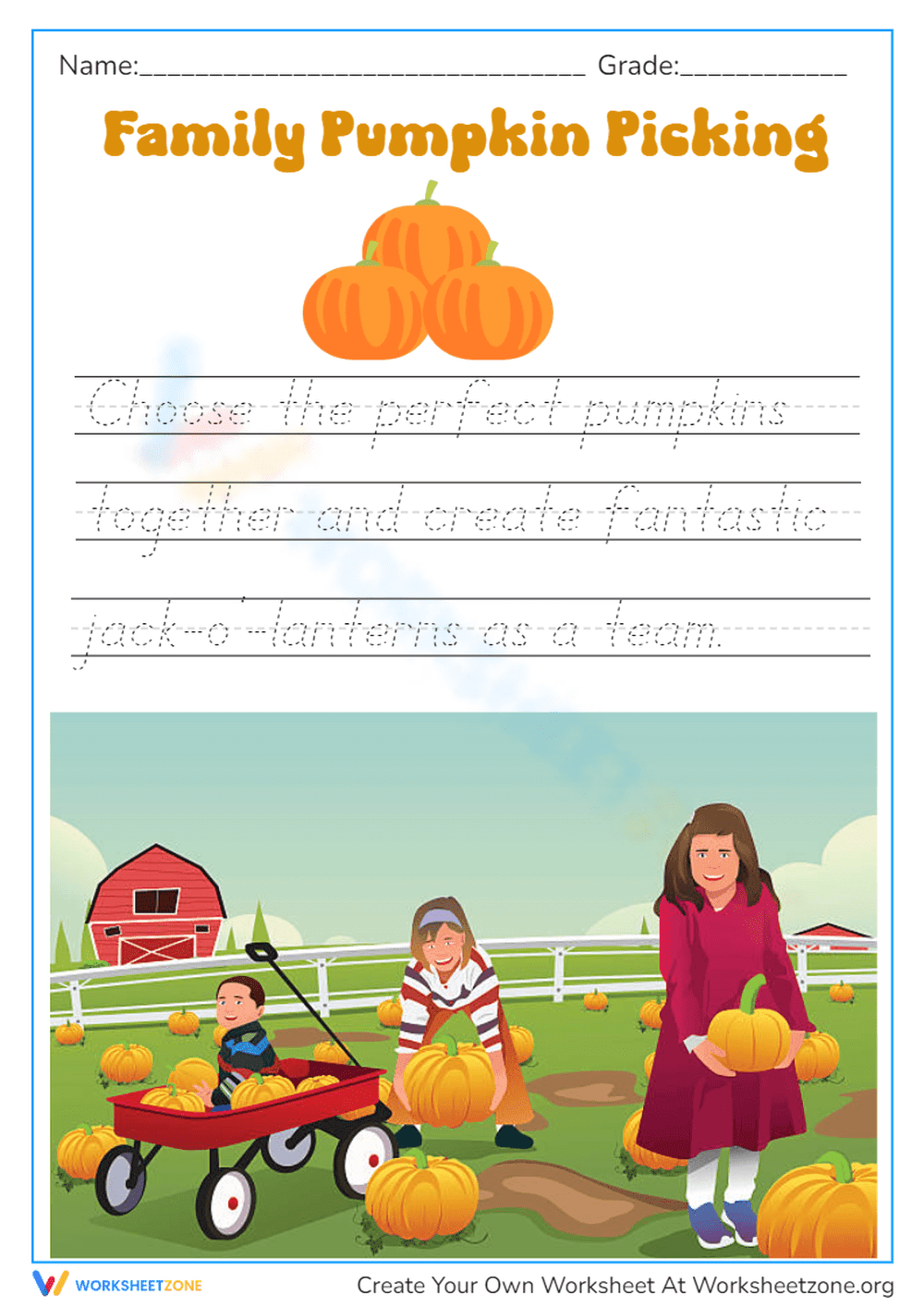
This single-page resource features a complete sentence spread across three primary-lined tracing sections. Students trace the dotted letters to write about choosing pumpkins and creating jack-o'-lanterns. The page also includes a vibrant, full-color illustration of a family at a pumpkin patch to keep early readers visually engaged with the text they are writing.
Zero-Prep Workflow
This resource is designed for immediate classroom implementation with absolutely no teacher setup required.
- Print (1 minute): Simply download the PDF and print a class set. The clear dotted lines reproduce perfectly in both color and black-and-white.
- Distribute (1 minute): Hand out the sheets during morning arrival or transition times. The instructions are self-explanatory for young learners.
- Review (1 minute): Quickly scan student work to ensure letters touch the top, middle, and bottom guidelines correctly.
With a total prep time of under two minutes, this is an ideal activity for emergency sub plans or quick literacy centers.
Standards Alignment
This worksheet aligns directly with CCSS.ELA-LITERACY.L.1.1.A, which requires students to print all upper- and lowercase letters accurately. By tracing a complete sentence, students also practice appropriate spacing between words and basic punctuation. Both standard codes can be copied directly into lesson plans, IEP goals, or district curriculum mapping tools.
How to Use It
This tracing activity works exceptionally well as morning work to settle students into the daily routine before direct instruction begins. It can also be placed in an independent literacy center during guided reading rotations. As a formative assessment tip, observe students while they trace to ensure they are forming letters from top to bottom rather than bottom to top. Expected completion time ranges from 5 to 10 minutes depending on the student's fine motor proficiency.
Who It's For
This worksheet is primarily designed for first-grade students mastering their printing skills, but it also serves as excellent remedial practice for second graders needing fine motor reinforcement. For differentiation, teachers can provide a highlighter for students who need a thicker line to trace before using a pencil. Pair this activity with a seasonal read-aloud about autumn or a direct instruction lesson on capitalization and end marks.
Developing automaticity in handwriting is a critical foundational skill for early literacy. When students practice with resources aligned to CCSS.ELA-LITERACY.L.1.1.A, they learn to print all upper- and lowercase letters efficiently. This automaticity reduces the cognitive load required for transcription, allowing young writers to focus their mental energy on idea generation and sentence composition. According to Fisher & Frey (2014), explicit instruction and repeated guided practice in foundational skills like letter formation are essential for developing fluent writers. By tracing complete, context-rich sentences rather than isolated letters, students simultaneously reinforce their understanding of word spacing, spelling patterns, and basic syntax. Consistent, targeted handwriting practice ensures that mechanical transcription barriers do not impede a student's expressive writing capabilities as they progress through the primary grades.


