































Essential Winter Birds Word Search | Grades 6–7 Science

Paste this activity's link or code into your existing LMS (Google Classroom, Canvas, Teams, Schoology, Moodle, etc.).
Students can open and work on the activity right away, with no student login required.
You'll still be able to track student progress and results from your teacher account.
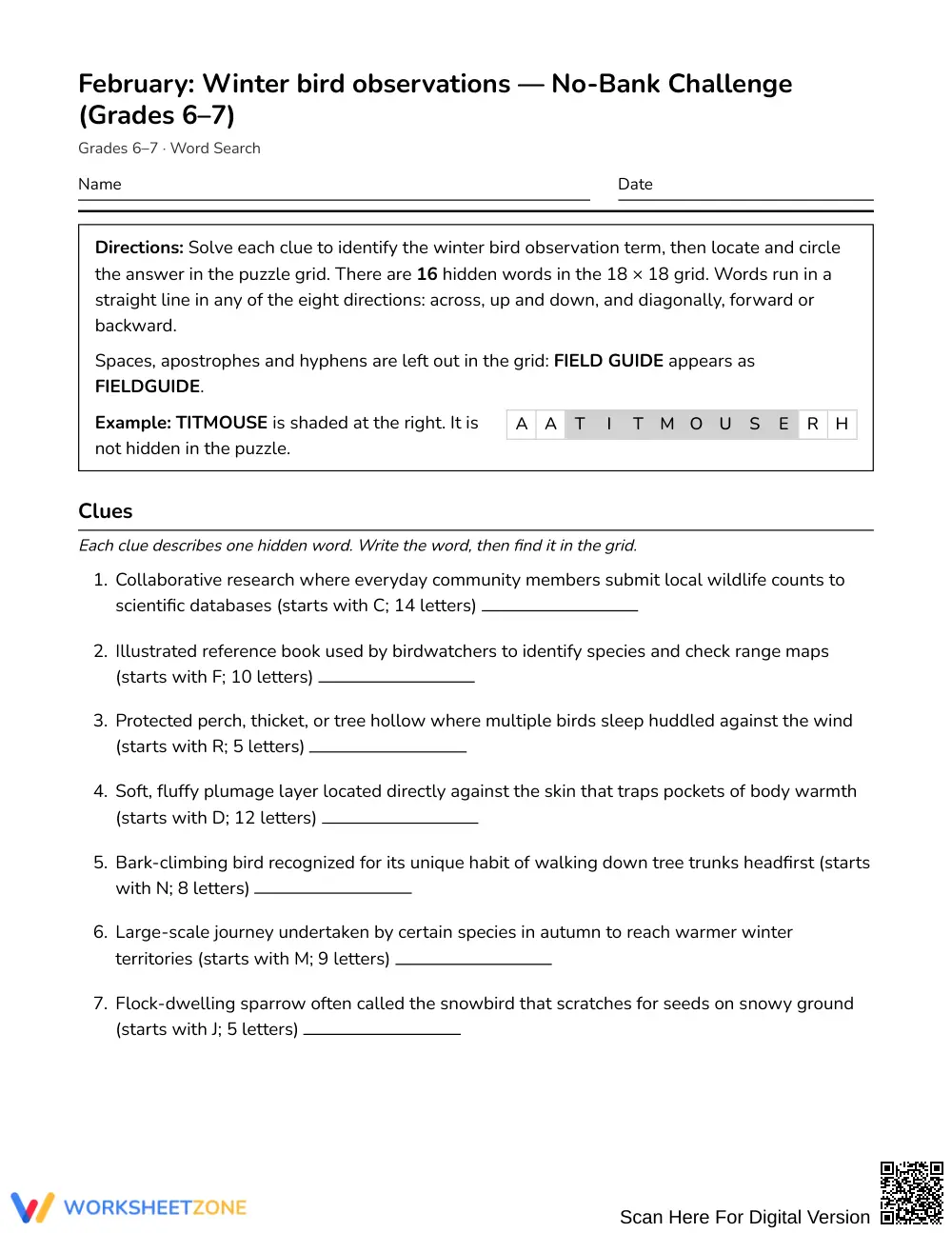
This winter bird observations word search challenges Grades 6–7 students to reinforce essential avian life science vocabulary through contextual clue solving. Students analyze biological clues describing seasonal adaptations, behaviors, and anatomical features before locating each hidden term. The activity sharpens ecological comprehension and scientific vocabulary retention during cold-weather nature studies.
At a Glance
- Grade: Grades 6–7 · Subject: Science
- Standard: Not standards-assessed — vocabulary enrichment
- Skill Focus: Winter bird observation vocabulary and biological adaptations
- Format: 3 pages · 16 words · Answer key included · PDF
- Best For: Winter biology warm-ups and early finisher enrichment
- Time: 25–35 minutes
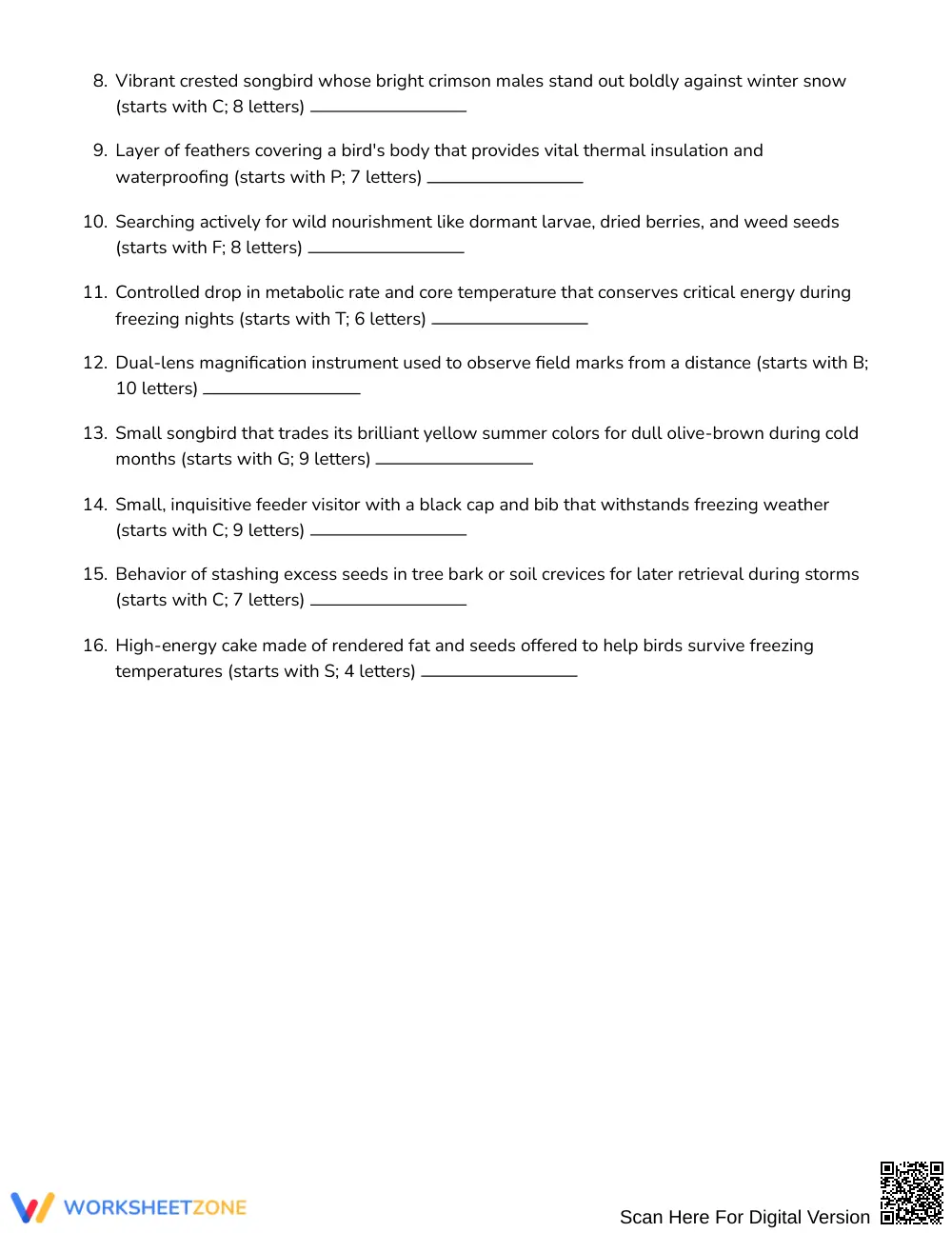
This 3-page printable science resource contains a complete no-bank puzzle layout featuring 16 words alongside an extensive 4-page answer key. Rather than scanning from a pre-printed word bank, students read descriptive scientific definitions covering ornithological topics such as torpor, caching, plumage, and citizen science. Students deduce the correct vocabulary term from each contextual clue prior to searching the grid.
The activity is built on a dense 18 × 18 letter grid that provides an engaging cognitive challenge for middle school learners. Hidden words run in all eight possible directions: north, northeast, east, southeast, south, southwest, west, and northwest. Because no word bank is supplied, students must actively retrieve vocabulary by solving each scientific clue before searching the letter matrix, eliminating passive letter-matching.
This resource serves as targeted vocabulary enrichment and is not aligned to a specific state or national standard. It supports general middle school life science units on ecology, organism survival, and seasonal behavioral adaptations. Teachers can incorporate the puzzle into thematic winter environmental science lessons without mapping formal testing benchmarks.
Deploy this word search during an ecology unit after direct instruction on seasonal animal adaptations. Introduce the puzzle as an independent review task where students demonstrate their understanding of terms like torpor and caching without glossaries. For formative assessment, circulate to observe which clues prompt reference checks in science notebooks. Anticipate a completion window of 25 to 35 minutes.
This activity is designed for middle school life science students in Grades 6–7 exploring avian biology, food webs, and seasonal ecosystems. Differentiate by allowing peer collaboration for struggling readers or having advanced students formulate their own field notes for each species. Pair this puzzle with an authentic outdoor feeder observation log or local bird species identification chart.
According to Fisher & Frey (2014), intentional vocabulary acquisition requires students to interact with domain-specific terminology across varied linguistic contexts rather than memorizing isolated definitions. This winter bird observations resource supports non-standardized vocabulary enrichment for Grades 6–7 science classes by pairing detailed contextual definitions with spatial puzzle retrieval. By withholding a traditional word bank, the activity demands active semantic retrieval: middle school learners must synthesize biological concepts, including metabolic torpor, lipid-dense suet nutrition, and seed caching, before scanning the letter matrix. Research demonstrates that combining clue decoding with visual search strengthens orthographic mapping, reinforces scientific nomenclature, and solidifies content retention. Educators can integrate this self-directed enrichment task during winter ecology units to foster scientific curiosity, improve biological literacy, and encourage authentic participation in schoolyard citizen science projects without requiring burdensome administrative lesson planning or complex prerequisite setup.


