































Essential Weather Forecast Word Search | Grades 7–8 Science

Paste this activity's link or code into your existing LMS (Google Classroom, Canvas, Teams, Schoology, Moodle, etc.).
Students can open and work on the activity right away, with no student login required.
You'll still be able to track student progress and results from your teacher account.
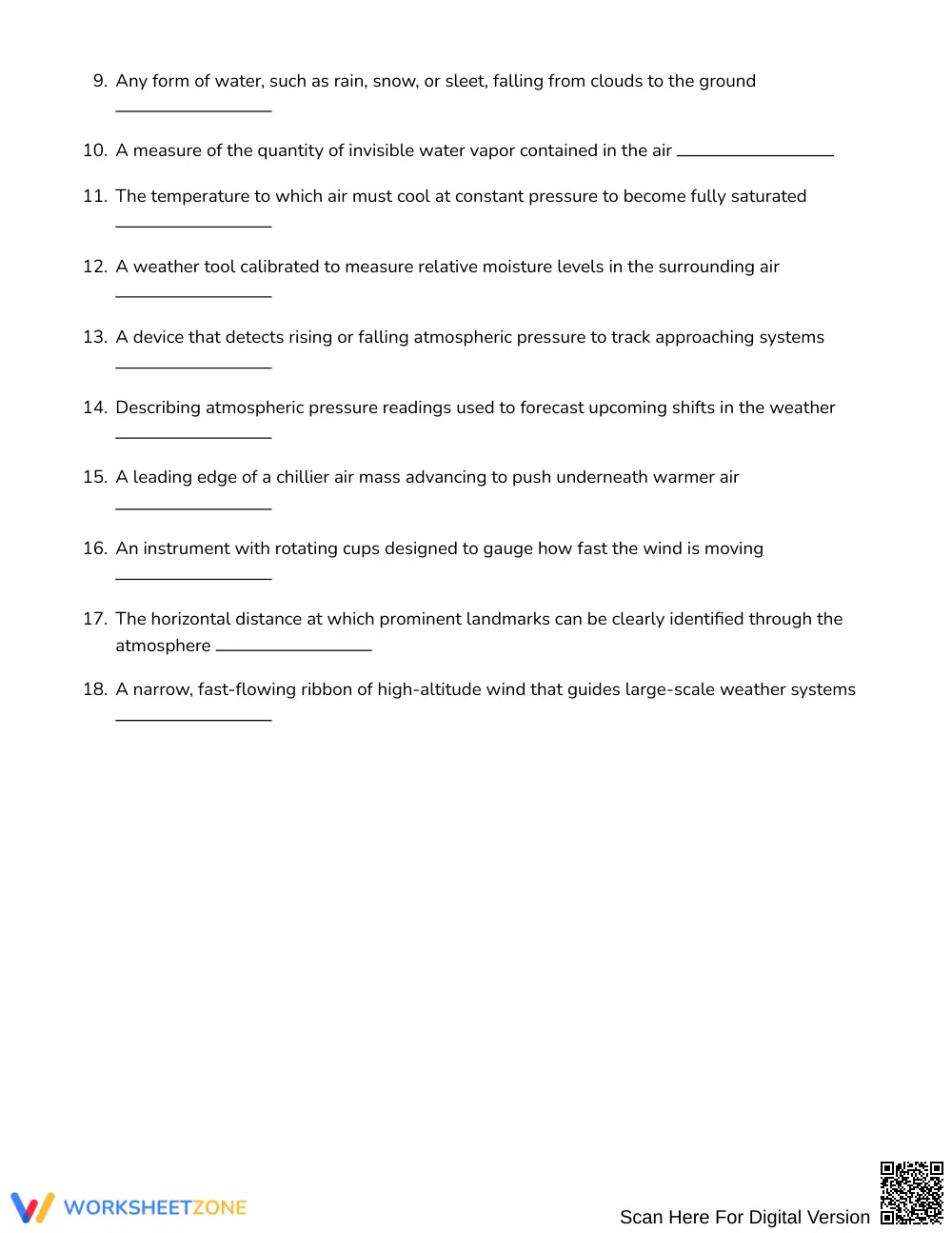
This science word search helps middle school students reinforce weather forecasting terminology through active clue-based puzzle solving. Students analyze definitions to identify 18 essential meteorological concepts before locating them within the grid. The activity consolidates atmospheric vocabulary, deepening conceptual recall for weather fronts, pressure systems, and observation tools.
At a Glance
- Grade: Grades 7–8 · Subject: Science
- Standard: Not standards-assessed — vocabulary enrichment
- Skill Focus: Reading a simple forecast
- Format: 3 pages · 18 words · Answer key included · PDF
- Best For: Vocabulary review and unit wrap-up
- Time: 25–35 minutes
What's Inside
The activity package spans 3 student pages accompanied by a complete 4-page answer key showing full letter coordinates. Instead of a basic word bank, students receive 18 comprehensive meteorological clues defining essential tools, boundaries, and phenomena. Learners must read each technical description, determine the correct vocabulary term, and track it down within the puzzle.
Puzzle Mechanics
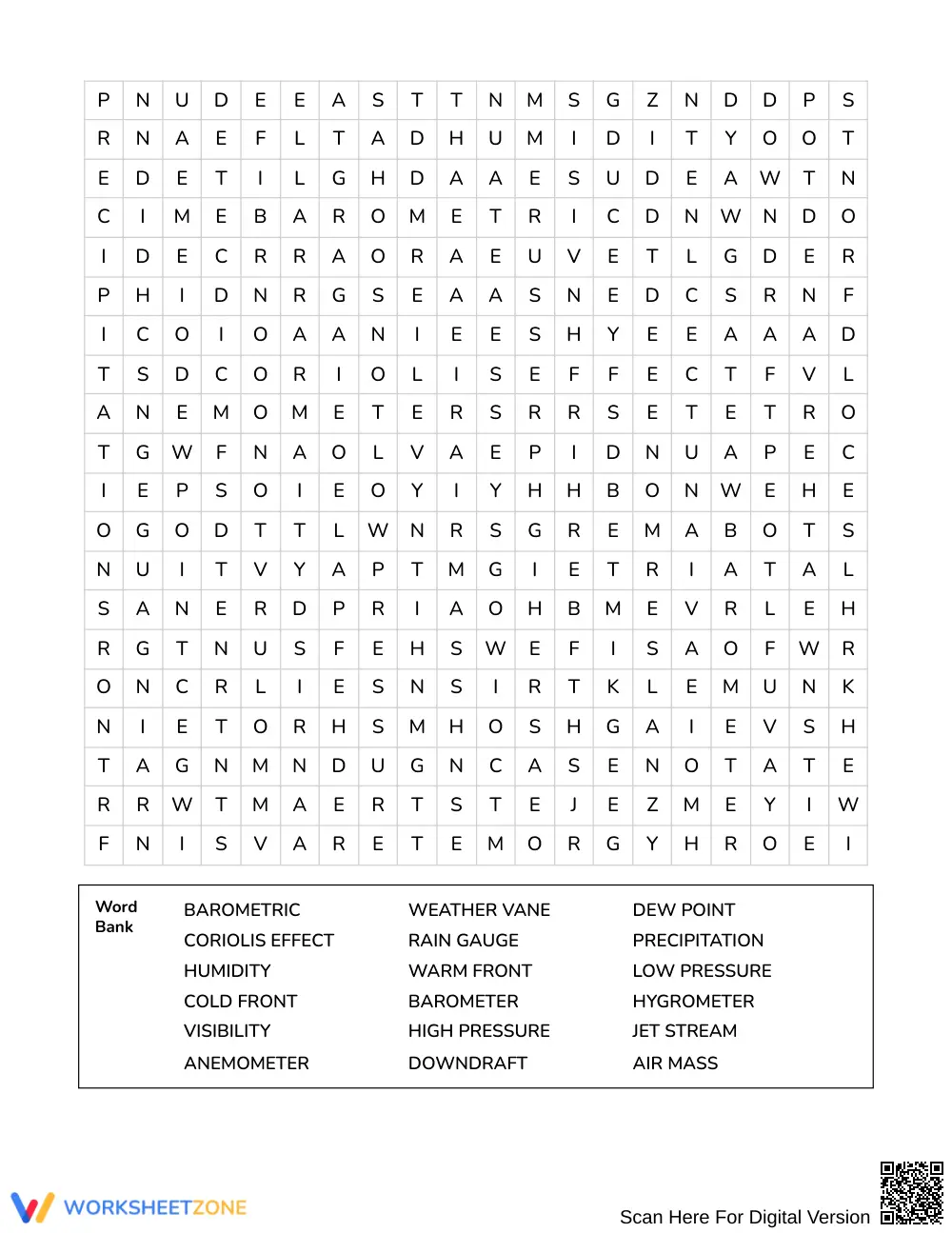
Students search a dense 20×20 letter grid containing 18 hidden meteorological terms. Words are positioned in all eight compass directions: north, northeast, east, southeast, south, southwest, west, and northwest. Forward, backward, and diagonal placements challenge visual scanning and spatial reasoning. Learners match clues to terms before searching, transforming routine word-finding into meaningful retrieval practice.
Standards Alignment
This resource serves as targeted vocabulary enrichment and is not aligned to a specific state or national standard. It provides supplementary terminology reinforcement to support broader earth science and atmospheric units, strengthening foundational science literacy across middle school grade bands.
How to Use It
Deploy this puzzle as a cumulative review station following direct instruction on atmospheric systems, or assign it as an engaging independent task for early finishers. During the session, monitor whether students can identify terms directly from definitions without peer assistance to gauge conceptual retention. Completion typically requires 25 to 35 minutes of focused student work.
Who It's For
This resource is designed for Grades 7–8 science students reviewing meteorological concepts. For learners needing additional support, teachers can highlight initial letters or provide a separate word list. Pair this activity with daily weather map analysis or a hands-on air pressure lab to connect terminology with practical forecast interpretation.
Vocabulary mastery plays a pivotal role in middle school science comprehension, establishing the foundational schema necessary for interpreting complex atmospheric data and weather forecast models. According to Fisher & Frey (2014), intentional integration of domain-specific academic vocabulary through active retrieval exercises significantly enhances long-term retention and reading comprehension in secondary content classrooms. Rather than relying on passive rote memorization, this clue-driven weather activity requires students to evaluate 18 detailed scientific descriptions, retrieve corresponding meteorological terms, and verify their spelling across a complex 20×20 puzzle grid. By functioning as targeted vocabulary enrichment without standard-specific constraints, the resource bridges the gap between basic definitions and practical data literacy, reinforcing essential terms such as barometric pressure, dew point, and cold fronts. This structured cognitive engagement provides science educators with an effective, zero-prep tool that strengthens students' analytical vocabulary and scientific discourse skills.


