


























Views
Downloads



Essential Unknown Forces Worksheet | Grade 12 Physics
Paste this activity's link or code into your existing LMS (Google Classroom, Canvas, Teams, Schoology, Moodle, etc.).
Students can open and work on the activity right away, with no student login required.
You'll still be able to track student progress and results from your teacher account.
This Grade 12 physics worksheet equips students to infer unknown forces from motion constraints in multi-body systems. Students resolve dynamic equations along acceleration axes, evaluate competing friction models, and synthesize tension constraints. The problems prepare learners to calculate applied forces, normal reactions, and thrust vectors with mathematical precision.
At a Glance
- Grade: 12 · Subject: Physics
- Standard: Advanced Mechanics — Apply Newton's second law to calculate unknown forces from observed kinematic constraints
- Skill Focus: Infer an Unknown Force from Motion Constraints
- Format: 5 pages · 6 multi-step problems · Comprehensive 3-page answer key included · PDF
- Best For: Advanced Placement mechanics mastery and exam preparation
- Time: 50–75 minutes
What's Inside
Across 5 pages, this resource features 6 analytical physics problems supported by free-body diagrams, system schematics, and an explicit analysis framework. Tasks span inclined planes, banked turns, vertical walls, contact forces, and fluid drag. A 3-page worked answer key provides complete algebraic derivations and vector decompositions.
Skill Progression
- Guided practice (Part A — 2 problems): Students resolve standard constrained multi-body systems, calculating horizontal applied forces on an incline and normal forces on a banked curve.
- Supported practice (Part B — 3 problems): Learners evaluate inverse problems, analyzing strut forces on a vertical wall, proving contact maintenance between sliding blocks, and contrasting fluid drag models.
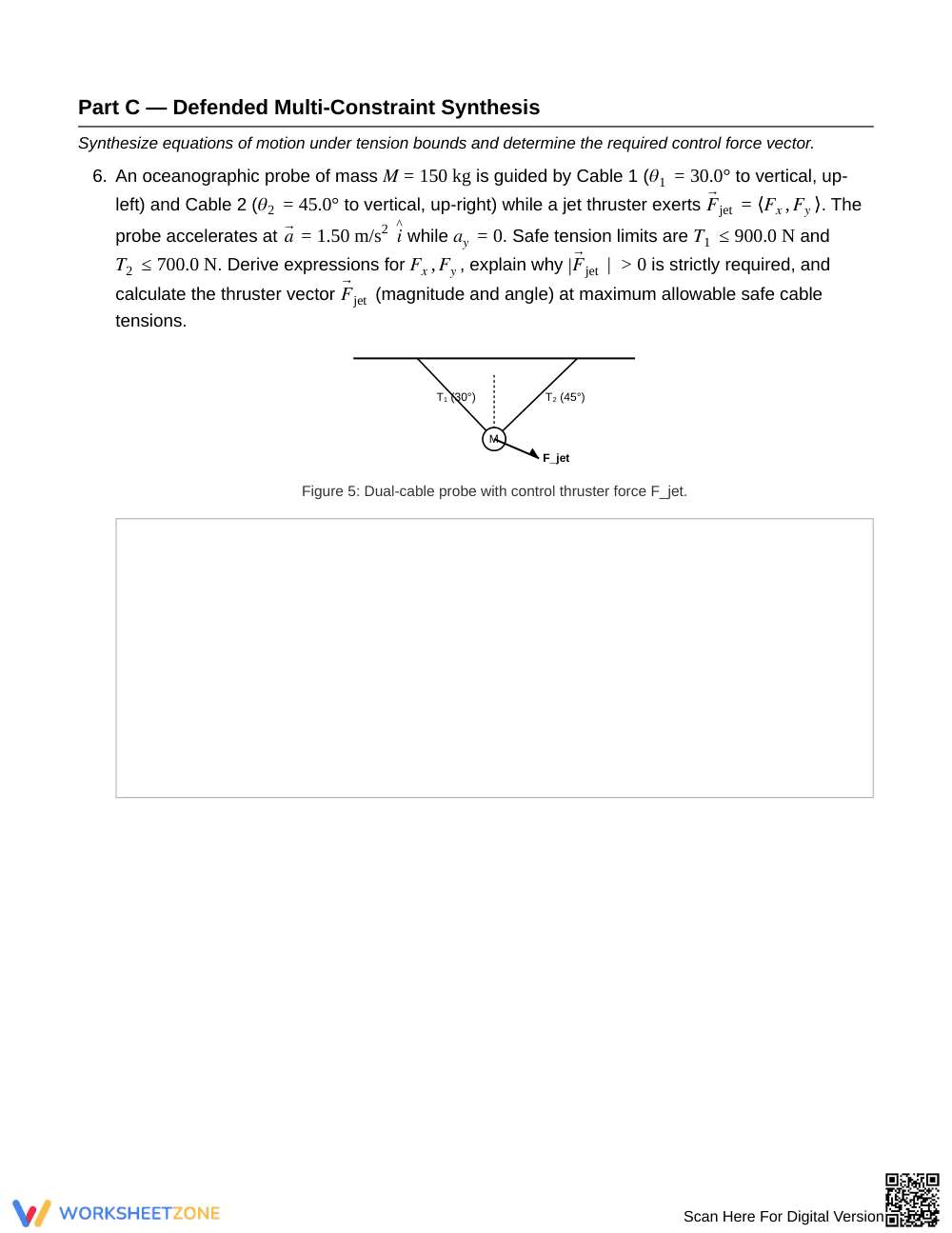
- Independent practice (Part C — 1 problem): Students synthesize equations of motion under dual-cable tension bounds to calculate a two-dimensional control thruster vector.
This sequence implements gradual release, moving from scaffolded vector decomposition to unprompted parametric synthesis.
Standards Alignment
This resource aligns with advanced mechanics standards requiring students to analyze multi-body interactions by applying Newton's second law along constrained acceleration axes. A supporting standard addresses mathematical modeling of fluid resistance. Both standard codes can be copied directly into lesson plans, IEP goals, or district curriculum mapping tools.
How to Use It
Deploy this worksheet after direct instruction on friction and multi-body dynamics. Use Part A for paired in-class problem solving, and assign Parts B and C for independent mastery or AP exam review. During practice, formatively check that students align coordinate axes with system acceleration rather than the horizontal. Students typically complete the 6 problems in 50 to 75 minutes.
Who It's For
This resource serves Grade 12 AP Physics C, honors physics, and college-prep mechanics students. Differentiate by providing isolated free-body diagram templates for struggling learners in Part A, while challenging advanced students to derive generalized algebraic formulas in Part C. Pair this worksheet with an instructional lesson on non-inertial reference frames and vector components.
Mastering the ability to infer an unknown force from motion constraints requires students to translate physical kinematics into resolved dynamic vector equations. According to research on the gradual release of responsibility by Fisher & Frey (2014), structured instructional progressions that guide learners from coupled multi-body systems to independent multi-constraint synthesis significantly enhance analytical reasoning and mathematical transfer. This Grade 12 physics resource embodies these principles across 6 rigorous, college-preparatory analytical problems. By challenging students to resolve inclined planes, evaluate competing vertical wall friction models, prove contact forces between sliding blocks, and optimize bounded cable tensions under fluid drag, the worksheet bridges theoretical dynamics and applied engineering mechanics. The inclusion of a comprehensive 3-page worked answer key ensures instructors can easily track student misconceptions in vector decomposition and terminal velocity equations, delivering rigorous physics instruction supported by validated pedagogical frameworks.


