


























Views
Downloads


Essential Trig Ratio Tables Worksheet | Grade 10 Geometry
Paste this activity's link or code into your existing LMS (Google Classroom, Canvas, Teams, Schoology, Moodle, etc.).
Students can open and work on the activity right away, with no student login required.
You'll still be able to track student progress and results from your teacher account.
This high school geometry worksheet helps students connect abstract trigonometric ratio tables to concrete side-length proportions in similar right triangles. Learners analyze tabular values, calculate missing dimensions, and verify that angle-based trigonometric ratios remain constant regardless of triangle scale. Through structured multi-step tasks, students build a rigorous foundation for right triangle trigonometry.
At a Glance
- Grade: 10 · Subject: Geometry
- Standard:
HSG-SRT.C.6— Understand that by similarity, side ratios in right triangles define trigonometric ratios- Skill Focus: Comparing ratio tables and triangle geometry
- Format: 5 pages · 12 problems · Answer key included · PDF
- Best For: Core practice and conceptual reinforcement
- Time: 40–50 minutes
What's Inside
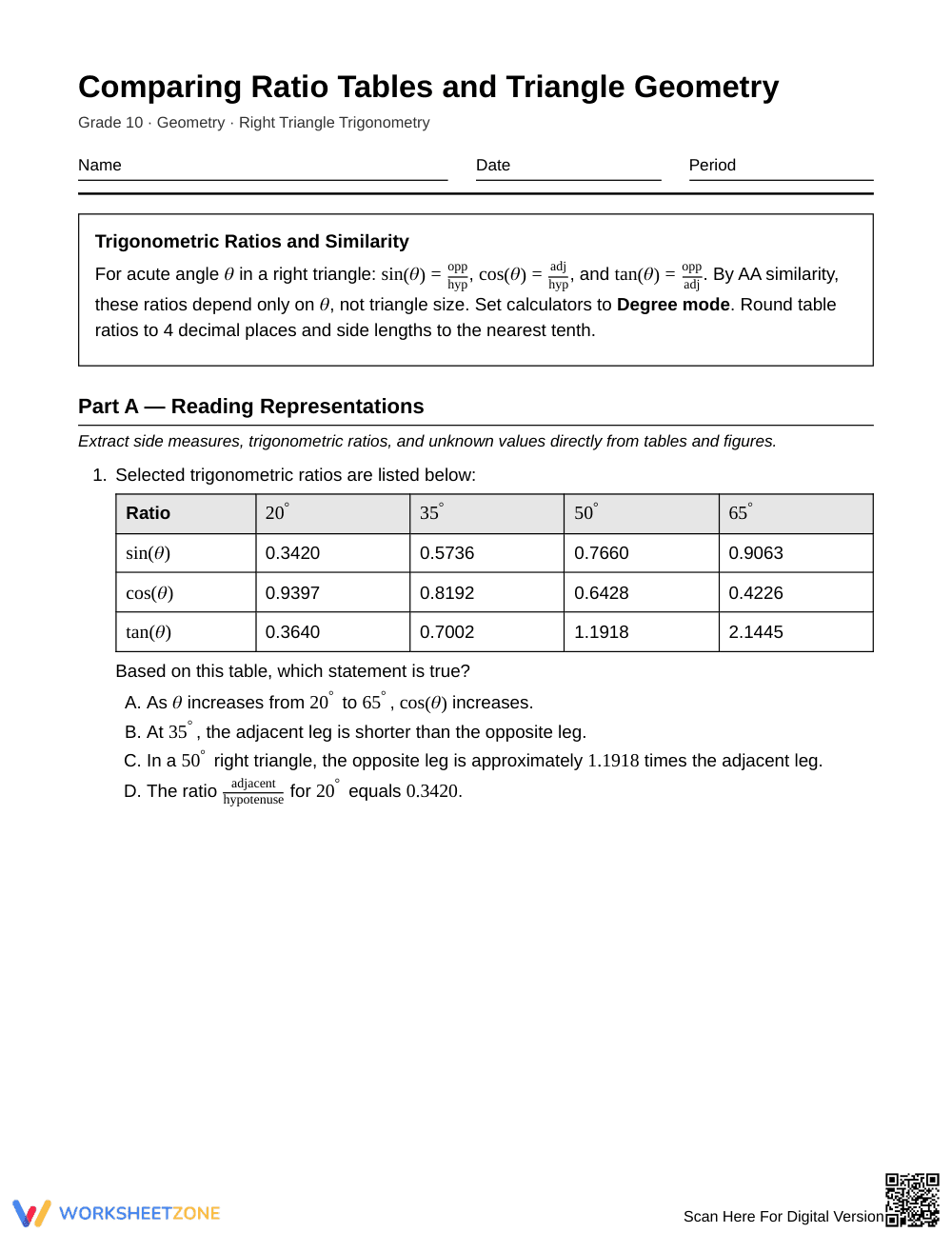
The 5-page student resource delivers 12 comprehensive problems organized into three distinct parts, complete with reference diagrams, ratio reference tables, and a full 2-page worked answer key. Students interpret reference charts, calculate side lengths using decimal approximations, evaluate geometric similarity classes, and justify algebraic relationships such as the cofunction identity between complementary acute angles.
Skill Progression
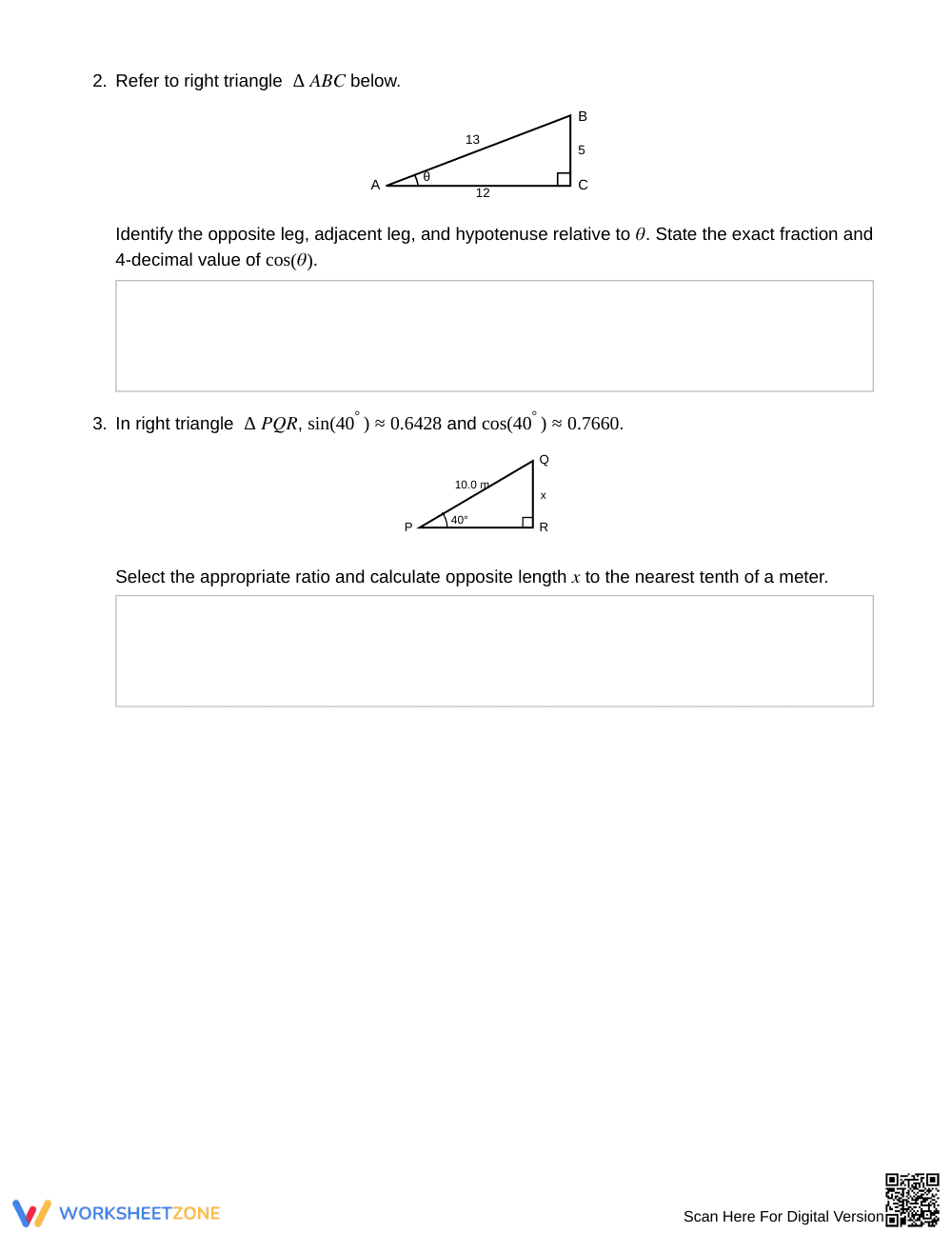
- Guided Practice (Part A, Tasks 1–3): Students read reference tables and direct diagrams to extract side measures, set up fundamental ratios (sine, cosine, and tangent), and calculate single missing side lengths with explicit scaffolds.
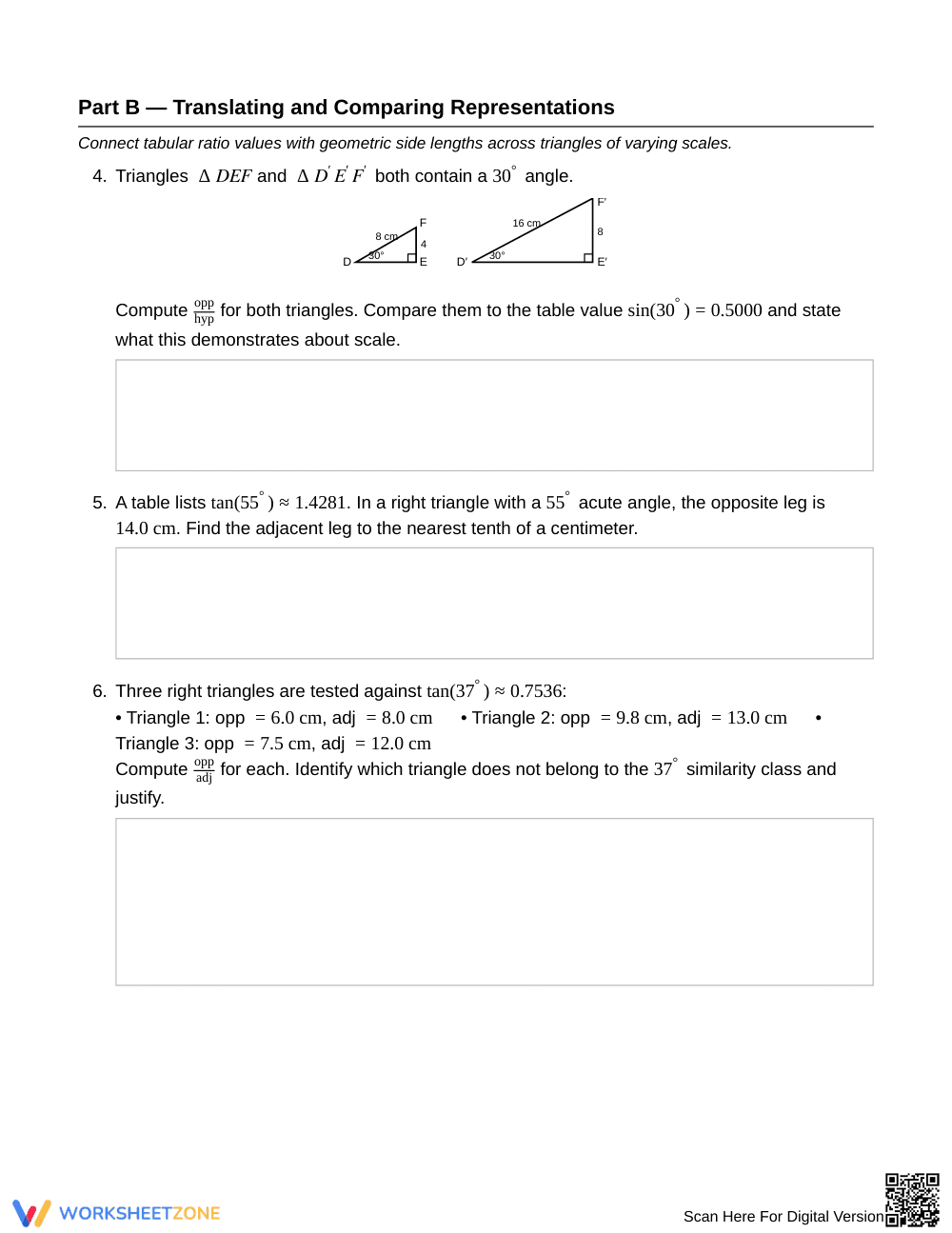
- Supported Practice (Part B, Tasks 4–9): Learners translate between tabular values and geometric side lengths across triangles of varying scales, testing similarity classes, verifying measured angle data, and solving applied indirect measurement scenarios.
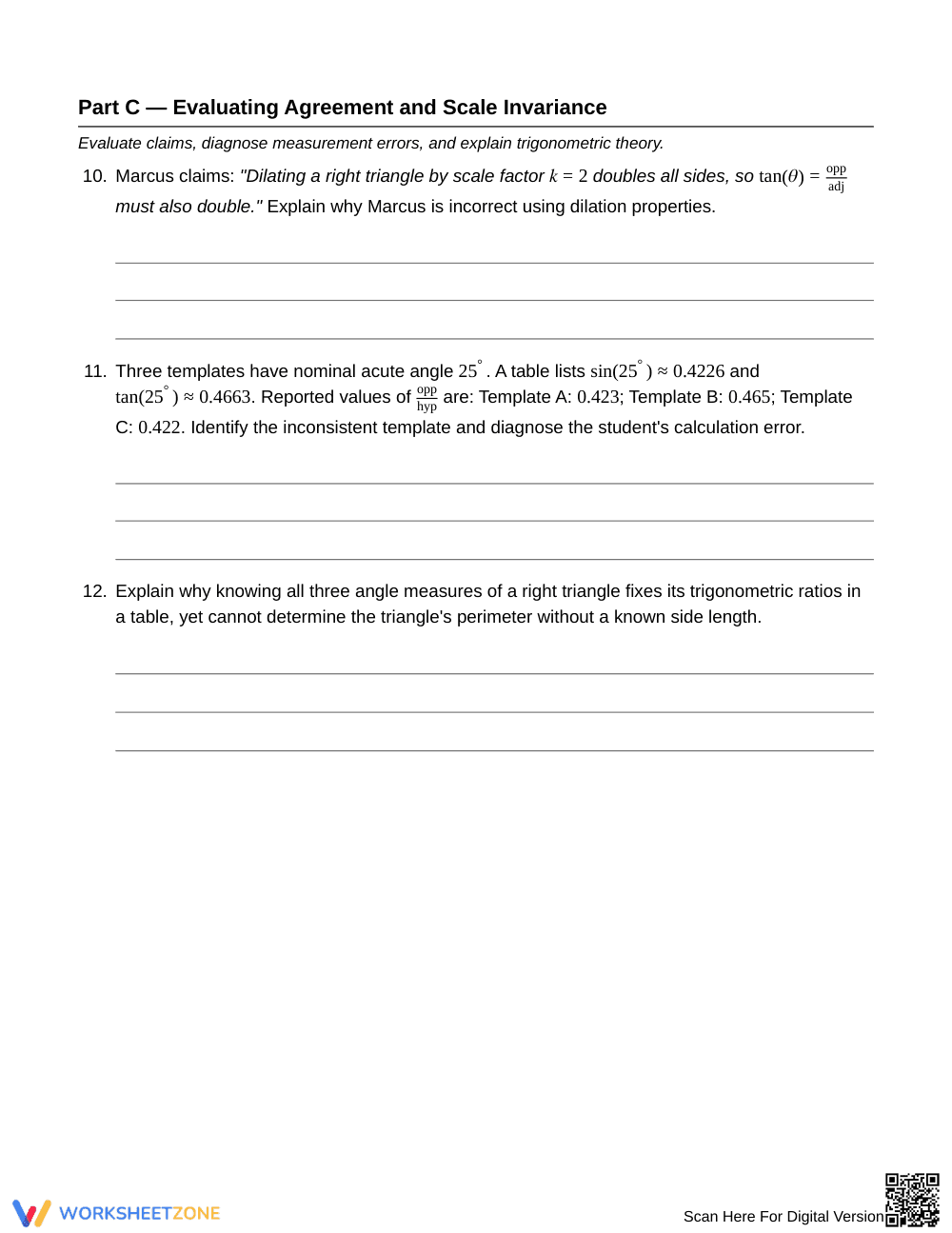
- Independent Practice (Part C, Tasks 10–12): Students complete open-ended theoretical evaluations, critiquing dilation misconceptions, diagnosing calculation errors in simulated student work, and explaining scale invariance.
This sequence follows a gradual-release instructional model that moves students systematically from foundational table reading to advanced conceptual justification.
Standards Alignment
This worksheet directly addresses primary standard `HSG-SRT.C.6`: Understand that by similarity, side ratios in right triangles are properties of the angles in the triangle, leading to definitions of trigonometric ratios for acute angles. It reinforces the geometric basis of trigonometry through similarity transformations. Both standard codes can be copied directly into lesson plans, IEP goals, or district curriculum mapping tools.
How to Use It
Deploy this resource during the direct practice phase immediately following an introductory lesson on right triangle similarity and trigonometric definitions. Alternatively, assign Part C as a mid-unit formative check to assess conceptual understanding before procedural testing. During instruction, observe how students explain why dilating a triangle leaves trigonometric ratios unchanged to identify lingering proportional reasoning errors. Most students complete the 12 tasks in 40 to 50 minutes.
Who It's For
This resource is designed for Grade 10 Geometry students learning right triangle trigonometry. Provide the reference table and diagram annotations for struggling learners needing visual support, while challenging advanced students to algebraically prove the complementary angle relationships in Part B. It pairs naturally with an interactive similarity transformation lesson or an anchor chart showing trigonometric definitions.
According to research synthesized by Fisher & Frey (2014) on the gradual release of responsibility, structured transitions from guided representation reading to independent error analysis significantly enhance student conceptual retention in secondary mathematics. When Grade 10 students work through targeted tasks addressing standard HSG-SRT.C.6, they shift from treating sine, cosine, and tangent as isolated calculator keystrokes to understanding them as invariant properties of geometric similarity. Analyzing ratio tables alongside scaled figures helps learners confront common misconceptions about dilations and side-length proportionality. By combining tabular data extraction, geometric computation, and analytical writing across 12 focused problems, this worksheet provides the deliberate practice necessary for students to master right triangle trigonometry and build lasting algebraic-geometric connections.


