




























Views
Downloads



Essential Trig Parameters Worksheet | Grade 12 Precalculus

Paste this activity's link or code into your existing LMS (Google Classroom, Canvas, Teams, Schoology, Moodle, etc.).
Students can open and work on the activity right away, with no student login required.
You'll still be able to track student progress and results from your teacher account.
This Grade 12 Precalculus worksheet equips students to analyze and justify the physical meaning of sinusoidal function parameters in authentic contexts. Through algebraic proof and model evaluation, learners connect amplitude, frequency, phase shift, and midline to periodic systems, building the conceptual mastery required for advanced STEM coursework.
At a Glance
- Grade: 12 · Subject: Precalculus
- Standard:
HSF-TF.B.5— Model periodic phenomena with trigonometric functions using amplitude, frequency, and midline- Skill Focus: Justify a Parameter’s Contextual Meaning in Sinusoidal Models
- Format: 4 pages · 8 problems · Comprehensive answer key included · PDF
- Best For: Advanced modeling practice and conceptual justification
- Time: 45–60 minutes
What's Inside
This 4-page document contains 8 analytical tasks and a concise Sinusoidal Model Parameters reference box defining amplitude, midline, angular frequency, and phase shift. Across two student pages and two complete answer key pages, learners evaluate scenarios including HVAC cycles, tidal resonance, Ferris wheels, solar irradiance, acoustic pressure, and arterial blood pressure.
Skill Progression
- Guided Practice (Part A, Problems 1–2): Students evaluate HVAC and tidal claims, using reference definitions to algebraically test assertions and address misconceptions.
- Supported Practice (Part B, Problems 3–6): Learners justify derivations across four applied contexts—Ferris wheels, solar cycles, acoustic frequencies, and blood pressure symmetry—with fading prompts.
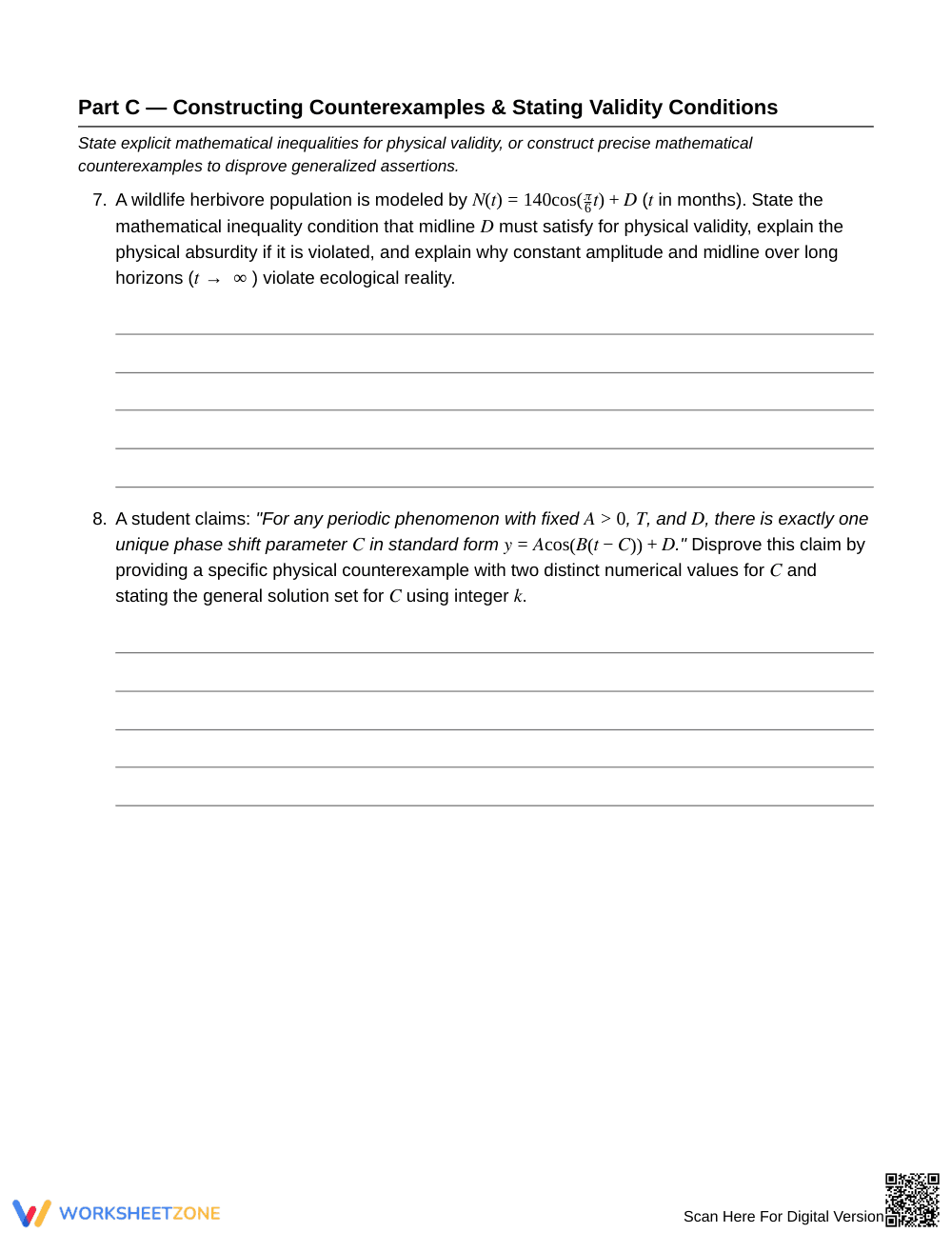
- Independent Practice (Part C, Problems 7–8): Students establish ecological validity inequalities and construct formal counterexamples disproving phase shift uniqueness.
This gradual-release sequence guides students from supported claim testing to independent mathematical justification.
Standards Alignment
This resource aligns to `HSF-TF.B.5`: Choose trigonometric functions to model periodic phenomena with specified amplitude, frequency, and midline. It also supports `HSF-IF.B.4` by interpreting key features of periodic graphs within contextual applications. Both standard codes can be copied directly into lesson plans, IEP goals, or district curriculum mapping tools.
How to Use It
Assign this worksheet after direct instruction on sinusoidal transformations to deepen modeling comprehension, or use it during collaborative workshops to encourage mathematical discourse. As a formative assessment check, verify whether students recognize in Problem 1 that changing amplitude alters oscillation range rather than the cycle average. Expected completion time is 45 to 60 minutes.
Who It's For
This resource is built for Grade 12 Precalculus and advanced trigonometry students developing analytical modeling skills. Support striving learners by pairing the worksheet with a trigonometric graph transformation anchor chart. Use it alongside direct instruction on periodic modeling to solidify conceptual understanding.
According to the EdReports 2024 instructional materials review, high school mathematics curricula must balance procedural fluency with rigorous contextual modeling to ensure college readiness. This 4-page Precalculus worksheet addresses standard HSF-TF.B.5 by requiring twelfth-grade students to justify a parameter's contextual meaning across 8 rigorous analytical tasks. Rather than computing values in isolation, learners investigate physical systems such as tidal resonance, Ferris wheel mechanics, and arterial blood pressure to explain how amplitude, frequency, phase shift, and midline govern real-world periodic behaviors. EdReports 2024 benchmarks emphasize that requiring learners to construct mathematical counterexamples and establish parameter validity conditions deepens conceptual retention and prevents common misconceptions regarding sinusoidal symmetry. By translating directly between algebraic equations and physical phenomena, this resource equips students with the advanced modeling and mathematical reasoning competencies demanded in university-level calculus, physics, and engineering coursework.


