




























Views
Downloads




Essential Trig Identities Worksheet | Grade 12 Precalculus

Paste this activity's link or code into your existing LMS (Google Classroom, Canvas, Teams, Schoology, Moodle, etc.).
Students can open and work on the activity right away, with no student login required.
You'll still be able to track student progress and results from your teacher account.
This Precalculus worksheet provides structured practice on fundamental Pythagorean identities, quadrant analysis, and trigonometric proofs. Students calculate exact trigonometric ratios, simplify rational expressions, solve equations on specified intervals, and analyze algebraic errors. The resource ensures twelfth-grade students develop rigorous analytical reasoning before progressing to advanced formulas.
At a Glance
- Grade: 12 · Subject: Precalculus
- Standard:
HSF-TF.C.8— Prove and apply the Pythagorean trigonometric identity to find exact trigonometric values- Skill Focus: Trigonometric Reasoning & Pythagorean Identities
- Format: 5 pages · 16 problems · Answer key included · PDF
- Best For: Identity mastery and unit exam review
- Time: 45–60 minutes
What's Inside
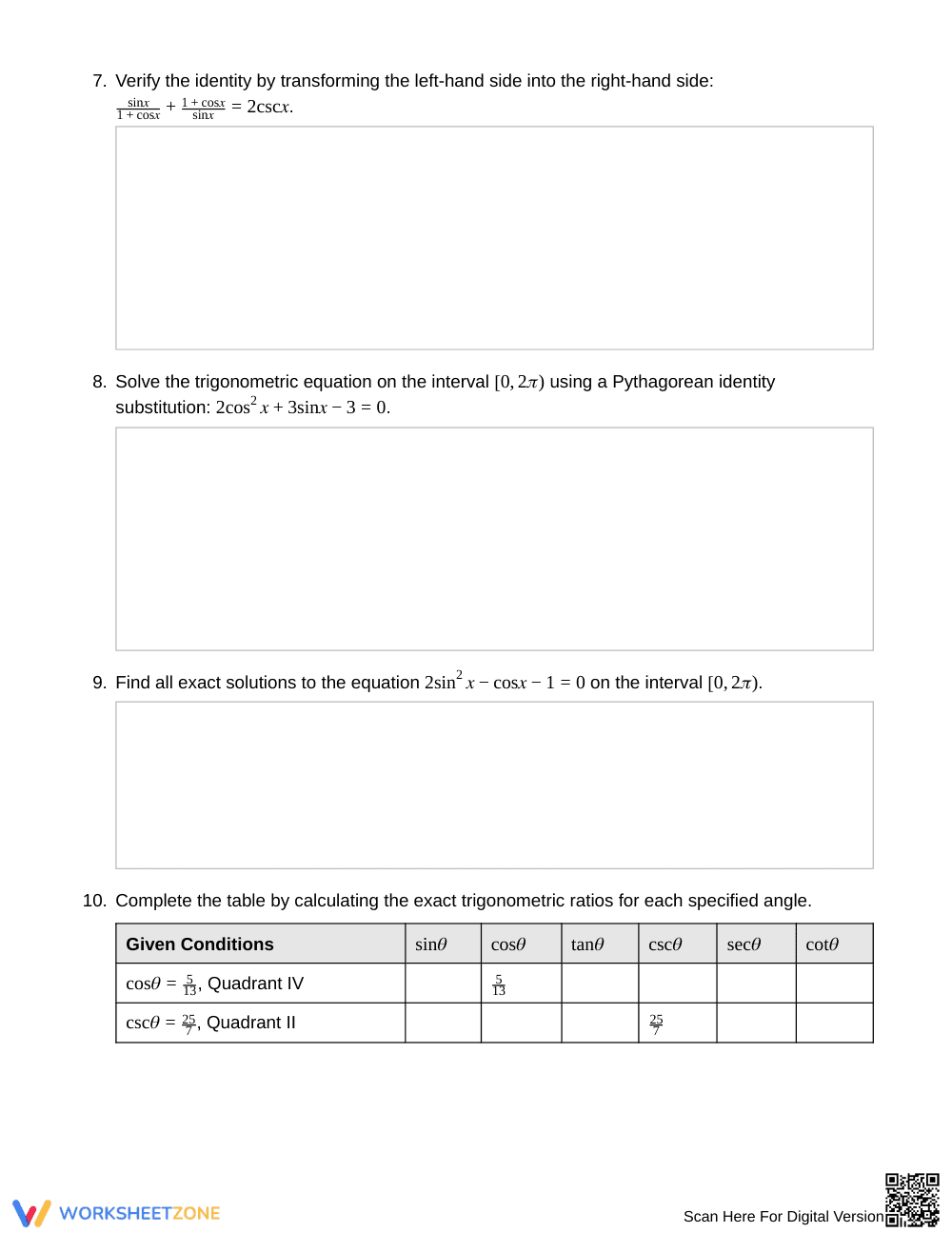
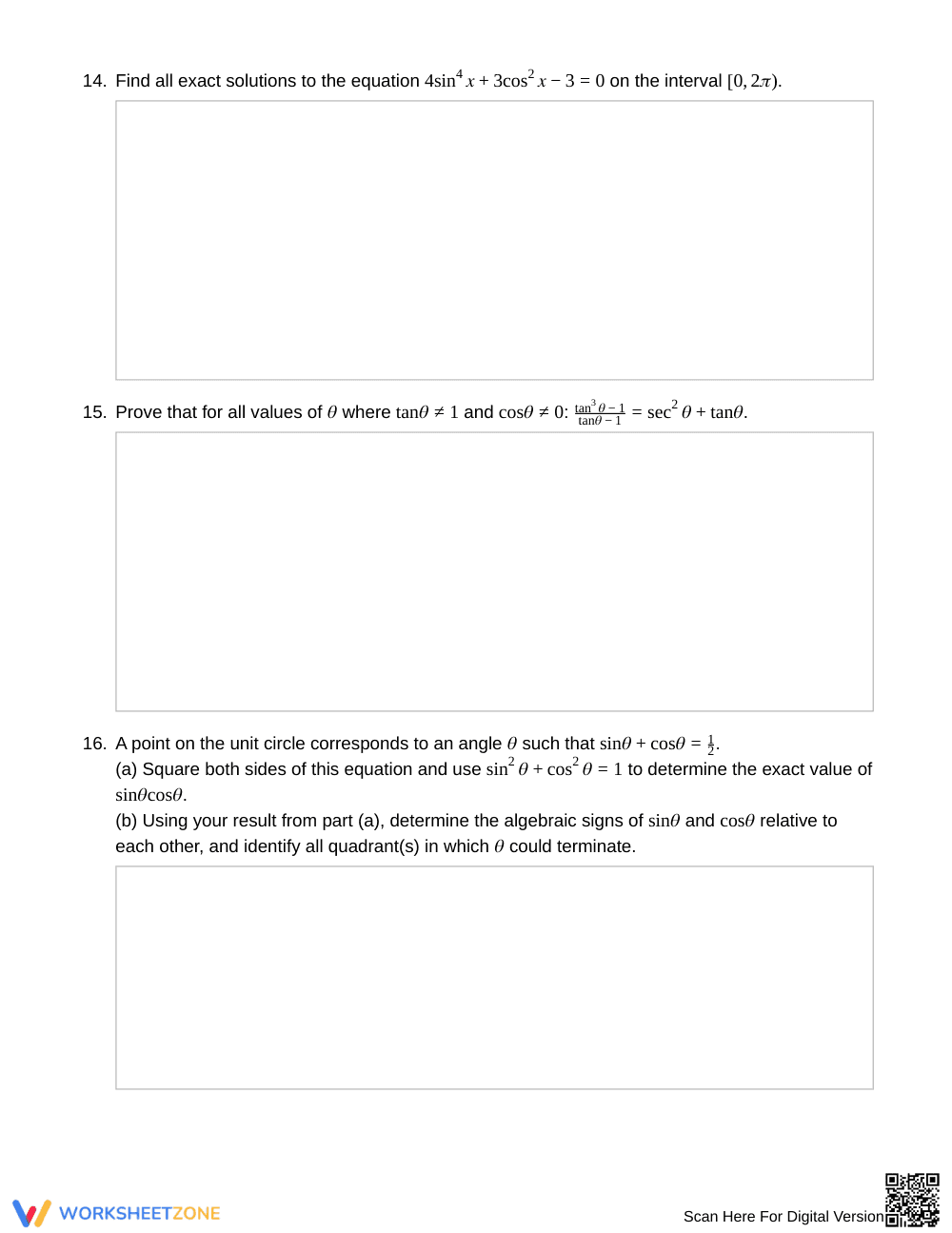
The five-page printable contains 16 multi-step problems organized across three parts, plus a three-page answer key. Students reference core formulas on page 1 before completing unit circle proofs, ratio tables across four quadrants, identity verifications, error analysis, and parametric expressions.
Skill Progression
- Guided practice (Part A, 4 items): Reviews core identity derivations and evaluates basic identities using unit circle geometry and domain restrictions.
- Supported practice (Part B, 8 items): Guides students through identity simplification, four-quadrant ratio tables, quadratic trigonometric equations, and error analysis.
- Independent practice (Part C, 4 items): Challenges learners with parametric substitutions, higher-degree equations, quotient proofs, and algebraic sign analysis.
This gradual-release structure builds student confidence from initial verification to independent proof.
Standards Alignment
This worksheet aligns directly with HSF-TF.C.8: "Prove the Pythagorean identity sin^2(θ) + cos^2(θ) = 1 and use it to find sin(θ), cos(θ), or tan(θ) given sin(θ), cos(θ), or tan(θ) and the quadrant of the angle." It also supports HSF-TF.C.9 by establishing fundamental identity manipulation skills. Both standard codes can be copied directly into lesson plans, IEP goals, or district curriculum mapping tools.
How to Use It
Use this worksheet after direct instruction on the unit circle as a focused practice activity or unit exam review. During classwork, check quadrant signs in Part B to catch algebraic errors early. Expect students to complete the set in 45–60 minutes.
Who It's For
This resource serves Grade 12 Precalculus students mastering analytic trigonometry. Pair it with a unit circle visual reference chart for learners requiring additional scaffolding during coordinate substitutions.
According to research by Fisher & Frey (2014), structured instructional frameworks that systematically transition students from foundational concepts to independent synthesis foster deeper algebraic problem-solving capabilities. This Grade 12 Precalculus worksheet applies that research-backed progression to standard HSF-TF.C.8, which requires students to prove the Pythagorean identity and determine exact trigonometric ratios given specific quadrant conditions. Across 16 carefully scaffolded tasks, learners progress from geometric unit circle proofs to analytical equation solving, ratio table synthesis, and rigorous algebraic verification. By incorporating student error-analysis tasks alongside algebraic derivations, the resource actively targets common high school misconceptions regarding domain restrictions, interval notation, and radical sign conventions. Educators can utilize this complete five-page instructional tool with its full answer key as a reliable formative checkpoint or summative review to confirm student mastery prior to calculus-level coursework.


