


























Views
Downloads



Essential System Choice Worksheet | Grade 12 Physics
Paste this activity's link or code into your existing LMS (Google Classroom, Canvas, Teams, Schoology, Moodle, etc.).
Students can open and work on the activity right away, with no student login required.
You'll still be able to track student progress and results from your teacher account.
This 4-page physics worksheet trains Grade 12 students to define multi-body system boundaries and isolate external forces. Learners analyze contact interactions, calculate accelerations across coupled objects, and validate equations through limiting case models. By resolving internal versus external forces, students achieve conceptual clarity and computational mastery in advanced Newtonian mechanics.
At a Glance
- Grade: 12 · Subject: High School Physics
- Standard: Advanced Physics Mechanics — Define system boundaries and isolate external forces acting on multi-body systems
- Skill Focus: System Choice and External Forces
- Format: 4 pages · 12 problems · Answer key included · PDF
- Best For: Advanced mechanics and multi-body dynamics practice
- Time: 45–60 instructional minutes
What's Inside
This 4-page worksheet includes 12 multi-body problems and a 3-page complete answer key. A reference box outlines Newton's second law, friction models, and internal force cancellation. Tasks feature force classification tables, symbolic component resolution, coupled Atwood and incline calculations, and limiting case derivations.
Skill Progression
- Guided practice (Problems 1–4): Scaffolds system identification with classification tables, force component selection, and conceptual distinctions between internal pairs and external drivers.
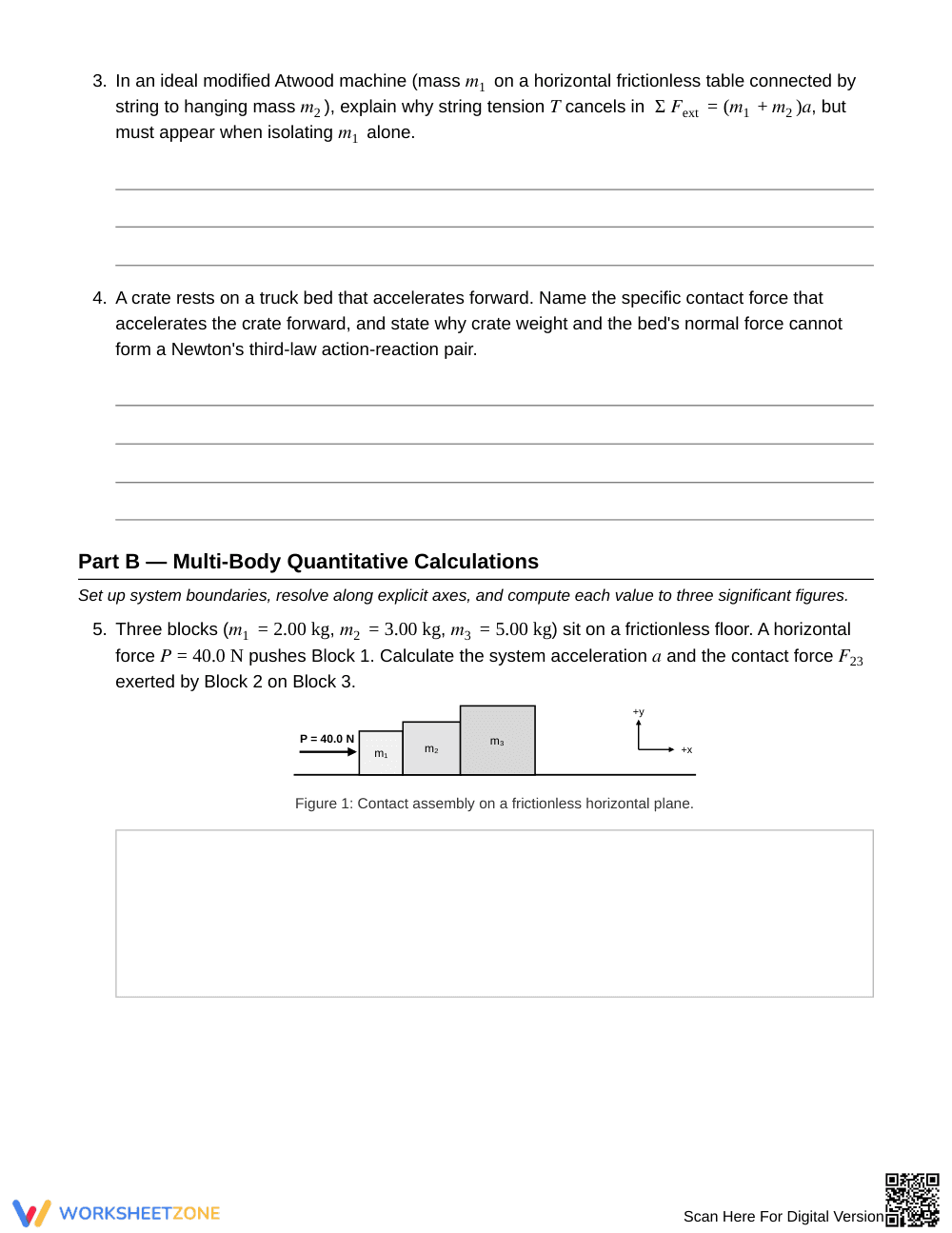
- Supported practice (Problems 5–10): Solves multi-body calculations involving contact blocks, static friction thresholds, coupled incline pulleys, and crane cable tensions.
- Independent practice (Problems 11–12): Challenges learners to evaluate Atwood machine limiting mass behaviors and mathematically disprove common tension misconceptions.
This gradual-release structure moves students from guided boundary classification to independent algebraic proof.
Standards Alignment
This resource aligns with high school mechanics standards governing Newton's laws and multi-body dynamics. Students apply the rule that system acceleration depends solely on net external forces while internal action-reaction forces cancel to zero. Both standard codes can be copied directly into lesson plans, IEP goals, or district curriculum mapping tools.
How to Use It
Use this worksheet following direct instruction on Newton's laws to bridge single-body dynamics to multi-body systems, or assign it during mid-unit review. Formatively check Part A to ensure students do not include internal tension in composite system equations. Students complete these 12 tasks in 45 to 60 minutes.
Who It's For
This resource serves Grade 12 Physics, Honors, and AP Physics students mastering coupled free-body diagrams. The top formula box scaffolds struggling learners, while Part C extends high-achieving students. Pair this worksheet with a physical Atwood machine lab demonstration to connect concrete observations to analytical boundary choices.
Developing systematic system choice and external force identification skills is fundamental for high school mechanics mastery. Research highlighted by Fisher & Frey (2014) demonstrates that structured gradual-release frameworks significantly enhance problem-solving transfer in complex STEM domains. When learners first distinguish internal contact forces from net external drivers before executing numerical procedures, they avoid standard computational errors in coupled dynamic systems. This Grade 12 physics worksheet delivers 12 rigorous tasks progressing from system boundary classification tables to multi-body incline calculations and functional limit verifications. By prompting students to analyze why internal tension forces cancel in composite systems while governing isolated components, the resource solidifies deep conceptual reasoning alongside quantitative fluency. The included 3-page worked answer key supports targeted formative intervention, making this resource an evidence-based tool for developing independent analytical competence in advanced mechanics curricula.


