































Essential Summer Reading Word Search | Grades 6–7 ELA

Paste this activity's link or code into your existing LMS (Google Classroom, Canvas, Teams, Schoology, Moodle, etc.).
Students can open and work on the activity right away, with no student login required.
You'll still be able to track student progress and results from your teacher account.
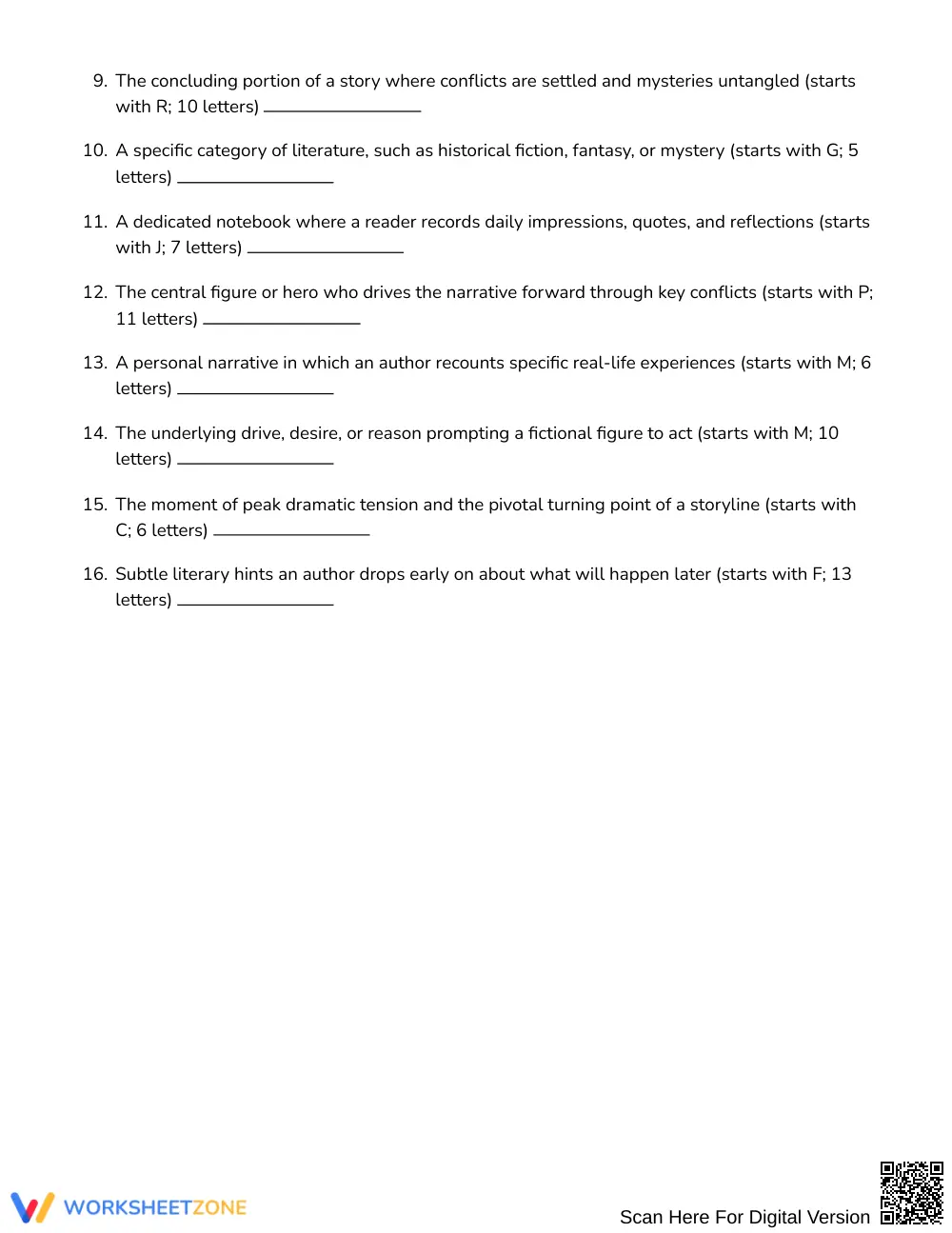
Build literary analysis vocabulary and celebrate independent reading with this Grades 6–7 summer reading reflections word search. Students review critical narrative concepts such as protagonist, foreshadowing, and theme by solving clues rather than scanning a word bank. This challenging activity strengthens reading comprehension recall and reinforces essential English language arts terminology at the start of the school year.
At a Glance
- Grade: Grades 6–7 · Subject: English Language Arts (ELA)
- Standard: Not standards-assessed — vocabulary enrichment
- Skill Focus: Summer reading reflections, story elements, and literary terms
- Format: 3 pages · 16 words · Full answer key included · Printable PDF
- Best For: Back-to-school literary reflection and vocabulary review
- Time: 25–35 minutes
This 3-page printable resource features an intellectually stimulating word puzzle that eliminates the traditional word list. Instead of passively copying letters, students must read 16 definitions to identify narrative terms before hunting for them. The puzzle includes a comprehensive 3-page answer key that highlights exact letter coordinates and word placements, making grading or peer review immediate and straightforward.
This puzzle presents an advanced challenge designed for upper-elementary and middle school readers:
- Grid Structure: A dense 18 x 18 letter matrix containing 16 hidden literary vocabulary terms.
- Search Directions: Words run in all 8 directions—horizontally, vertically, and diagonally (N, NE, E, SE, S, SW, W, NW), including reverse orientations.
- Clue-Based Solving: Learners receive no word bank; they must actively deduce each term from detailed literary clues before locating it in the puzzle.
This resource serves as targeted vocabulary enrichment and is not aligned to a single state or national standard. It supports foundational English language arts proficiency by reinforcing critical story elements and academic vocabulary that students encounter across all middle school literary reading curricula.
Deploy this activity during the first two weeks of school following summer reading assignments, or schedule it as an engaging literacy station task. During independent work time, observe whether students can identify narrative terms directly from the clue descriptions without consulting an external glossary. Expect students to finish the complete puzzle within 25 to 35 minutes.
This activity is designed specifically for students in Grades 6–7 transitioning back into academic routines. It accommodates varied learning paces through collaborative peer solving or independent challenge, and pairs naturally with an opening unit narrative anchor chart or a student book talk presentation.
Vocabulary acquisition directly correlates with reading comprehension growth in the middle grades. Research highlighted by Fisher & Frey (2014) emphasizes that intentional word-learning experiences—particularly those requiring learners to actively retrieve conceptual definitions rather than passively copy terms—strengthen long-term lexical memory and textual analysis. This Grades 6–7 summer reading reflection word search operationalizes retrieval practice by replacing standard word banks with analytical literary clues. Students must connect descriptive prompts about narrative structure, character motivation, and point of view to precise literary terms before executing spatial visual searches across an 18 x 18 grid. By integrating definitional retrieval with orthographic scanning across 16 foundational terms, this activity bridges informal summer reading experiences with rigorous middle school academic expectations. The resulting cognitive engagement reinforces essential literary terminology, enhances student confidence during text-based classroom discussions, and establishes a shared analytical vocabulary for subsequent English language arts coursework.


