


























Views
Downloads
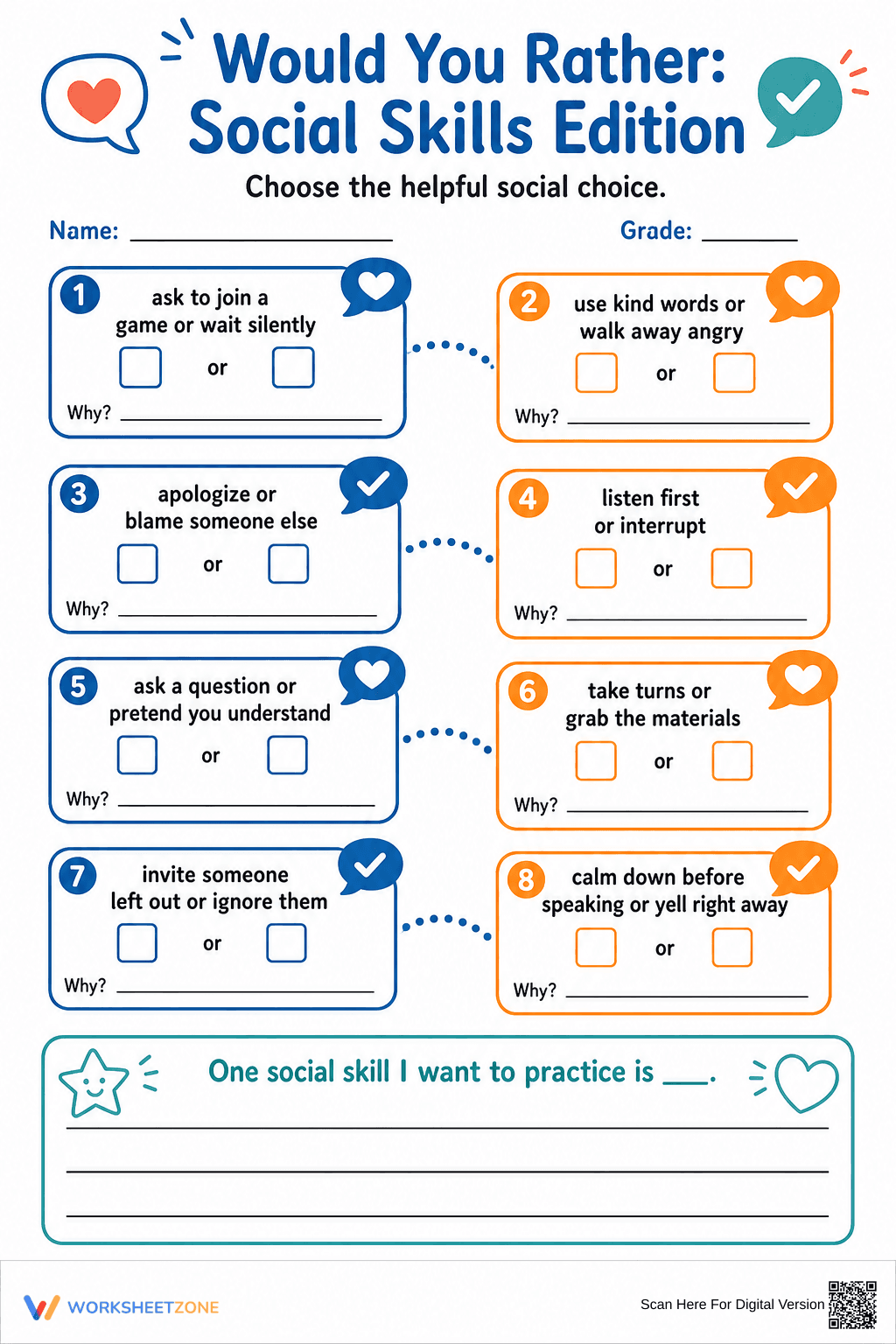

Essential Social Skills Worksheet | Grades 3-6 Ready
Paste this activity's link or code into your existing LMS (Google Classroom, Canvas, Teams, Schoology, Moodle, etc.).
Students can open and work on the activity right away, with no student login required.
You'll still be able to track student progress and results from your teacher account.
This social-emotional learning worksheet empowers students in grades 3 through 6 to evaluate interpersonal scenarios and select prosocial responses. By weighing "Would You Rather" options, learners develop the critical thinking skills necessary to navigate complex classroom dynamics and peer relationships with empathy and clarity.
At a Glance
- Grade: 4 · Subject: Social Emotional Learning
- Standard:
CCSS.ELA-LITERACY.SL.4.1— Engage in collaborative discussions by building on others' ideas and expressing choices clearly- Skill Focus: Social decision-making and reasoning
- Format: 1 page · 8 problems · Answer key not applicable · PDF
- Best For: Morning meetings and SEL small groups
- Time: 15–20 minutes
The resource features eight distinct scenario cards organized in a visually engaging zigzag trail. Each card presents a social dilemma—such as choosing between apologizing or blaming others—and provides a dedicated space for students to justify their reasoning. A final reflection area allows for goal setting and personal accountability.
Zero-Prep Workflow
- Print (1 min): Output the single-page PDF in color or grayscale for immediate use in the classroom.
- Distribute (1 min): Hand out to students during morning meetings, SEL blocks, or as a transition activity.
- Review (10-15 mins): Facilitate a whole-class discussion or peer-share to compare the logic behind different social choices.
Standards Alignment
Primary Standard: `CCSS.ELA-LITERACY.SL.4.1`. Engage effectively in a range of collaborative discussions (one-on-one, in groups, and teacher-led) with diverse partners on grade 4 topics and texts, building on others' ideas and expressing their own clearly. This standard code can be copied directly into lesson plans, IEP goals, or district curriculum mapping tools.
How to Use It
Use this worksheet as a formative assessment during a unit on conflict resolution. Observe student choices to identify specific social skills that require further direct instruction. It is also highly effective as a quiet reflection activity following a playground incident, taking approximately 15 to 20 minutes to complete.
Who It's For
This resource is designed for general education teachers, school counselors, and special education providers working with upper elementary students. It pairs naturally with an anchor chart on "Expected vs. Unexpected Behaviors" or a direct instruction lesson on active listening.
Citation Capsule: According to the RAND AIRS 2024 report on social-emotional learning, structured reflection on interpersonal scenarios significantly improves student self-regulation and peer relationship quality. This worksheet targets CCSS.ELA-LITERACY.SL.4.1 by requiring students to articulate the reasoning behind helpful social choices. By engaging with eight specific dilemmas, learners practice the perspective-taking skills essential for collaborative classroom environments. Research from Fisher & Frey (2014) supports the use of scaffolded prompts like "Why?" to move students from simple identification to higher-order evaluation of social consequences. This printable tool provides a concrete framework for discussing abstract social concepts, making it an essential addition to any evidence-based SEL curriculum. Educators can use the final reflection section to track individual progress toward behavioral IEP goals or classroom-wide social expectations. The clear, uncluttered design ensures accessibility for diverse learners while maintaining high cognitive demand for social reasoning.


