




























Views
Downloads




Essential Sequence Structure Worksheet | Grade 11 Algebra II

Paste this activity's link or code into your existing LMS (Google Classroom, Canvas, Teams, Schoology, Moodle, etc.).
Students can open and work on the activity right away, with no student login required.
You'll still be able to track student progress and results from your teacher account.
This Algebra II worksheet equips Grade 11 students to prove arithmetic and geometric sequence structures. Across 8 rigorous analytical tasks on 5 pages, learners examine consecutive differences, constant ratios, and summation properties to justify linear and exponential discrete models with complete algebraic reasoning.
At a Glance
- Grade: 11 · Subject: Algebra II
- Standard:
HSF-LE.A.1— Prove that linear models grow by equal differences and exponentials by equal factors- Skill Focus: Justify Arithmetic or Geometric Structure
- Format: 5 pages · 8 problems · Answer key included · PDF
- Best For: Advanced sequence proof and analysis
- Time: 45–60 minutes
What's Inside
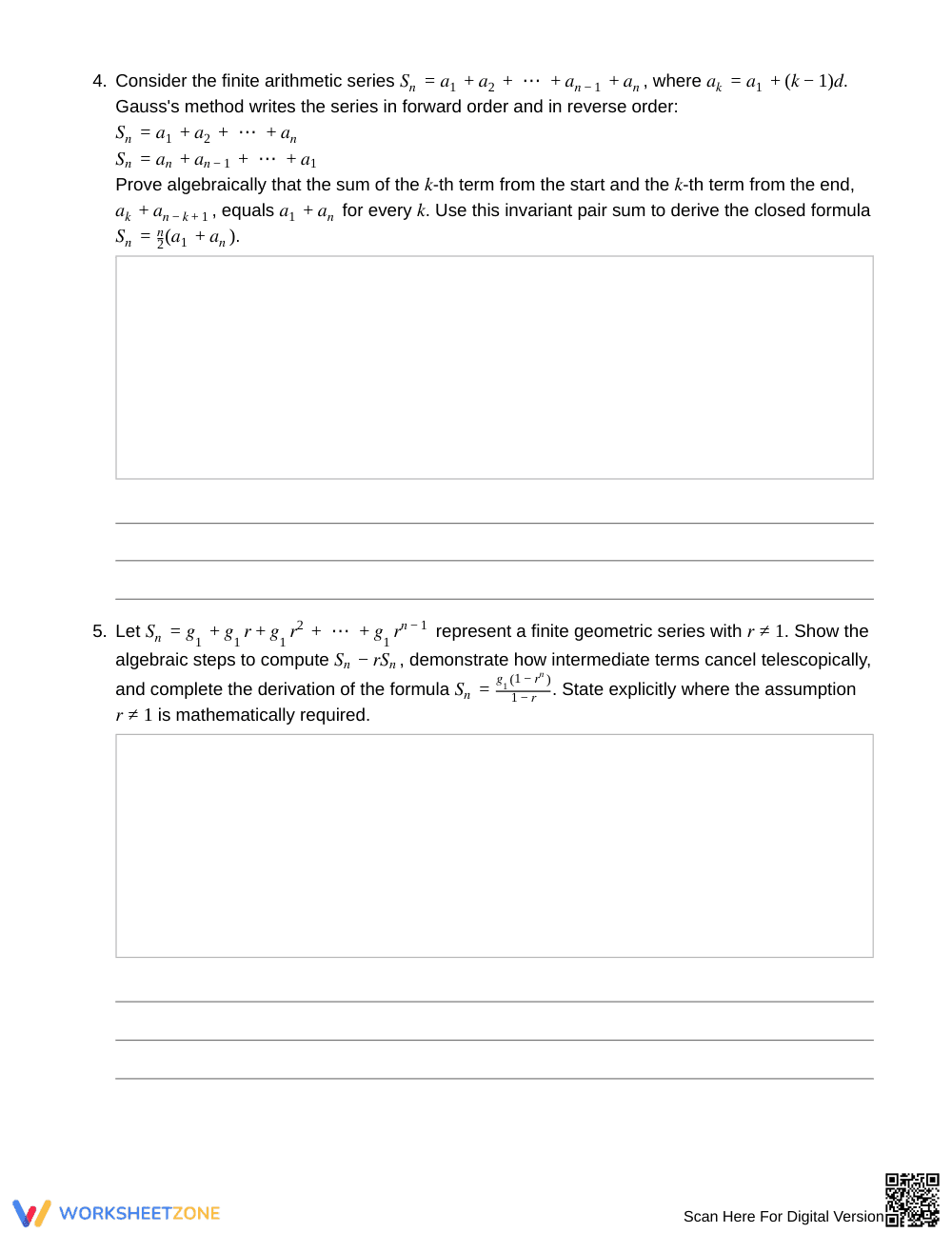
The 5-page worksheet begins with core definition boxes covering arithmetic and geometric formulas. Students complete 8 analytical problems across three parts, featuring algebraic claim testing, non-unit rate tables, Gauss and telescoping derivations, savings plan modeling, and counterexamples. A complete 4-page answer key provides worked proofs.
Skill Progression
- Guided Practice (Part A, 2 problems): Students test algebraic claims, verifying if exponentiating arithmetic sequences yields geometric growth and deducing terms from quadratic partial sums.
- Supported Practice (Part B, 4 problems): Learners write justifications for non-unit intervals, derive Gauss's pairing and telescoping sum formulas, and model college savings plans.
- Independent Practice (Part C, 2 problems): Students construct counterexamples to disprove sequence conjectures and determine boundary conditions when common ratios equal one.
This progression follows gradual-release principles, guiding students from claim verification to independent structural proof.
Standards Alignment
This worksheet aligns directly to `HSF-LE.A.1`: Prove that linear functions grow by equal differences over equal intervals, and that exponential functions grow by equal factors over equal intervals. It also supports `HSA-SSE.B.4` through finite geometric series derivations. Both standard codes can be copied directly into lesson plans, IEP goals, or district curriculum mapping tools.
How to Use It
Implement this worksheet after direct instruction on sequence formulas. Have students collaborate on Part A warm-ups before working through Part B proofs over 45 to 60 minutes. For formative assessment, verify whether students divide consecutive terms rather than subtracting when proving geometric behavior in Part A.
Who It's For
This worksheet suits Grade 11 Algebra II and Pre-Calculus students building formal proof skills. Provide an explicit formula reference sheet for students needing support, and challenge advanced learners to complete proofs without numerical scaffolding. It pairs effectively with direct instruction on exponential growth.
Mastering structural justification under standard HSF-LE.A.1—proving that linear functions grow by equal differences while exponential functions grow by equal factors—marks an essential shift in secondary mathematics from procedural computation to rigorous mathematical argument. According to research from EdReports 2024, instructional materials that require students to construct viable arguments and critique mathematical reasoning foster deeper structural fluency than rote algorithm practice. This 5-page Algebra II resource engages Grade 11 learners in proving whether discrete sequences exhibit constant unit differences or constant multiplicative ratios across 8 multi-step tasks. By testing algebraic conjectures, deriving Gauss's pairing method, analyzing telescoping series cancellation, and identifying boundary conditions where formulas fail, students build lasting conceptual understanding. High school learners move beyond memorizing rules by using counterexamples and formal algebraic manipulation to justify sequence structures, ensuring solid preparation for advanced STEM coursework in AP Calculus and discrete mathematics.


