































Essential Sequence Rules Worksheet | Grade 11 Algebra II

Paste this activity's link or code into your existing LMS (Google Classroom, Canvas, Teams, Schoology, Moodle, etc.).
Students can open and work on the activity right away, with no student login required.
You'll still be able to track student progress and results from your teacher account.
This Algebra II worksheet develops student mastery of recursive and explicit sequence rules through 16 analytical and computational problems. High school learners analyze arithmetic and geometric sequences, translate between recursive and closed-form equations, and evaluate series sums while solving authentic mathematical growth and decay scenarios.
At a Glance
- Grade: 11 · Subject: Algebra II
- Standard:
HSF-BF.A.2— Write arithmetic and geometric sequences recursively and explicitly- Skill Focus: Recursive and Explicit Sequence Rules
- Format: 5 pages · 16 problems · Answer key included · PDF
- Best For: High school sequences practice
- Time: 45–60 minutes
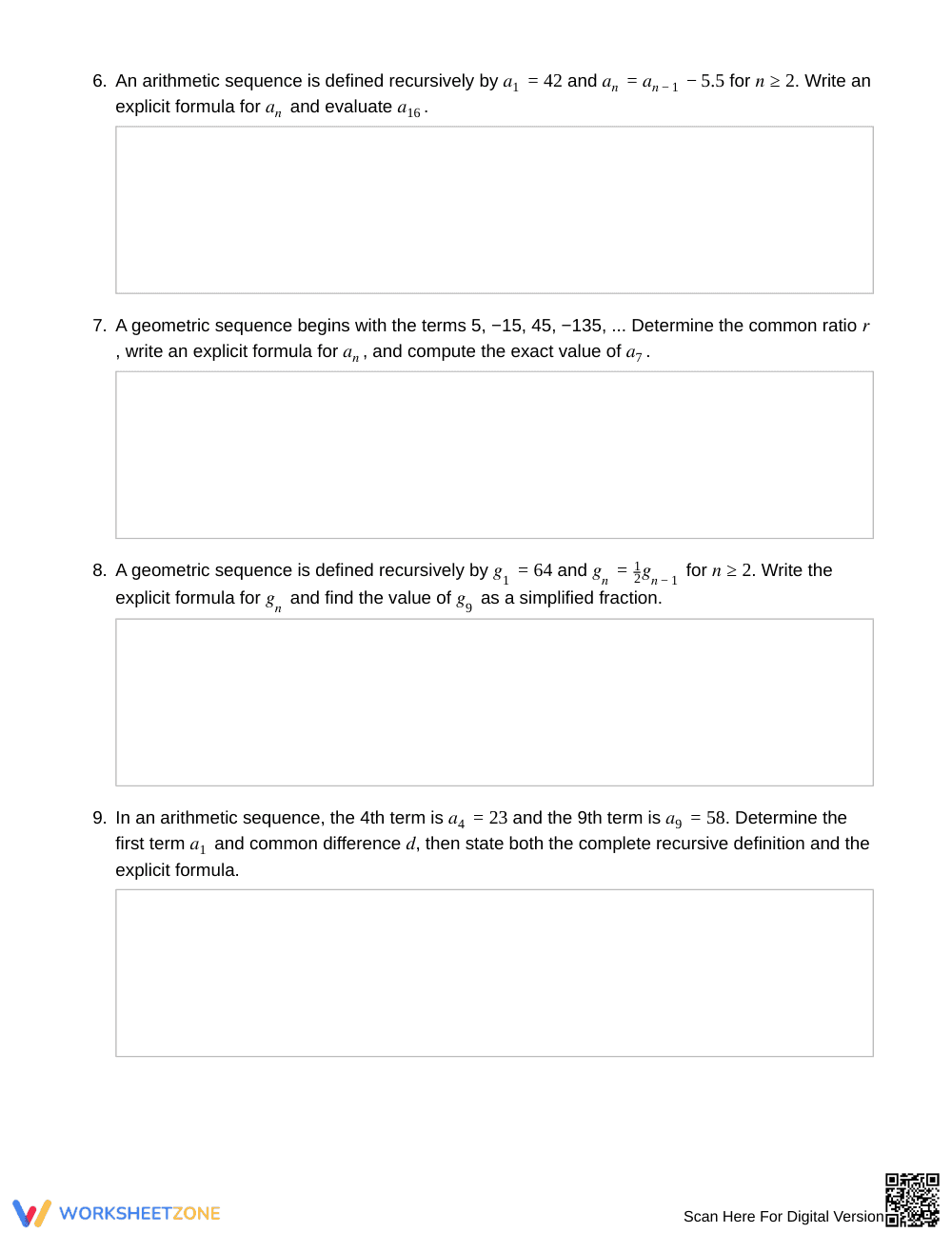
Inside this 5-page printable resource, students find a complete formula reference sheet followed by three tiered exercise sections. The resource features conceptual distinction prompts, indexing error analysis, multi-step formula conversions, and contextual word problems, paired with a complete 3-page step-by-step answer key.
Skill Progression
- Guided practice (Part A — 4 items): Targets conceptual distinctions and indexing error identification using the built-in reference table.
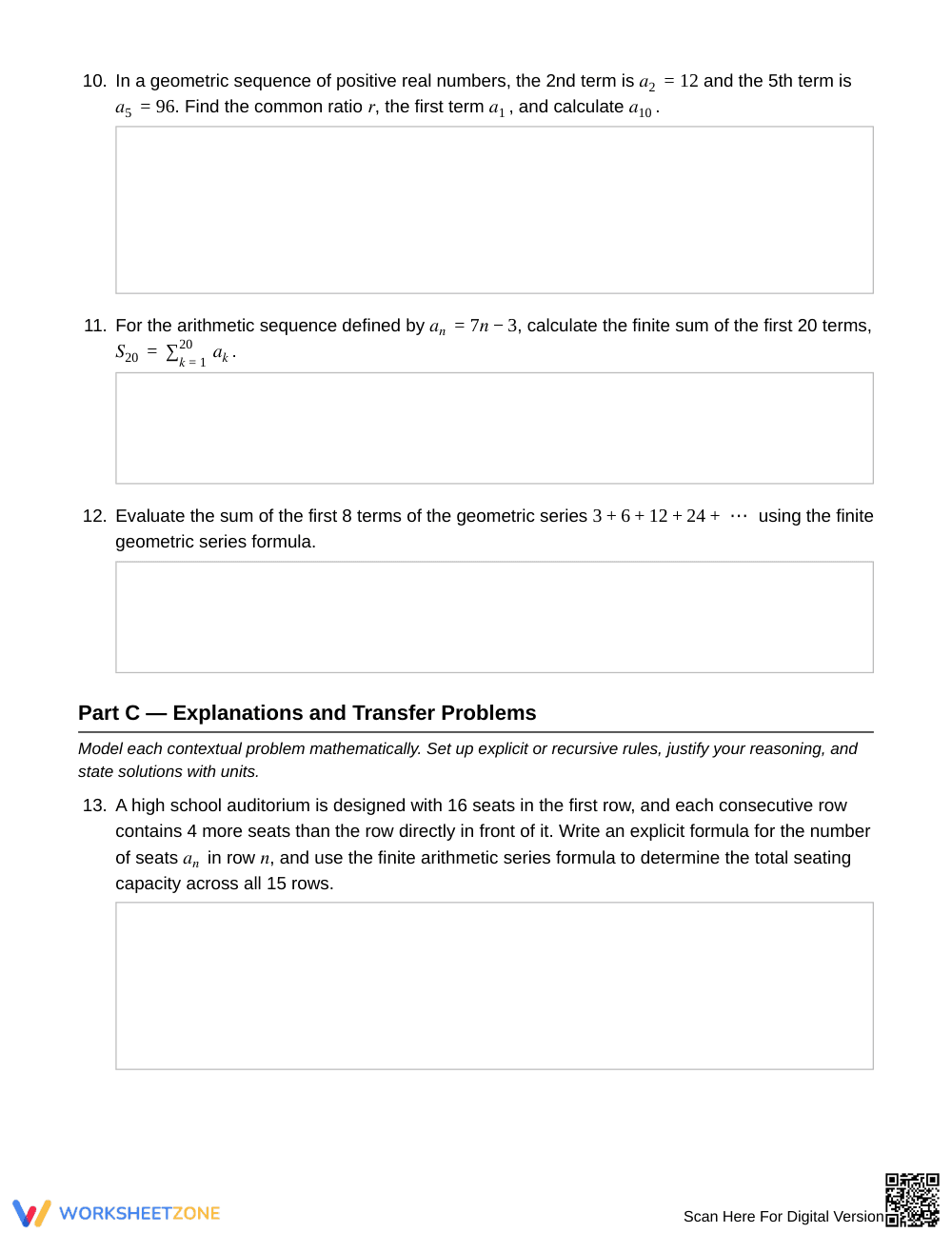
- Supported practice (Part B — 8 items): Guides algebraic conversions between recursive definitions and explicit formulas, missing term evaluation, and finite series calculations.
- Independent practice (Part C — 4 items): Applies explicit models to real-world contexts like auditorium seating capacity and chemical filtration decay.
This gradual-release structure transitions students systematically from core concepts to autonomous modeling.
Standards Alignment
This worksheet aligns directly with primary standard HSF-BF.A.2: Write arithmetic and geometric sequences both recursively and with an explicit formula, use them to model situations, and translate between the two forms. It also supports HSA-SSE.B.4 through finite series calculations. Both standard codes can be copied directly into lesson plans, IEP goals, or district curriculum mapping tools.
How to Use It
Use this worksheet after direct instruction on recursive definitions to reinforce procedural fluency. It functions effectively for paired classwork or independent practice during a 45–60 minute lesson. As a formative check, observe student index adjustments in Part A and Part C to catch exponent errors before testing.
Who It's For
Designed for Grade 11 Algebra II, Integrated Math III, or Precalculus students studying discrete sequences. Reference tables provide access for developing learners, while multi-step application tasks challenge advanced students. Pair this resource with a foundational lesson on linear versus exponential functions for optimal conceptual transfer.
According to research by Fisher & Frey (2014) on effective gradual-release instructional architecture, structured mathematical practice that purposefully shifts cognitive load from conceptual identification to autonomous problem-solving significantly strengthens high schoolers' algebraic reasoning and retention. Aligned to standard HSF-BF.A.2, this curriculum resource guides learners through the essential skill of constructing, analyzing, and translating between recursive definitions and explicit sequence rules for arithmetic and geometric progressions. Students systematically investigate term position indexing, calculate partial series sums, and evaluate real-world decay functions across 16 scaffolded problems. By confronting common index misconceptions and applying formulas across multi-step modeling tasks, students build the deep operational fluency necessary for subsequent study in precalculus and calculus series analysis. The structured progression guarantees that students synthesize both the discrete recursive steps and continuous functional representations of numerical patterns.


