




























Views
Downloads


Essential Sentence Combining Worksheet | Grade 6 ELA

Paste this activity's link or code into your existing LMS (Google Classroom, Canvas, Teams, Schoology, Moodle, etc.).
Students can open and work on the activity right away, with no student login required.
You'll still be able to track student progress and results from your teacher account.
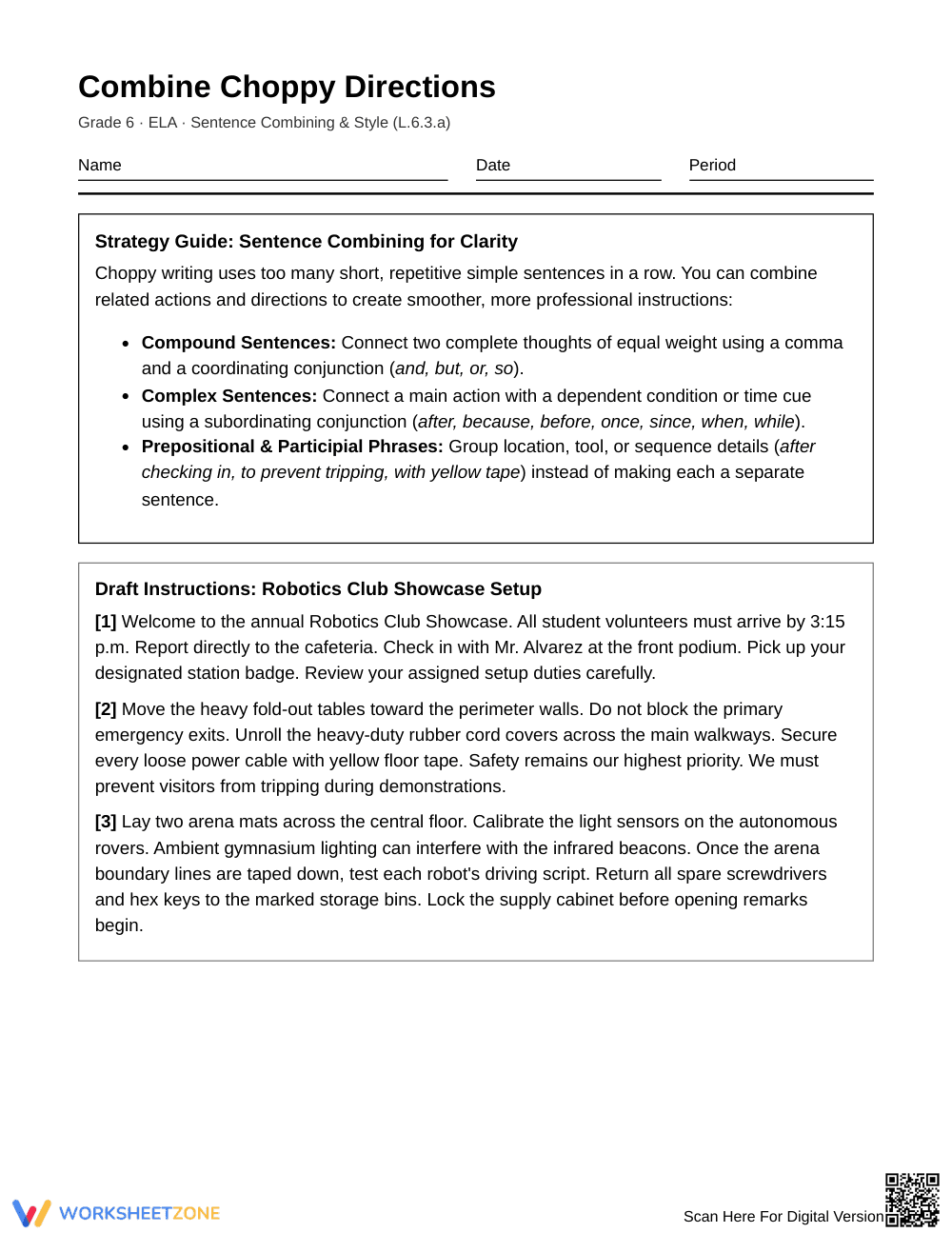
This Grade 6 grammar worksheet teaches middle school writers to diagnose and revise repetitive, choppy directions into cohesive, varied instructional prose. Students practice combining simple clauses using coordinating conjunctions, subordinating conjunctions, compound predicates, and introductory prepositional phrases to enhance readability, establish logical relationships, and maintain an authentic informational tone across authentic procedural texts.
At a Glance
- Grade: 6 · Subject: ELA
- Standard:
L.6.3.a— Vary sentence patterns for meaning, reader interest, and style- Skill Focus: Combining choppy sentences and directions
- Format: 5 pages · 12 problems · Answer key included · PDF
- Best For: Targeted grammar and revision lessons
- Time: 30–45 minutes
What's Inside
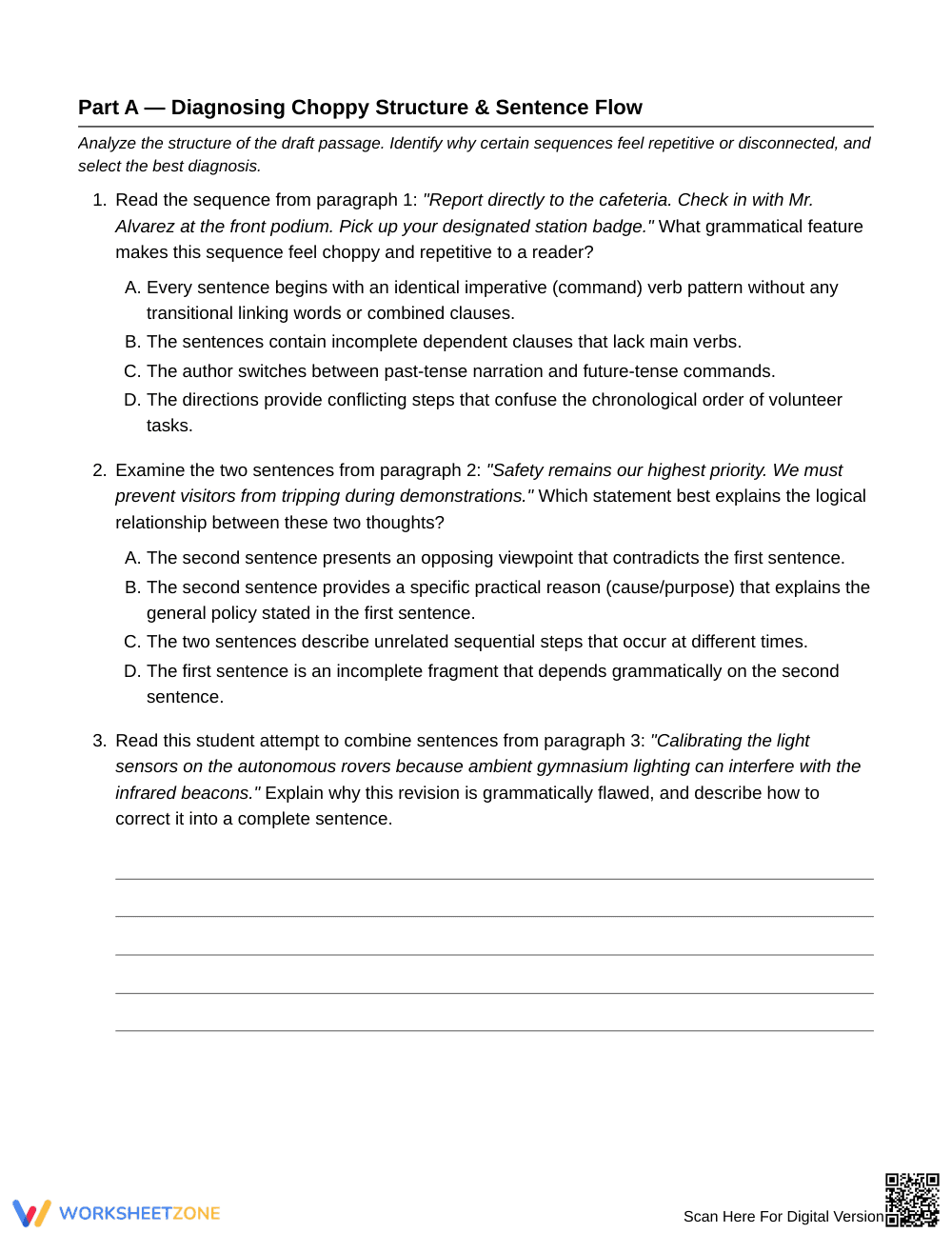
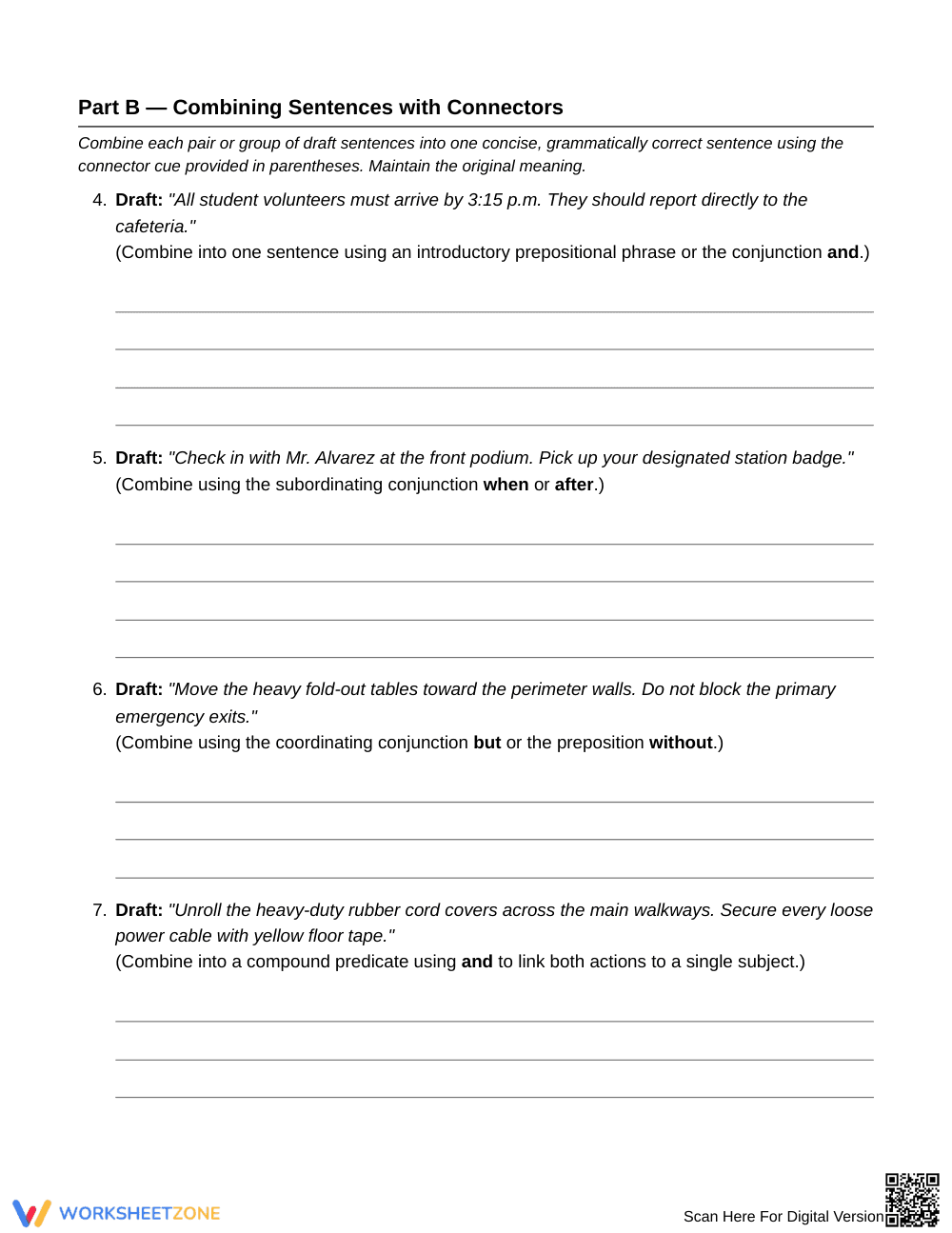
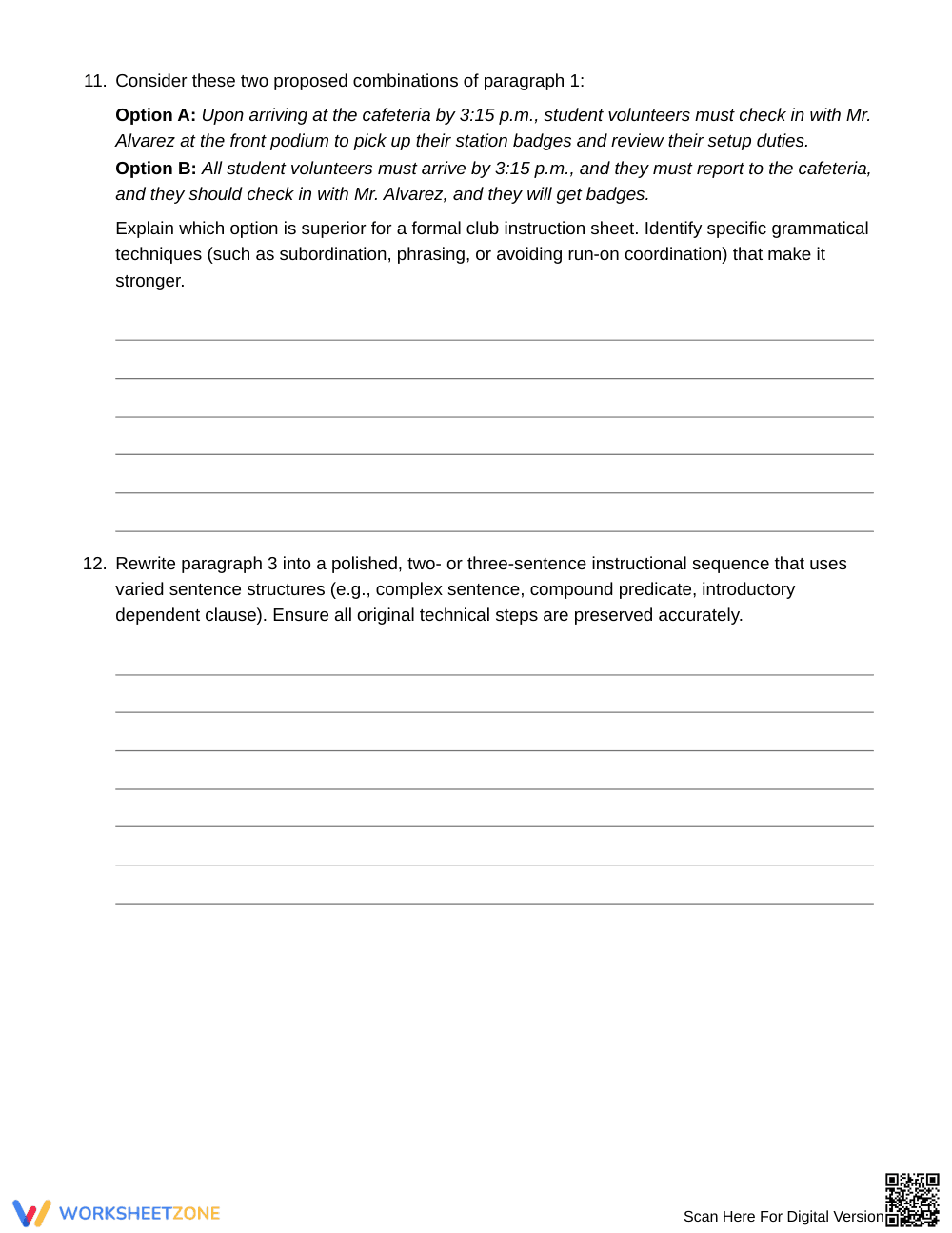
The resource features a concise instructional strategy guide defining compound sentences, complex sentences, and phrase integration alongside an authentic three-paragraph draft passage detailing robotics setup procedures. Across 12 structured tasks, students complete multiple-choice structural diagnoses, prompt-guided clause combinations, and analytical revision justifications, supported by a full 3-page explanatory answer key.
Skill Progression
- Guided Practice (Part A, 3 items): Students analyze authentic text excerpts to identify repetitive imperative patterns, determine causal relationships, and diagnose dependent clause fragments.
- Supported Practice (Part B, 6 items): Writers combine targeted sentence pairs using specific grammatical constraints, including subordinating conjunctions, compound predicates, and introductory phrases.
- Independent Practice (Part C, 3 items): Learners evaluate stylistic choices between competing revisions, justify syntactical improvements, and rewrite an entire instructional paragraph from scratch.
This structured sequence follows a gradual-release model, moving from analytical identification to direct application and independent synthesis.
Standards Alignment
Primary Standard: `L.6.3.a` — Vary sentence patterns for meaning, reader interest, and style. This worksheet also reinforces `W.6.5` by requiring students to strengthen draft writing through planning, revising, and editing syntax. Both standard codes can be copied directly into lesson plans, IEP goals, or district curriculum mapping tools.
How to Use It
Deploy this activity directly after whole-group instruction on compound and complex sentence structures, or assign it during a writing revision workshop before publishing procedural compositions. When circulating during formative practice, check Part B items to ensure students place commas accurately before coordinating conjunctions in compound sentences. Expected completion time is 30 to 45 minutes.
Who It's For
Designed for general education Grade 6 ELA classrooms, this resource supports emerging writers who overuse short simple sentences as well as advanced students refining their stylistic voice. It pairs naturally with informational writing units, procedural mentor texts, and punctuation anchor charts.
According to research synthesized by Fisher & Frey (2014), explicit instruction in sentence combining significantly bolsters syntactic maturity, reading comprehension, and overall writing quality for adolescent learners. Rather than studying isolated grammatical definitions, middle school students benefit most from evaluating and manipulating real sentence structures within authentic rhetorical contexts. This worksheet addresses standard L.6.3.a by giving sixth-grade writers 12 focused opportunities to vary sentence patterns, eliminate choppy syntax, and establish logical connections using subordinating conjunctions, compound structures, and prepositional phrases. By transitioning from diagnostic analysis to guided sentence combination and full-paragraph revision, students gain the procedural fluency needed to edit their own writing for clarity, flow, and stylistic precision.


