































Essential Pseudoreplication Worksheet | Grade 12 Statistics

Paste this activity's link or code into your existing LMS (Google Classroom, Canvas, Teams, Schoology, Moodle, etc.).
Students can open and work on the activity right away, with no student login required.
You'll still be able to track student progress and results from your teacher account.
This advanced experimental design worksheet equips Grade 12 Statistics students to diagnose and correct critical methodological errors in research studies. Students analyze real-world scenarios to differentiate experimental units from observational units, identify confounding variables, and redesign flawed experiments to ensure inferential validity and statistical integrity.
At a Glance
- Grade: 12 · Subject: Statistics
- Standard:
HSS-IC.B.3— Distinguish sample surveys, experiments, and observational studies, explaining how randomization controls bias- Skill Focus: Correcting Confounding and Pseudoreplication
- Format: 5 pages · 10 problems · Answer key included · PDF
- Best For: AP Statistics experimental design review
- Time: 45–60 minutes
What's Inside
The 5-page worksheet opens with core concept definitions and an annotated worked example modeling study correction. Students examine five research scenarios covering agriculture, standardized testing, material science, and education. Across 10 structured analytical tasks, learners perform diagnostic error analysis and build complete methodological redesigns, supported by a 5-page detailed answer key.
Skill Progression
- Guided Practice: Students review definitions and a worked example analyzing pseudoreplication in coral tank experiments.
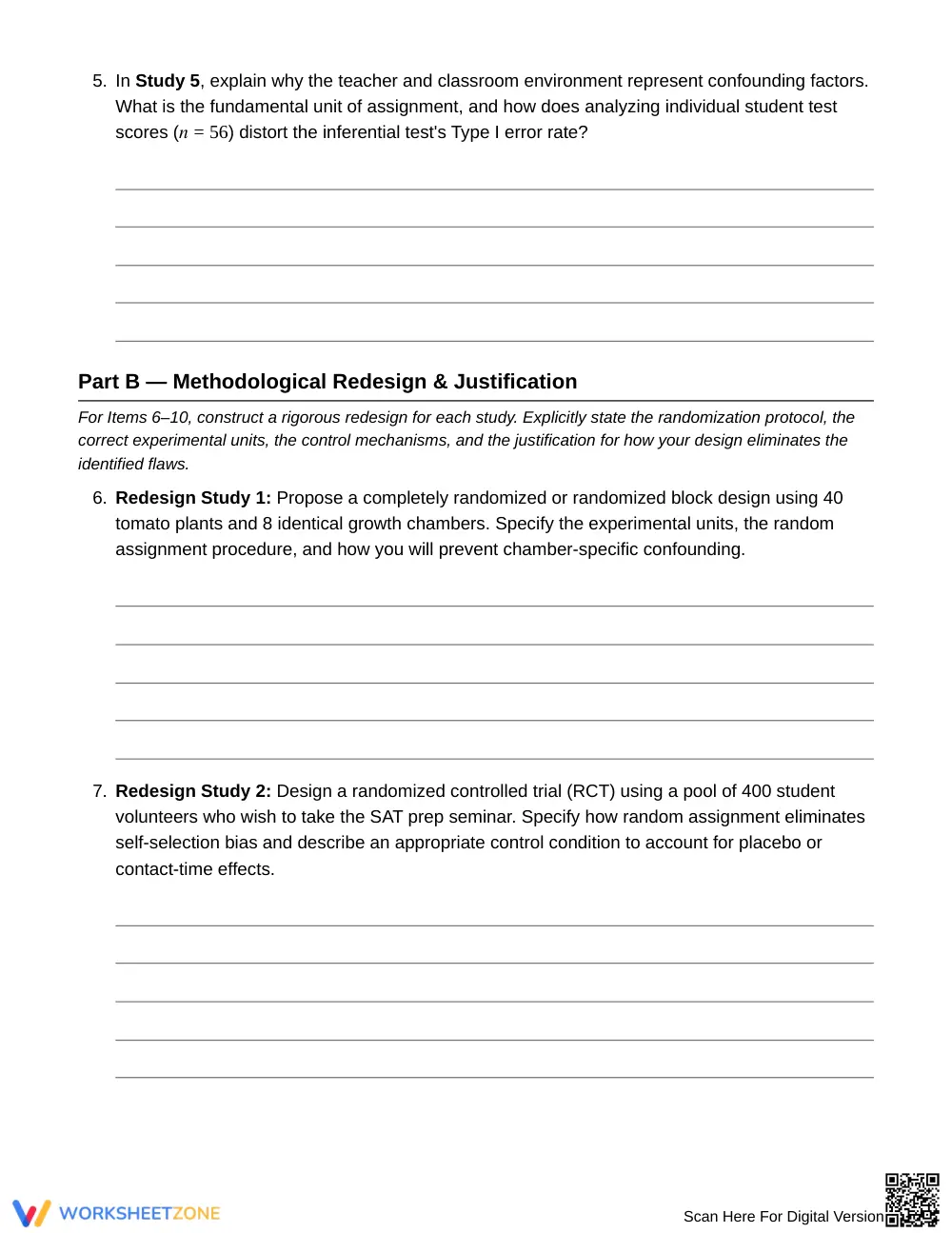
- Supported Practice (Tasks 1–5): Students identify unmeasured confounders, distinguish experimental units from subsamples, and trace Type I error inflation across five flawed studies.
- Independent Practice (Tasks 6–10): Students author complete experimental redesigns using randomized controlled protocols, blocking, and multi-batch structures.
This progression follows a gradual-release model, advancing students from diagnostic critique to independent experimental architecture.
Standards Alignment
Aligned to CCSS.MATH.CONTENT.HSS-IC.B.3: Recognize the purposes of and differences among sample surveys, experiments, and observational studies; explain how randomization relates to each. Both standard codes can be copied directly into lesson plans, IEP goals, or district curriculum mapping tools.
How to Use It
Assign after introductory instruction on experimental design and lurking variables. Have students complete Part A in pairs and Part B independently. Formatively check whether students correctly identify the randomized treatment unit rather than measurement units. Completion takes approximately 45 to 60 minutes.
Who It's For
Built for Grade 12 Statistics and AP Statistics students mastering experimental validity. Advanced learners engage with clustering effects, while the worked example supports developing students. Pair with direct instruction lessons on randomized blocking.
According to Fisher & Frey (2014), structured error analysis and guided redesign tasks accelerate metacognitive transfer in complex analytical disciplines. This Grade 12 statistics resource directly operationalizes standard HSS-IC.B.3 by requiring students to distinguish experimental units from observational subsamples and correct confounding variables in experimental design. Rather than relying on rote vocabulary recall, learners evaluate five authentic scientific scenarios, examine the inferential hazards of inflated degrees of freedom, and formulate valid randomized protocols. Research demonstrates that confronting common methodological misconceptions through gradual-release problem sets deepens statistical literacy and prepares high school seniors for collegiate empirical inquiry. By transitioning from diagnostic critique to full procedural redesign across 10 rigorous tasks, students master the causal logic required to evaluate scientific claims critically and construct statistically sound research investigations across diverse STEM and social science domains.


