
































Essential Projectile Motion Worksheet | Grades 8-12 Science

Paste this activity's link or code into your existing LMS (Google Classroom, Canvas, Teams, Schoology, Moodle, etc.).
Students can open and work on the activity right away, with no student login required.
You'll still be able to track student progress and results from your teacher account.
This projectile motion worksheet helps physical science students master two-dimensional kinematics by separating horizontal and vertical motion. Learners classify flight scenarios, analyze trajectory vectors, and evaluate how launch angles govern maximum height, flight duration, and horizontal range across 24 structured kinematics questions.
At a Glance
- Grade: Grades 8–12 · Subject: Science
- Standard:
Forces and Motion— Analyze two-dimensional projectile paths by separating independent horizontal and vertical motions.- Skill Focus: Projectile classification, velocity vectors, and launch angle relationships
- Format: 4 pages · 24 problems · Answer key included · PDF
- Best For: Physics unit practice or kinematics review
- Time: 45–60 minutes
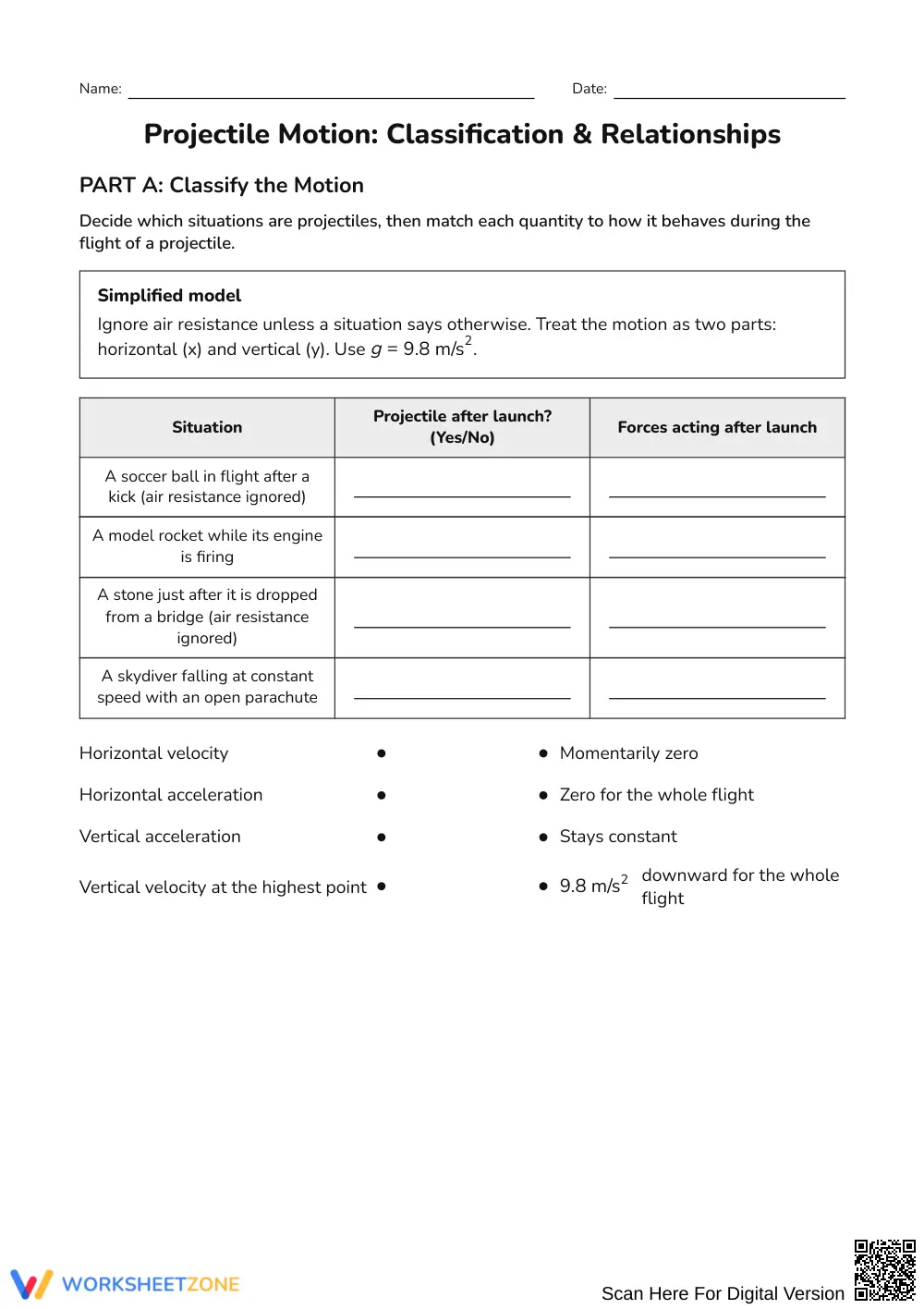
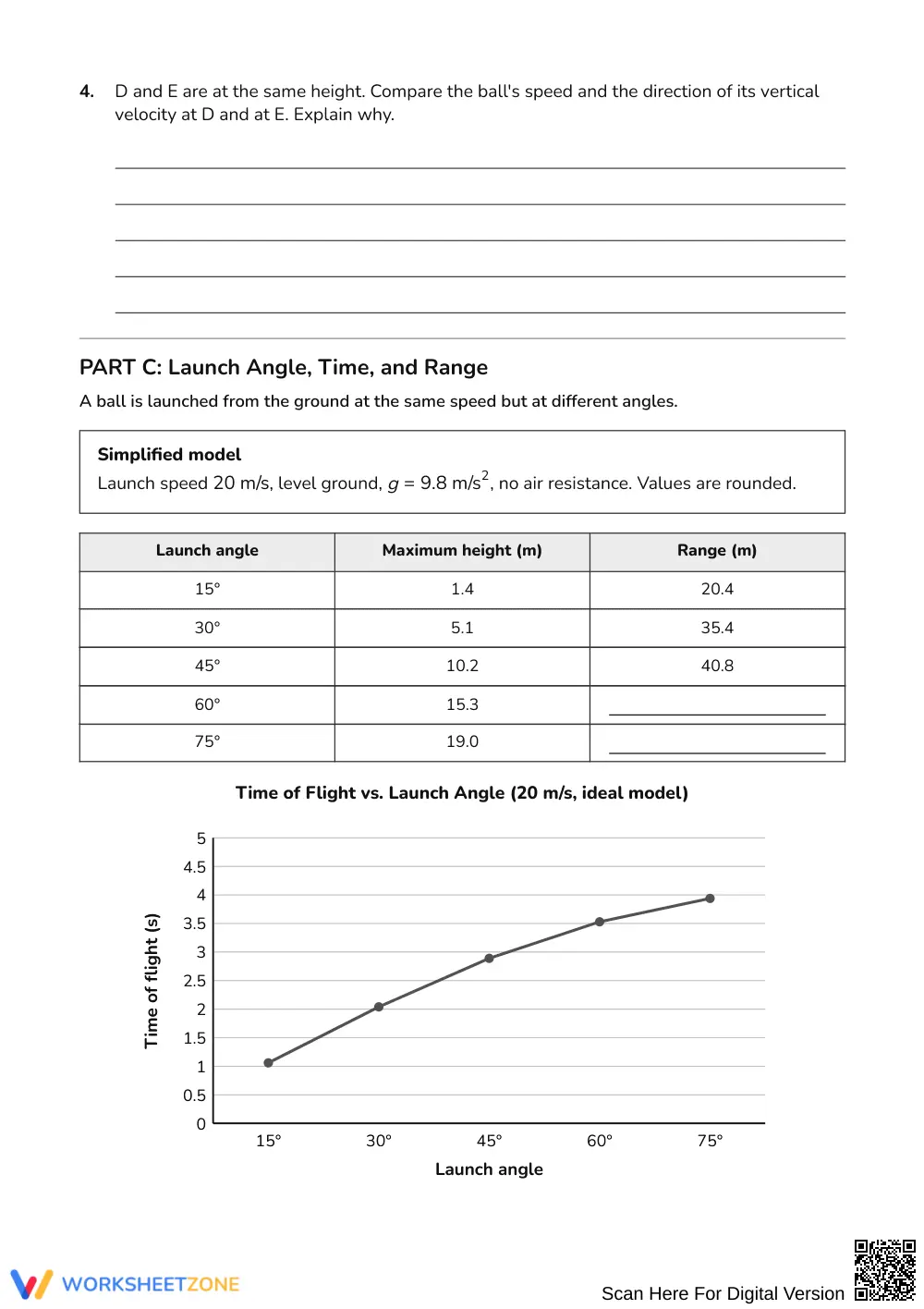
The 4-page activity packet features 24 structured items organized into three targeted parts. Students begin with a classification chart distinguishing true projectiles from propelled objects, progress to vector analysis along a trajectory diagram, and conclude by interpreting launch data tables and flight graphs to evaluate hang time and range.
Skill Progression
- Guided practice (Part A): Students classify four everyday situations as projectiles or non-projectiles and identify acting forces using a modeled reference box.
- Supported practice (Part B): Using a labeled trajectory diagram, students answer targeted prompts analyzing gravitational acceleration and velocity symmetry at matched heights.
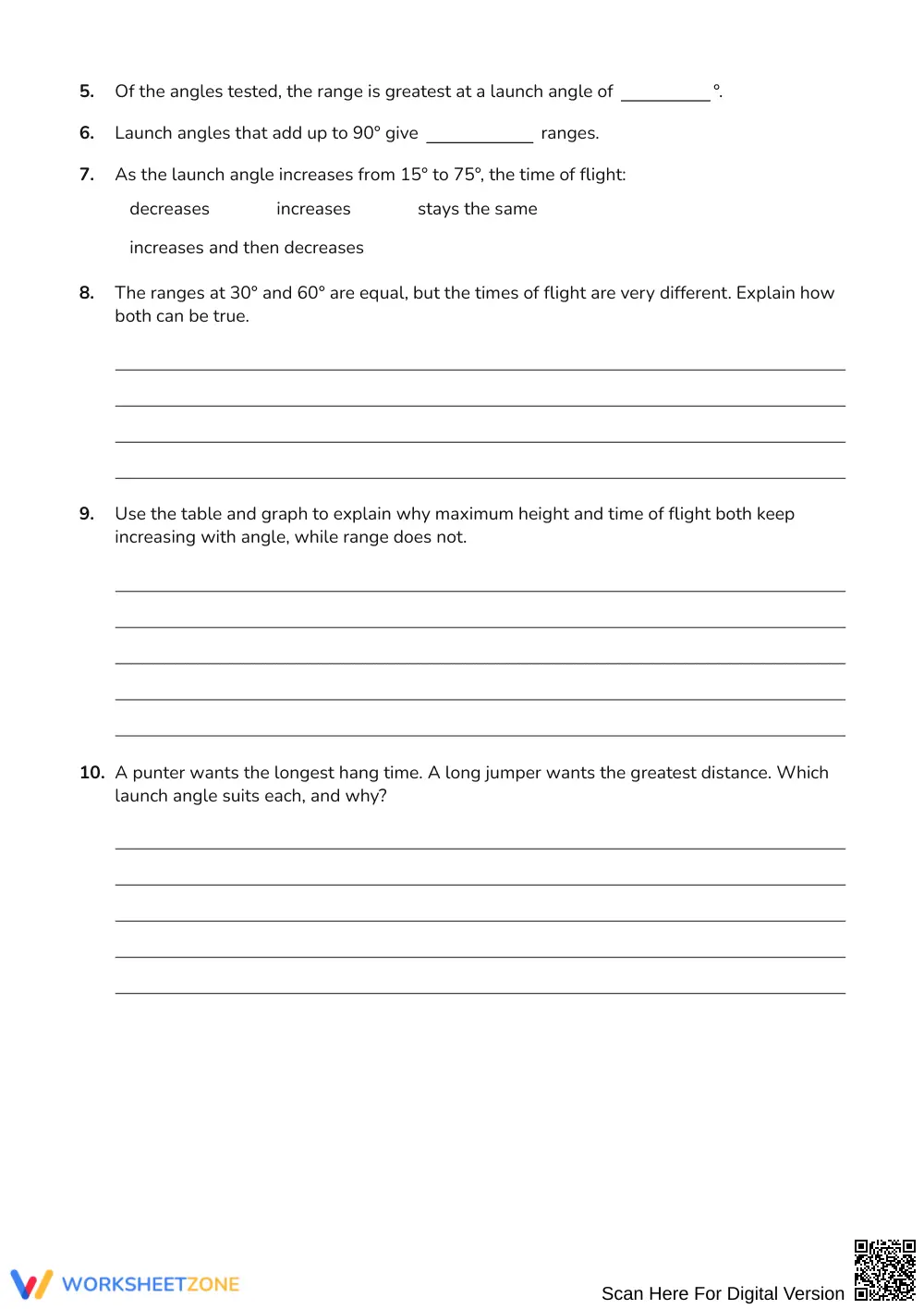
- Independent practice (Part C): Learners analyze numerical launch data and coordinate graphs to explain complementary angles and athletic trajectory trade-offs.
This sequence implements a gradual-release framework that moves students from basic definitions to deep conceptual reasoning.
Standards Alignment
This resource aligns with high school physical science standards for forces and motion, focusing on analyzing motion data to demonstrate that horizontal and vertical components operate independently. A supporting standard addresses constructing explanations using velocity, acceleration, and force vectors. Both standard codes can be copied directly into lesson plans, IEP goals, or district curriculum mapping tools.
How to Use It
Assign this worksheet following direct instruction on 2-D kinematics to reinforce constant horizontal velocity under gravity, or use it as a mid-unit checkpoint. During work time, observe how students explain equal ranges for complementary angles in Part C to verify conceptual mastery. Completion takes 45 to 60 minutes.
Who It's For
Designed for introductory physics, conceptual physics, and advanced 8th-grade physical science classes. Qualitative prompts support developing learners before formula-heavy calculations, while data synthesis challenges advanced students. Pair this worksheet directly with a digital trajectory simulation or lab demonstration.
Mastering projectile motion requires learners to decompose two-dimensional trajectory paths into independent horizontal and vertical vector components. Research by Fisher & Frey (2014) highlights that guided instructional progressions—moving systematically from qualitative categorization to data analysis and open response justification—yield significant gains in student conceptual retention. By first establishing that gravity acts exclusively in the vertical dimension, students overcome widespread misconceptions regarding horizontal propulsion forces. In this 4-page resource, students examine 24 structured tasks that classify flight conditions, track velocity shifts along parabolic curves, and interpret numerical data tables comparing launch angles, hang times, and horizontal displacements. This progression reinforces critical physical science standards, equipping secondary physics students to construct evidence-based scientific explanations for complex kinematics scenarios before transitioning to mathematical problem solving. As a result, teachers gain actionable diagnostic data on student conceptual readiness.


