































Essential Projectile Motion Worksheet | Grade 8-12 Science

Paste this activity's link or code into your existing LMS (Google Classroom, Canvas, Teams, Schoology, Moodle, etc.).
Students can open and work on the activity right away, with no student login required.
You'll still be able to track student progress and results from your teacher account.
This projectile motion worksheet guides secondary science students through experimental design, kinematic modeling, and graphical data analysis. Learners isolate variables, calculate velocity components, and evaluate evidence showing that horizontal and vertical motions operate independently. The 19 structured tasks build scientific reasoning skills across four complete pages.
At a Glance
- Grade: 8–12 · Subject: Science
- Standard: Secondary Physics — Plan and conduct investigations to analyze relationships among speed, time, and distance
- Skill Focus: Experimental design, variable identification, and projectile motion analysis
- Format: 4 pages · 19 problems · Answer key included · PDF
- Best For: Physics lab prep or kinematic concept review
- Time: 45–60 minutes
Inside, students analyze a four-part inquiry sequence centered on a marble launched horizontally from a table. The four-page packet features 19 scaffolded questions spanning variable matching, short justifications, vector analysis, and slope calculations. A four-page teacher answer key provides full solutions, worked formulas, and sample error explanations for rapid grading.
Skill Progression
- Guided practice (Tasks 1–4): Students analyze a laboratory scenario to define the experimental question, match independent and dependent variables, and formulate a testable "If... then... because" hypothesis.
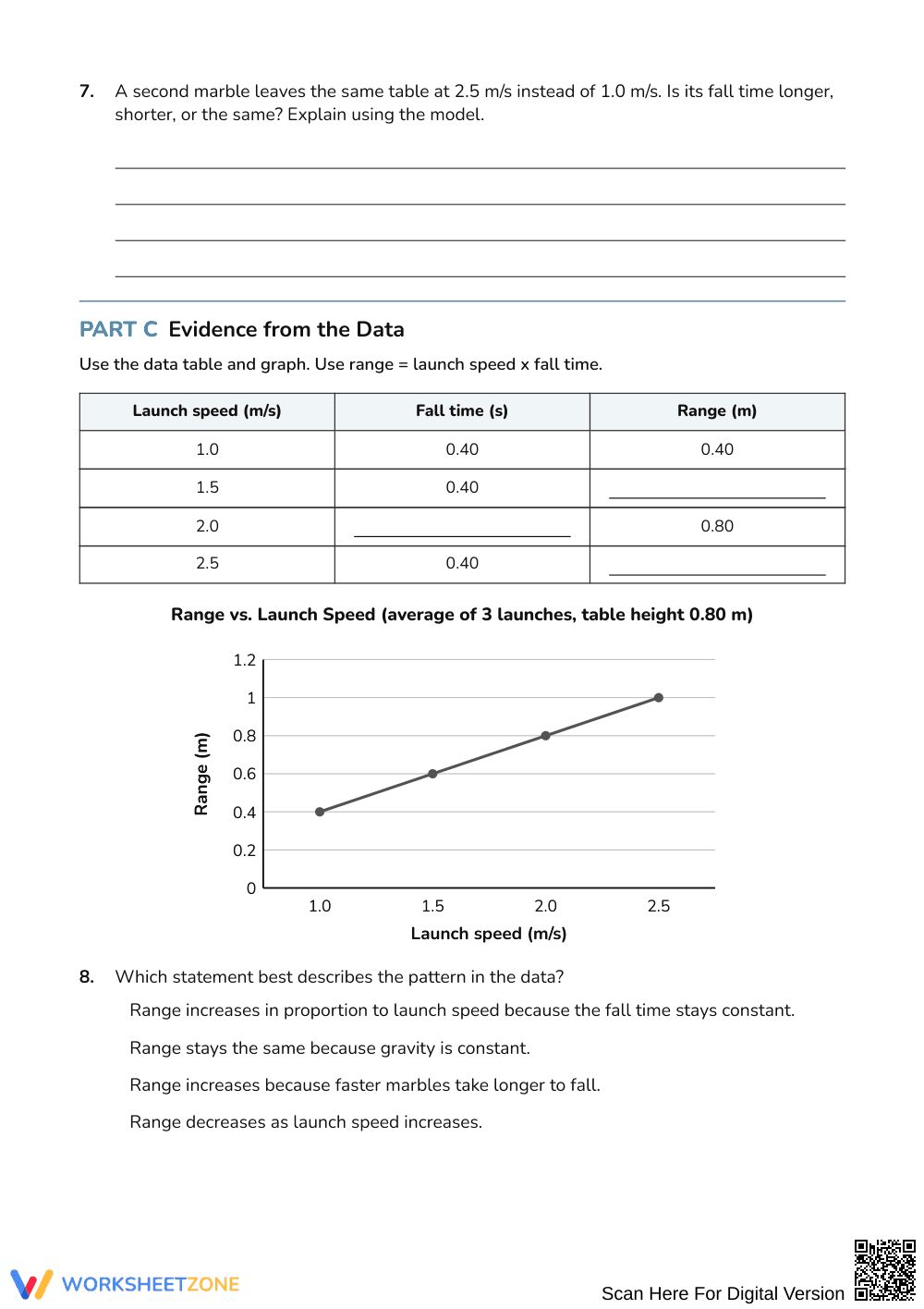
- Supported practice (Tasks 5–10): Learners apply kinematic formulas to examine vertical fall time, evaluate velocity vectors, and calculate horizontal ranges from a calibrated data table.
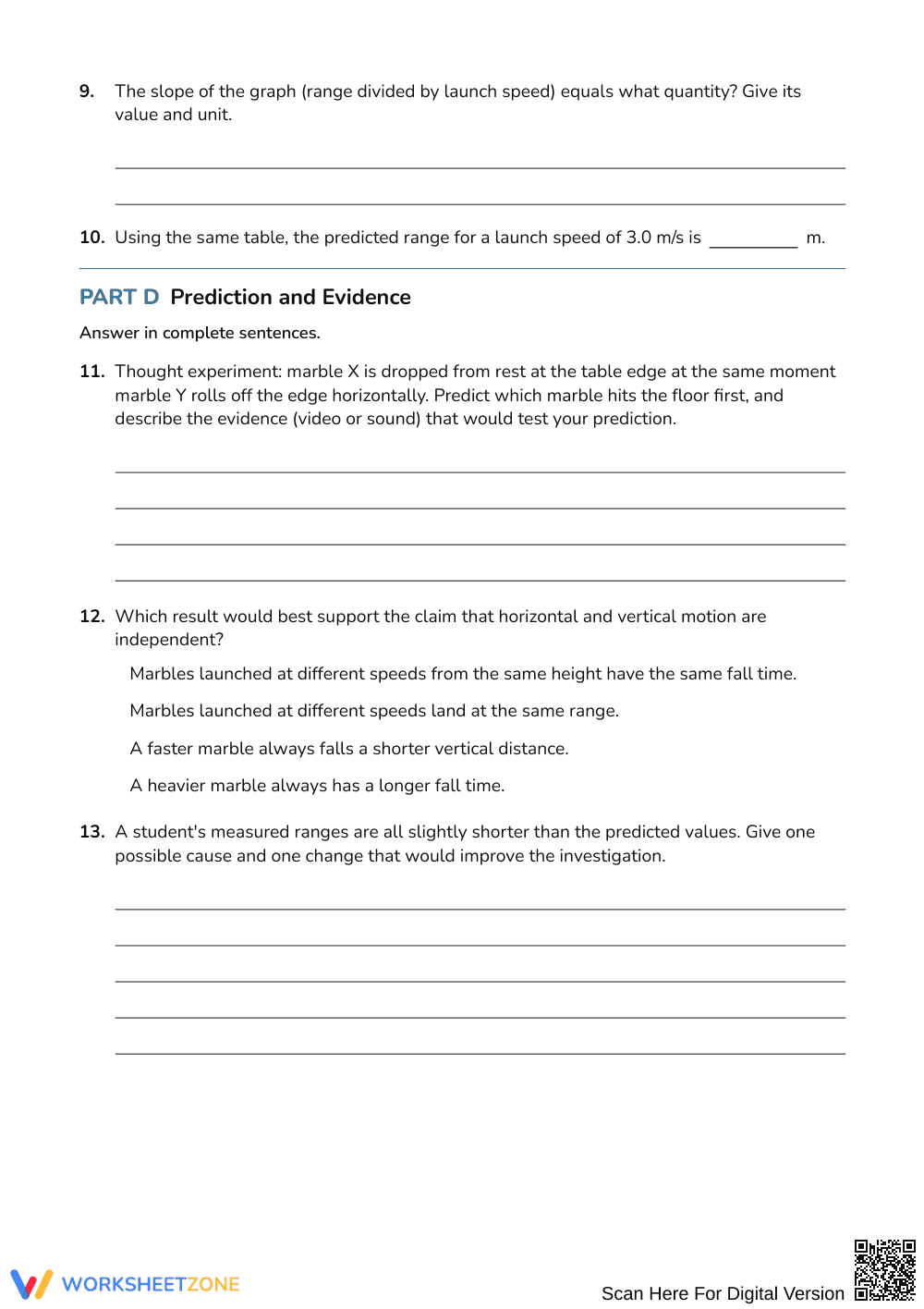
- Independent practice (Tasks 11–19): Students interpret graph slopes, resolve a two-marble drop thought experiment, and identify sources of measurement error without procedural prompts.
This sequence mirrors the gradual release of responsibility model, guiding students systematically from guided experimental design to independent theoretical synthesis.
Standards Alignment
This resource aligns with secondary physical science standards addressing kinematics, gravitational acceleration, and experimental design methodologies. Students systematically examine how vertical motion functions independently of horizontal speed. These core inquiry expectations can be copied directly into lesson plans, IEP goals, or district curriculum mapping tools.
How to Use It
Use this worksheet as a structured pre-lab activity before running hands-on ramp experiments, ensuring students understand controls before collecting data. Alternatively, assign it after direct kinematic instruction for independent review. Monitor whether students mistakenly adjust vertical fall times based on launch speed to catch vector misconceptions. The 19 problems require approximately 45 to 60 minutes to complete.
Who It's For
This resource serves Grades 8–12 physical science and physics classrooms. For struggling students, provide a graphic organizer separating horizontal and vertical variables; advanced learners can calculate landing distances under varied launch heights. Pair this packet with a physical ramp demonstration to reinforce key kinematic principles.
Secondary physics education requires deliberate scaffolds to help students decouple orthogonal motion components and internalize experimental control logic. As demonstrated by Fisher & Frey (2014) in their research on the gradual release of responsibility, structured transitions from guided variable identification to independent graphical analysis significantly strengthen conceptual retention in STEM domains. This 19-task projectile motion worksheet operationalizes that pedagogical framework by moving learners methodically through testable question framing, formulaic fall-time calculation, and evidence-based thought experiments. By isolating horizontal velocity from vertical gravitational acceleration, students confront pervasive intuitive misconceptions about falling bodies while grounding their reasoning in empirical data sets. The inclusion of multi-step graphical interpretation, slope deduction, and experimental error analysis ensures that learners cultivate both foundational inquiry habits and rigorous mathematical fluency. Teachers can deploy this focused instructional sequence to prepare students for formal laboratory reporting and standards-based physical science assessments.


