




























Views
Downloads


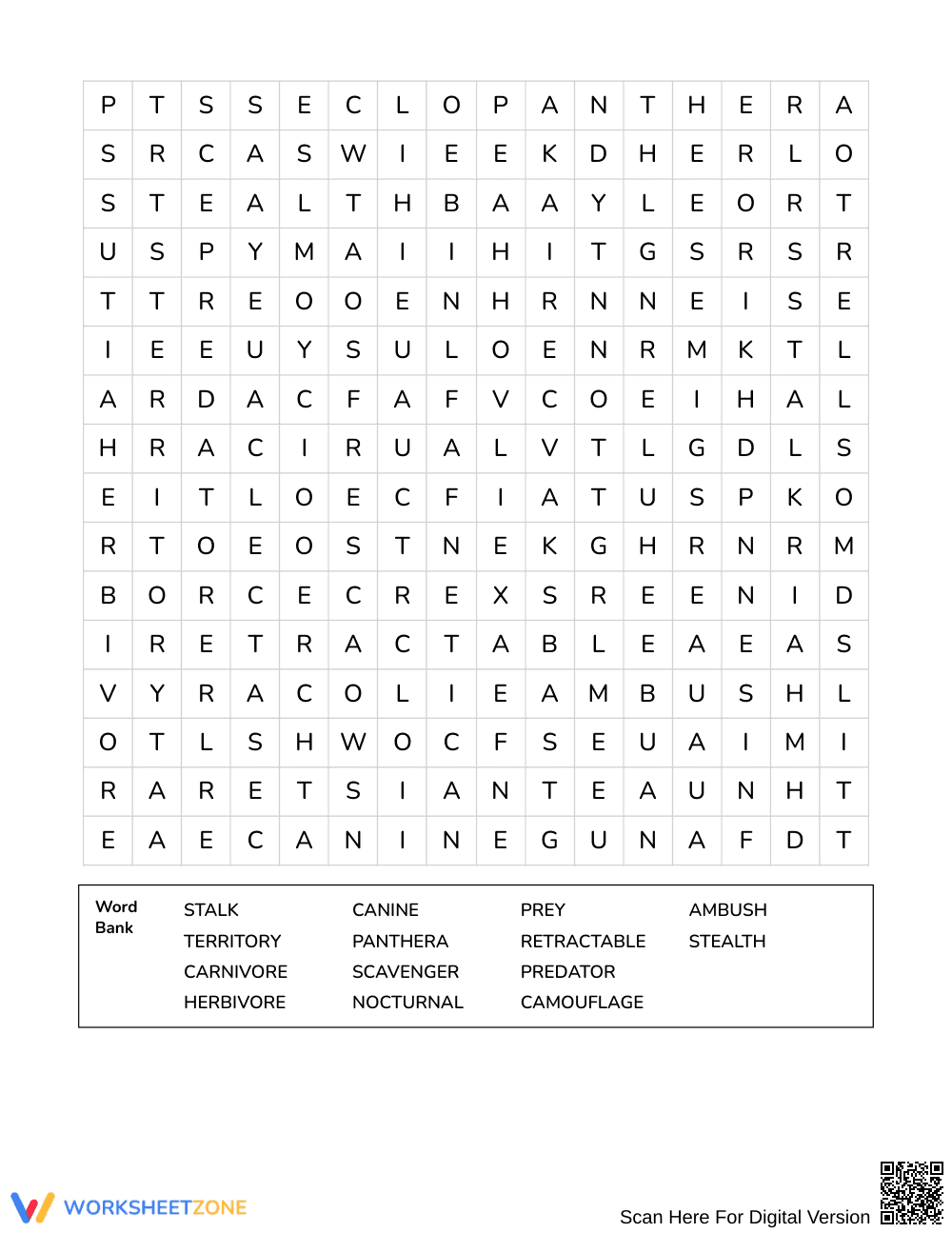

Essential Predator-Prey Word Search | Grades 4–5 Science

Paste this activity's link or code into your existing LMS (Google Classroom, Canvas, Teams, Schoology, Moodle, etc.).
Students can open and work on the activity right away, with no student login required.
You'll still be able to track student progress and results from your teacher account.
This predator and prey science word search challenges upper elementary learners to decode definitions and locate key ecological terminology. Students reinforce domain-specific vocabulary by matching scientific descriptions to foundational animal adaptation concepts, strengthening their reading comprehension across life science topics.
At a Glance
- Grade: Grades 4–5 · Subject: Science
- Standard: Not standards-assessed — vocabulary enrichment
- Skill Focus: Predator and prey vocabulary
- Format: 3 pages · 14 words · Answer key included · PDF
- Best For: Vocabulary review or sub plan
- Time: 20–30 minutes
What's Inside: The resource features a Clue Detective format containing 14 hidden science terms embedded in a 16 by 16 letter grid. Rather than scanning a simple list, students read 14 rigorous clues to identify each vocabulary word before finding it. The download includes a complete 3-page solution key displaying exact word placements.
Puzzle Mechanics: Words are placed across a 16 by 16 grid in four distinct orientations: northeast, east, southeast, and south. Students work from a clue bank covering behavioral adaptations, anatomical traits, and food web classifications. Learners solve clues for terms like carnivore, camouflage, and nocturnal, then hunt through letter pathways without confusing backward diagonals.
Standards Alignment: This activity serves as science vocabulary enrichment and is not aligned to a formal standard. It supplements life science units by cementing foundational terms through contextual clues and repetitive visual scanning.
How to Use It: Deploy this activity during independent practice after direct instruction on food chains, or assign it as a self-contained sponge activity for early finishers. For formative assessment, inspect student papers before grid searching to ensure learners correctly associate each descriptive clue with the accurate scientific term. Expect 20 to 30 minutes for complete clue decoding and puzzle resolution.
Who It's For: Designed for Grades 4–5 science classes, this puzzle supports general education students, gifted learners seeking enrichment, and multilingual learners practicing scientific language. Pair this puzzle with an introductory text on big cat hunting adaptations or an animal behavior anchor chart.
Scientific literacy in late elementary classrooms depends heavily on acquiring specialized, domain-specific terminology. According to EdReports 2024, regular engagement with content vocabulary through contextual definitions solidifies informational text comprehension and supports long-term memory retention. This clue-based word search blends definitional analysis with active search mechanics, requiring students to interpret anatomical terms such as canine and behavioral concepts like ambush before identifying their visual spelling patterns. Incorporating explicit clue-solving mechanisms ensures students focus on authentic semantic meaning rather than passive letter tracking. The resource provides accessible, self-directed vocabulary exposure that supports upper elementary science instruction, strengthens conceptual recall across diverse student populations, and serves as an effective, low-stress reinforcement tool within life science units.


