





























Essential Physical vs Chemical Worksheet | Grade 7 Science
Paste this activity's link or code into your existing LMS (Google Classroom, Canvas, Teams, Schoology, Moodle, etc.).
Students can open and work on the activity right away, with no student login required.
You'll still be able to track student progress and results from your teacher account.
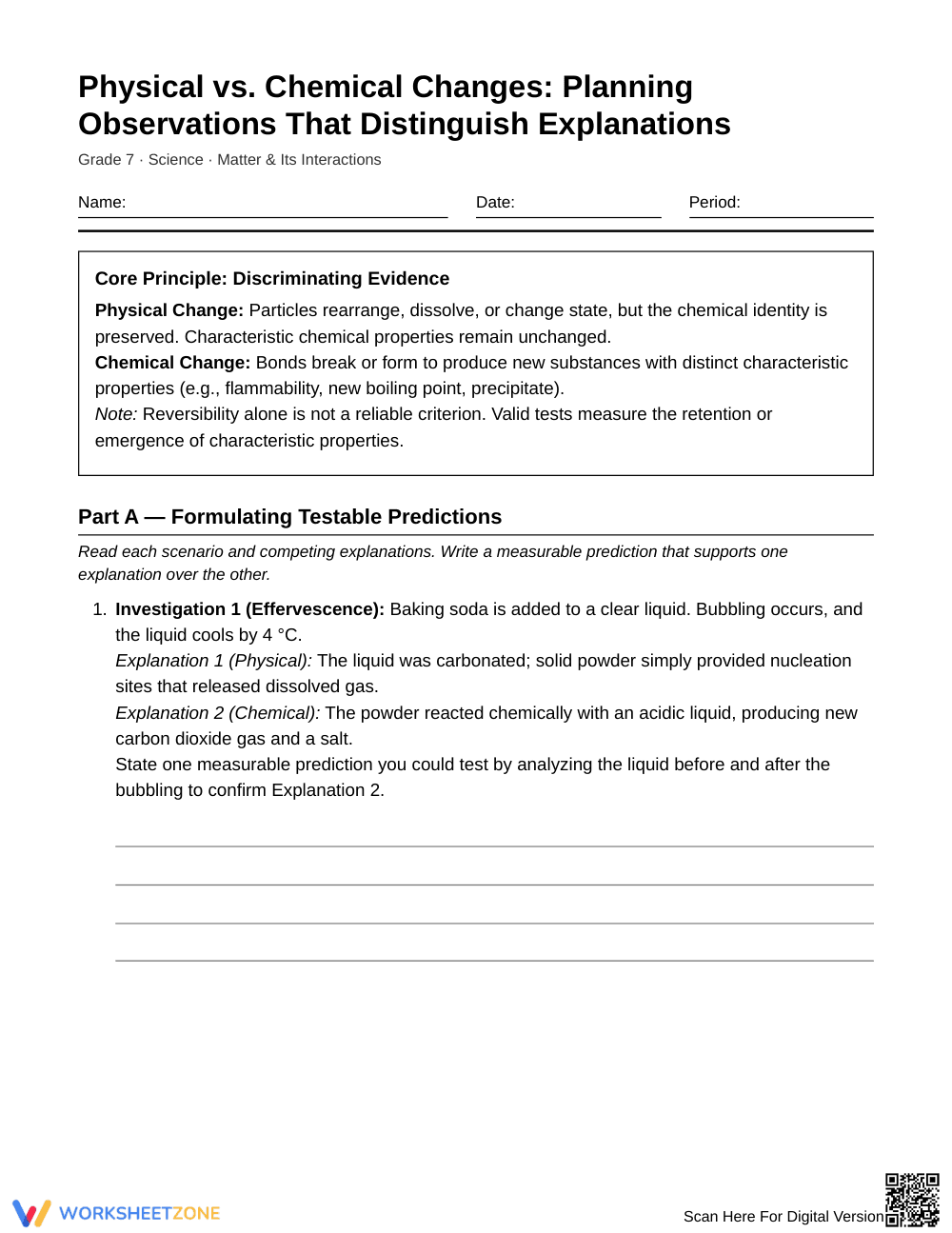
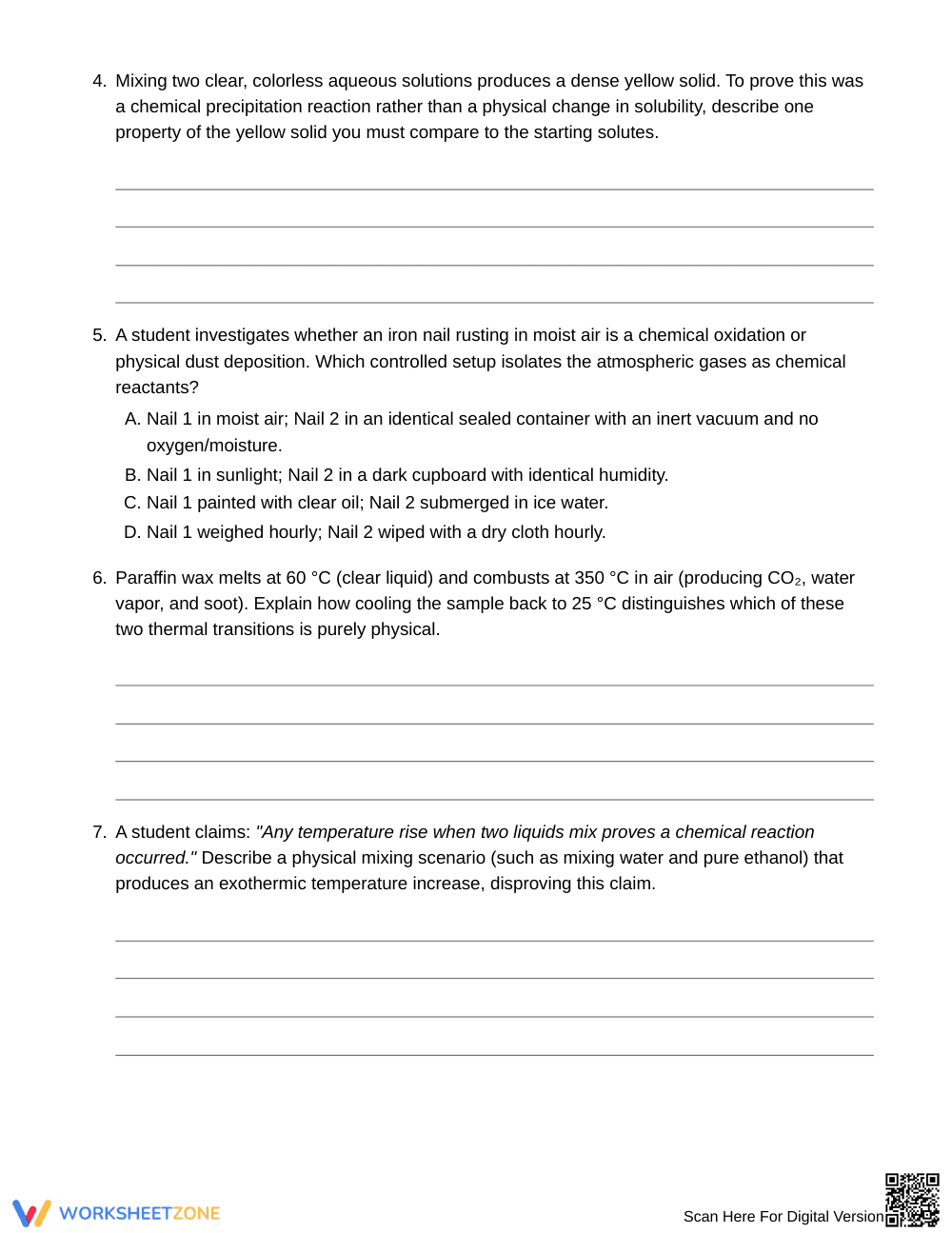
This Grade 7 physical science worksheet trains middle school students to design scientific investigations that distinguish between physical and chemical changes. Through 10 rigorous tasks, learners evaluate competing explanations, identify controlled variables, and interpret synthetic experimental datasets to identify whether chemical identities are preserved or altered.
At a Glance
- Grade: 7 · Subject: Science
- Standard: Middle School Physical Science — Plan investigations to distinguish physical and chemical changes
- Skill Focus: Planning observations to distinguish explanations
- Format: 5 pages · 10 problems · Answer key included · PDF
- Best For: Lab prep, concept reinforcement, and data analysis
- Time: 40–50 minutes
What's Inside
This 5-page printable resource includes 10 multi-step inquiry problems divided into three structured sections, accompanied by a comprehensive 2-page answer key. Students engage with clear core principles defining characteristic properties, scenario-based prediction tasks, variable control experimental designs, and synthetic data evaluation tables comparing open and closed systems.
Skill Progression
- Guided practice (Part A — 2 problems): Students analyze competing chemical versus physical explanations for observed phenomena, using structured prompts to formulate testable, measurable predictions.
- Supported practice (Part B — 6 problems): Learners design controlled experimental procedures, isolate atmospheric variables, and identify specific property tests that isolate chemical changes from solubility shifts.
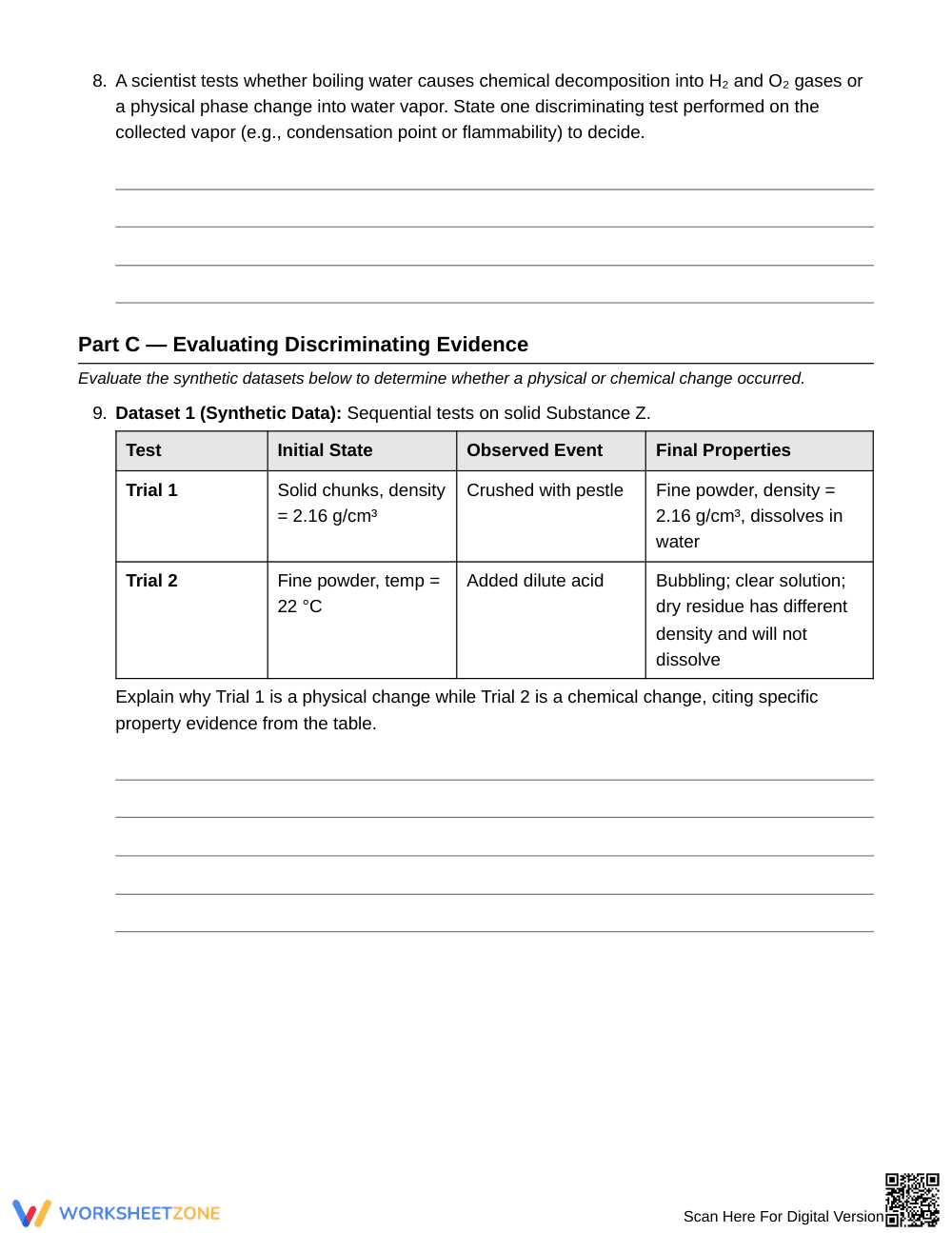
- Independent practice (Part C — 2 problems): Students independently analyze multi-trial datasets and conservation of mass measurements across open and closed systems to justify chemical change classifications.
This sequence supports gradual release from scaffolded hypothesis testing to independent scientific reasoning and evidence-based argumentation.
Standards Alignment
This resource aligns with middle school physical science standards for matter and its interactions. Students analyze characteristic properties of substances before and after interactions to determine if a chemical reaction has occurred. Supporting science and engineering practices include planning controlled investigations and constructing evidence-based explanations. Both standard codes can be copied directly into lesson plans, IEP goals, or district curriculum mapping tools.
How to Use It
Deploy this worksheet after direct instruction on characteristic properties as a pre-lab conceptual checkpoint, ensuring students can differentiate dissolving from reacting before entering the laboratory. Alternatively, assign Part C during small-group remediation to target misconceptions surrounding mass conservation and gas production. While students work, circulate to observe whether they cite qualitative observations or measurable characteristic properties when defending claims. Expected completion time is 40 to 50 minutes.
Who It's For
This worksheet serves Grade 7 general science, physical science, and honors introductory chemistry classrooms. It provides differentiated scaffolding through clear explanatory anchor notes for developing learners, while offering deep analytical challenges for advanced students. Pair this activity with a hands-on chemical reaction demonstration or interactive matter simulation to solidify observational skills.
Middle school science curricula frequently encounter persistent student misconceptions regarding chemical reactions, particularly when gas release or thermal changes occur during purely physical dissolutions. According to Fisher & Frey (2014), structured inquiry tasks that require learners to isolate variables and justify explanations with empirical data significantly enhance conceptual mastery and disciplinary literacy in science classrooms. This 10-task Grade 7 physical science worksheet reinforces rigorous observation planning by requiring students to distinguish chemical transformations from physical state changes using measurable characteristic properties such as density, boiling point, and mass conservation. By progressing methodically from guided scenario analysis to complex synthetic data interpretation, the resource directly supports student mastery of scientific inquiry and evidence-based argumentation, ensuring learners build the foundational analytical capabilities necessary for advanced secondary laboratory coursework.


