


























Views
Downloads




Essential Parameter Changes Worksheet | Grade 9 Algebra I
Paste this activity's link or code into your existing LMS (Google Classroom, Canvas, Teams, Schoology, Moodle, etc.).
Students can open and work on the activity right away, with no student login required.
You'll still be able to track student progress and results from your teacher account.
This Algebra I worksheet equips ninth-grade students to interpret parameter changes in quadratic functions by connecting vertex form equations to graphical transformations. Learners analyze how altering values for a, h, and k causes vertical stretches, compressions, reflections, and shifts. Students progress from identifying isolated transformations to modeling real-world parabolic contexts with precision.
At a Glance
- Grade: 9 · Subject: Algebra I
- Standard:
HSF-BF.B.3— Identify the effect of transformations on quadratic functions graphically and algebraically- Skill Focus: Interpret Parameter Changes
- Format: 5 pages · 18 problems · Answer key included · PDF
- Best For: Guided instruction and independent transformation practice
- Time: 45–60 minutes
What's Inside
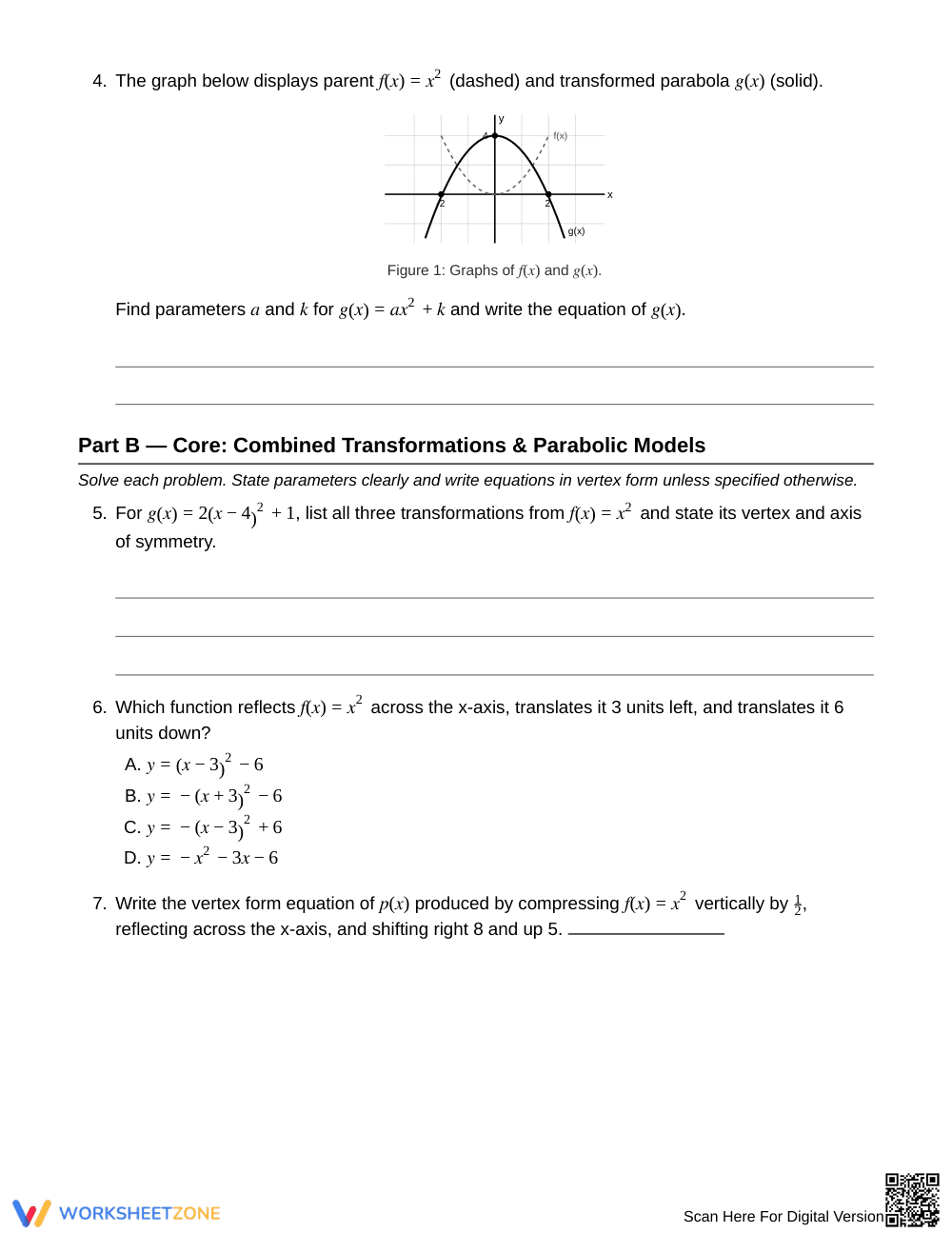
The 5-page printable document features 18 multi-part problems organized across three structured phases, accompanied by a comprehensive 3-page worked answer key. Students reference an explicit vertex form formula box, interpret labeled coordinate graphs, evaluate multiple-choice options, complete the square to isolate parameters, and solve projectile trajectory application tasks.
Skill Progression
- Guided practice (Part A, 4 problems): Isolates single parameter changes with vertex form reference support, reinforcing horizontal shifts, vertical displacements, and reflections.
- Supported practice (Part B, 10 problems): Combines multiple transformations, graph analysis, completing the square, and real-world modeling contexts like bridge arches and falling objects.
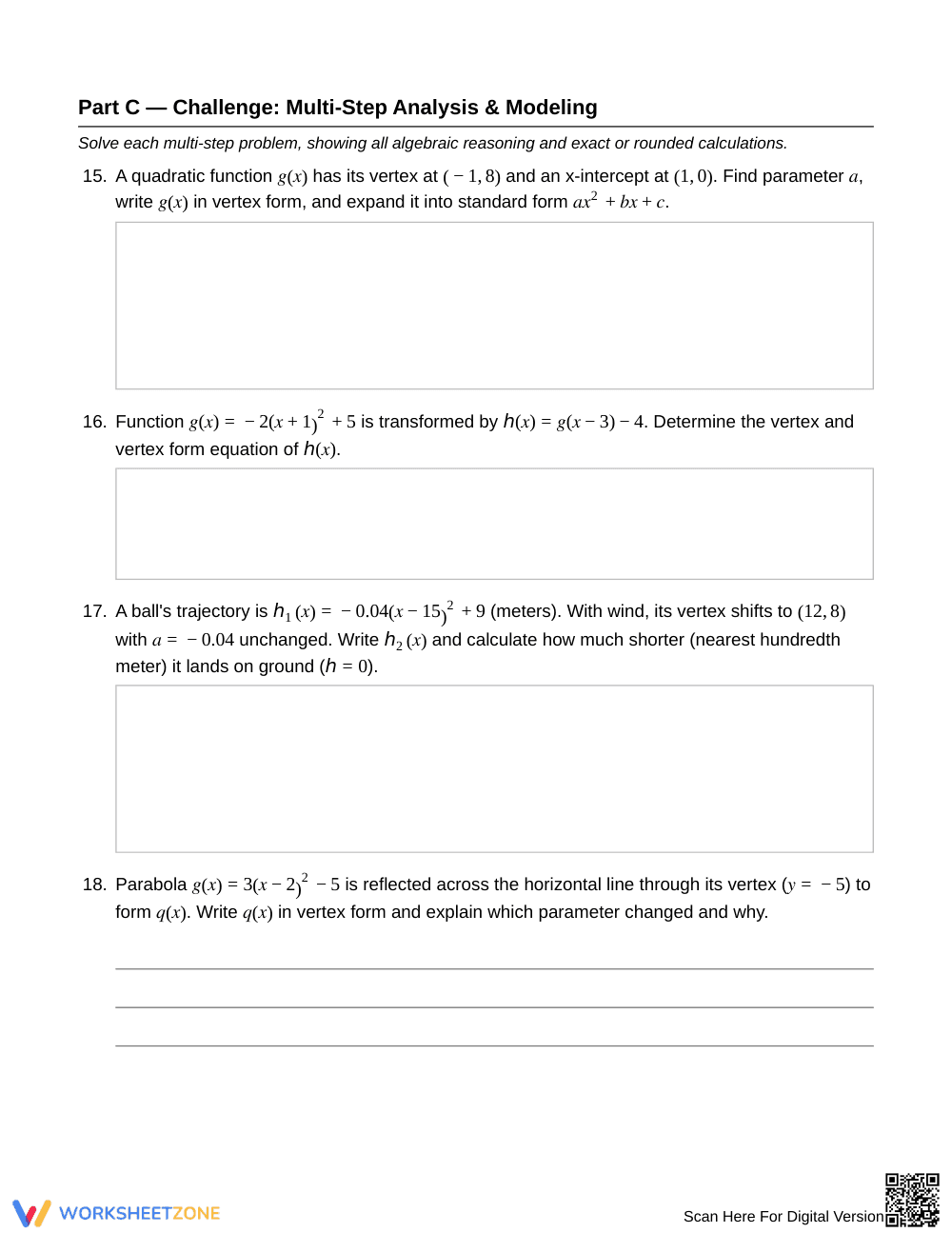
- Independent practice (Part C, 4 problems): Challenges students with multi-step algebraic derivations and trajectory shifts without graphic hints.
This sequence implements a gradual-release model, moving students from guided identification to autonomous problem-solving.
Standards Alignment
This worksheet aligns directly with HSF-BF.B.3, requiring students to identify transformation effects on graphs when replacing f(x) with f(x) + k, k f(x), and f(x + h). It also reinforces HSA-SSE.B.3.b through completing the square to identify quadratic vertices. Both standard codes can be copied directly into lesson plans, IEP goals, or district curriculum mapping tools.
How to Use It
Deploy Part A during initial direct instruction to verify student understanding of isolated parameters before transitioning to Part B for collaborative partner work. Use Part C as an extension during independent practice or as an assessment checkpoint. During work time, monitor whether students correctly distinguish between the horizontal shift direction in (x − h) versus the sign of h. Plan for 45 to 60 minutes of instructional time.
Who It's For
Designed for ninth-grade Algebra I students, this practice set supports core learners mastering quadratic graphs, while providing built-in scaffolds for students needing visual anchor support. Part C offers rigorous analysis for advanced learners. Pair this worksheet directly with a parent function graphing investigation or an interactive graphing calculator demonstration.
According to Fisher & Frey (2014), structured instructional design that progresses from scaffolded modeling to independent problem-solving significantly strengthens mathematical retention and conceptual transfer. This worksheet targets standard HSF-BF.B.3 by guiding ninth-grade Algebra I students through interpreting parameter changes in quadratic functions. Learners analyze how individual constants within vertex form alter parabolic orientation, steepness, and position. By structuring 18 rigorous problems across single transformations, combined parabolic models, and multi-step projectile trajectories, the resource operationalizes the gradual release of responsibility framework. Students bridge concrete visual representations of parabolas with abstract algebraic equations, evaluating vertex coordinates, line symmetries, and real-world domain constraints. The detailed 3-page answer key provides clear solution pathways, allowing educators to identify common misconceptions regarding sign changes in horizontal translations. Consequently, this targeted practice document ensures secondary students build enduring fluency in connecting function parameters directly to geometric transformations.


