




























Views
Downloads




Essential Order-of-Magnitude Worksheet | Grade 11 Chemistry

Paste this activity's link or code into your existing LMS (Google Classroom, Canvas, Teams, Schoology, Moodle, etc.).
Students can open and work on the activity right away, with no student login required.
You'll still be able to track student progress and results from your teacher account.
This chemistry worksheet trains high school students to defend quantitative order-of-magnitude claims involving the mole concept and chemical scale. Learners evaluate laboratory data, isolate necessary parameters, track exponential powers of ten, and articulate evidence-based scientific arguments that connect microscopic atomic populations to macroscopic measurable masses.
At a Glance
- Grade: 11 · Subject: Chemistry
- Standard: HS Chemistry Quantitative Modeling — Defend order-of-magnitude particle counts using dimensional reasoning and molar mass
- Skill Focus: Defending Order-of-Magnitude Results
- Format: 7 pages · 8 problems · Answer key included · PDF
- Best For: Quantitative mole unit review
- Time: 45–60 minutes
What's Inside
This 7-page student resource delivers 8 in-depth analytical problems arranged across three rigorous parts, accompanied by a comprehensive 3-page solution key. Students engage with authentic chemical contexts featuring elemental silicon, gold leaf, helium canisters, aluminum foil, diamond crystals, and comparative molecular solutions. Reference constants, standard atomic masses, and governing formulas are provided directly on the page header.
Skill Progression
- Guided Practice (Part A, 2 tasks): Students inspect multidimensional data tables to identify minimal necessary variables, eliminating extraneous intensive properties like conductivity and ambient temperature.
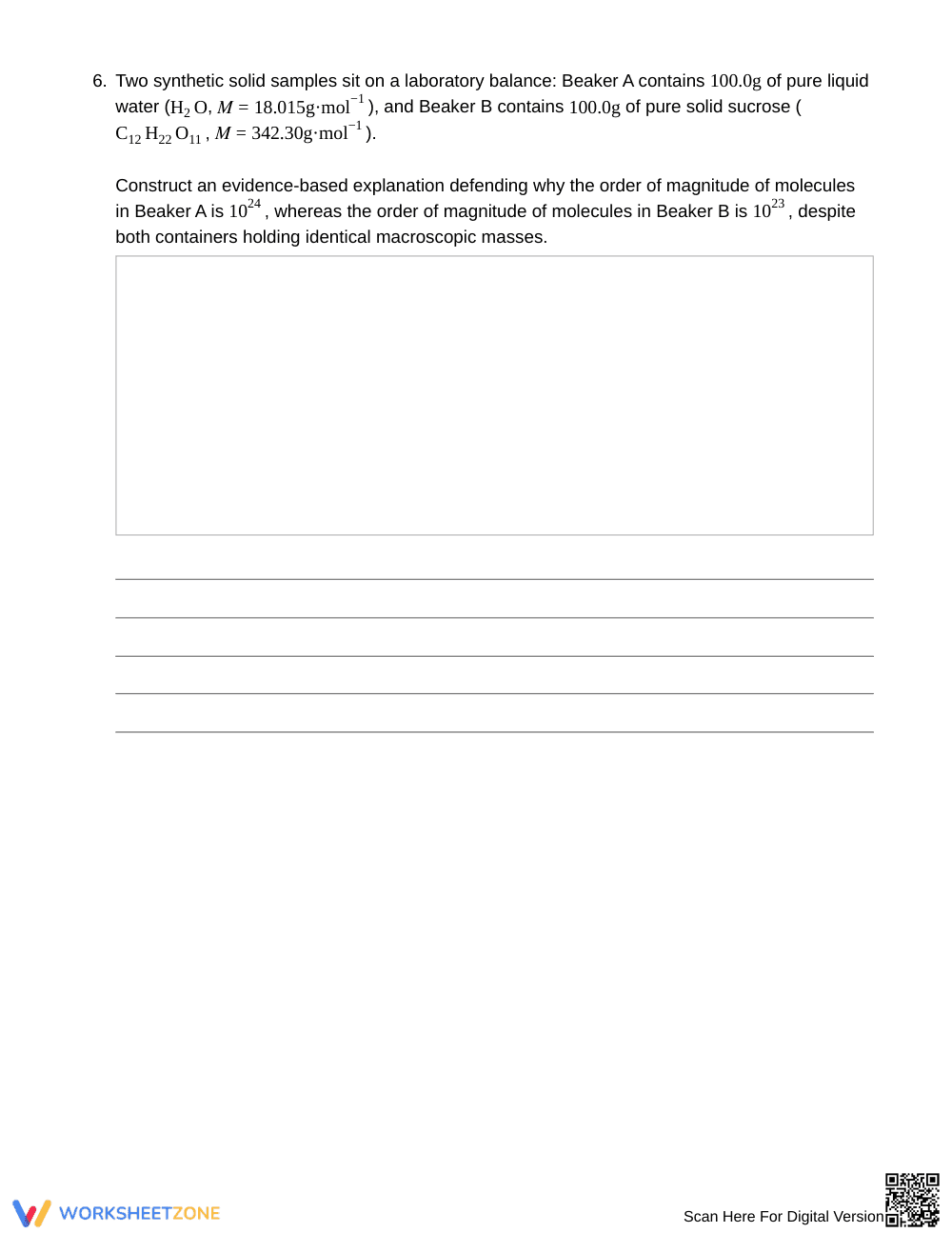
- Supported Practice (Part B, 4 tasks): Students construct structured written arguments defending target powers of ten, mechanistically explaining how high molar mass suppresses total particle counts.
- Independent Practice (Part C, 2 tasks): Students analyze competing student claims, diagnose scale intuition errors, and refute flawed exponential logic.
This sequence embodies a gradual-release instructional model, shifting students from variable isolation to independent claim defense and error diagnosis.
Standards Alignment
This resource aligns with high school chemistry expectations for scientific argumentation and mathematical modeling. Students use mathematical representations to support claims regarding the microscopic composition of matter and calculate proportional quantities using Avogadro's constant. The quantitative reasoning demands can be integrated directly into advanced chemistry lesson plans, IEP tracking, and district curriculum mapping documents.
How to Use It
Implement this worksheet after direct instruction on the mole concept and standard molar mass calculations. For formative assessment, monitor student progress during Part A to observe whether learners rely on memorized formulas or actively discern between extensive properties and irrelevant intensive values. The full activity requires approximately 45 to 60 minutes of focused classroom work.
Who It's For
This activity is designed for Grade 11 chemistry and AP Chemistry students strengthening their quantitative literacy. It pairs naturally with laboratory stoichiometry investigations, gas law units, and anchor charts detailing dimensional analysis conversion pathways.
High school chemistry students often struggle to reconcile the abstract magnitude of Avogadro's number with small laboratory masses. According to research on conceptual scaffolding by Fisher & Frey (2014), structured argumentation tasks that require learners to defend calculations improve analytical retention and correct intuitive scale misconceptions. This worksheet operationalizes that framework across 8 rigorous tasks, guiding students through variable selection, mechanistic modeling, and peer claim evaluation. By defending powers of ten across diverse elements such as silicon, gold, and helium, learners build a robust bridge between macroscopic measurement and particulate scale. The included 3-page teacher key provides complete mathematical derivations and written justifications for efficient scoring.


