




























Views
Downloads



Essential Nuclear Power Worksheet | Grades 9–12 Science

Paste this activity's link or code into your existing LMS (Google Classroom, Canvas, Teams, Schoology, Moodle, etc.).
Students can open and work on the activity right away, with no student login required.
You'll still be able to track student progress and results from your teacher account.
Students completing this worksheet will synthesize nuclear‑power concepts, perform quantitative energy calculations, and evaluate environmental trade‑offs, culminating in a clear, evidence‑based claim about nuclear versus coal energy. The assessment blends model analysis, plant schematic interpretation, and real‑world data to demonstrate mastery of core science ideas.
At a Glance
- Grade: Grades 9–12 (high school) · Subject: Science
- Standard:
— Assess nuclear power concepts, perform energy calculations, and evaluate environmental impacts by students- Skill Focus: Cumulative nuclear power assessment for secondary science
- Format: 4 pages total · 19 problems total · Answer key included · PDF ready
- Best For: Review before unit test or project work in class
- Time: 30–45 minutes estimated
What’s Inside
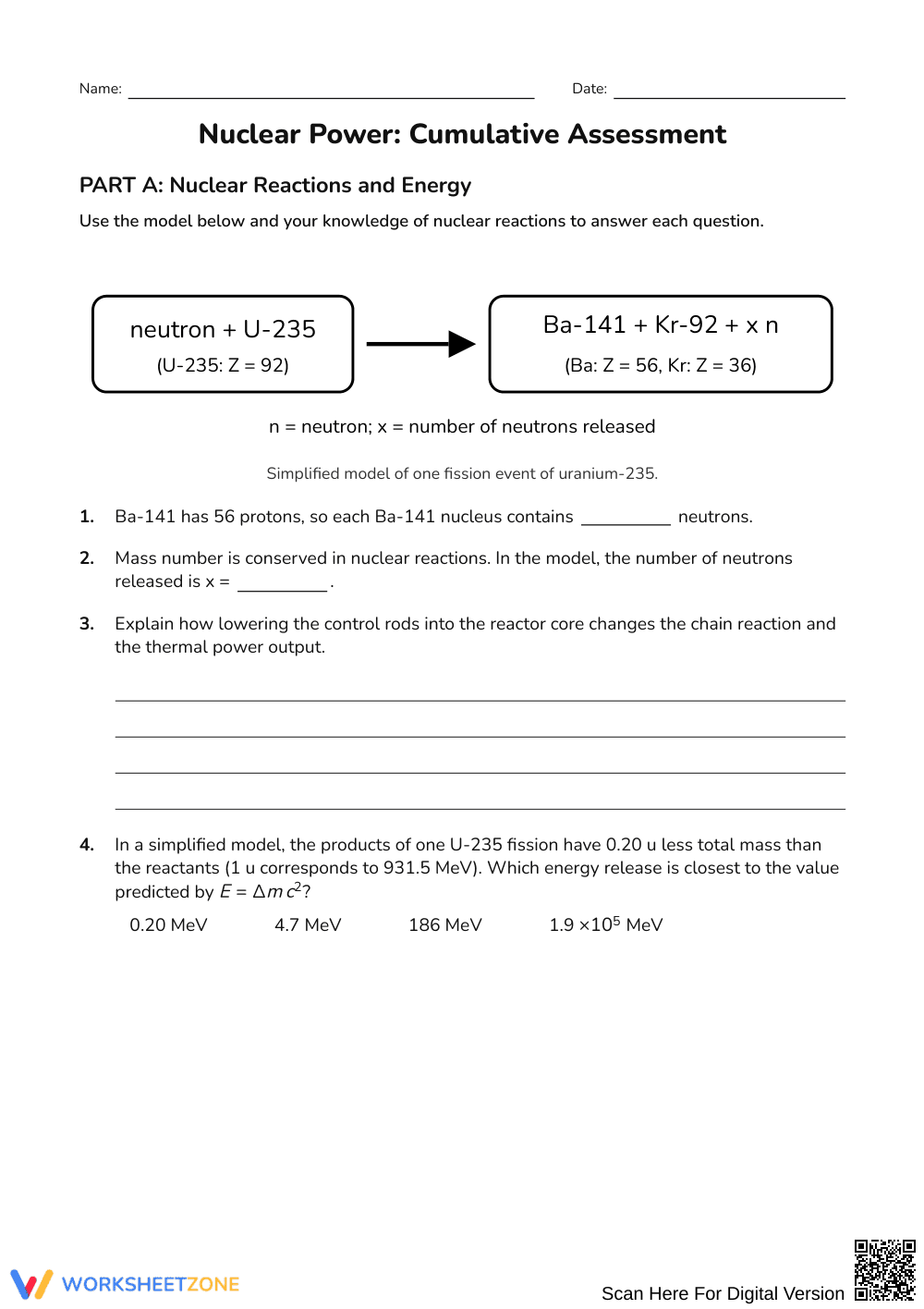
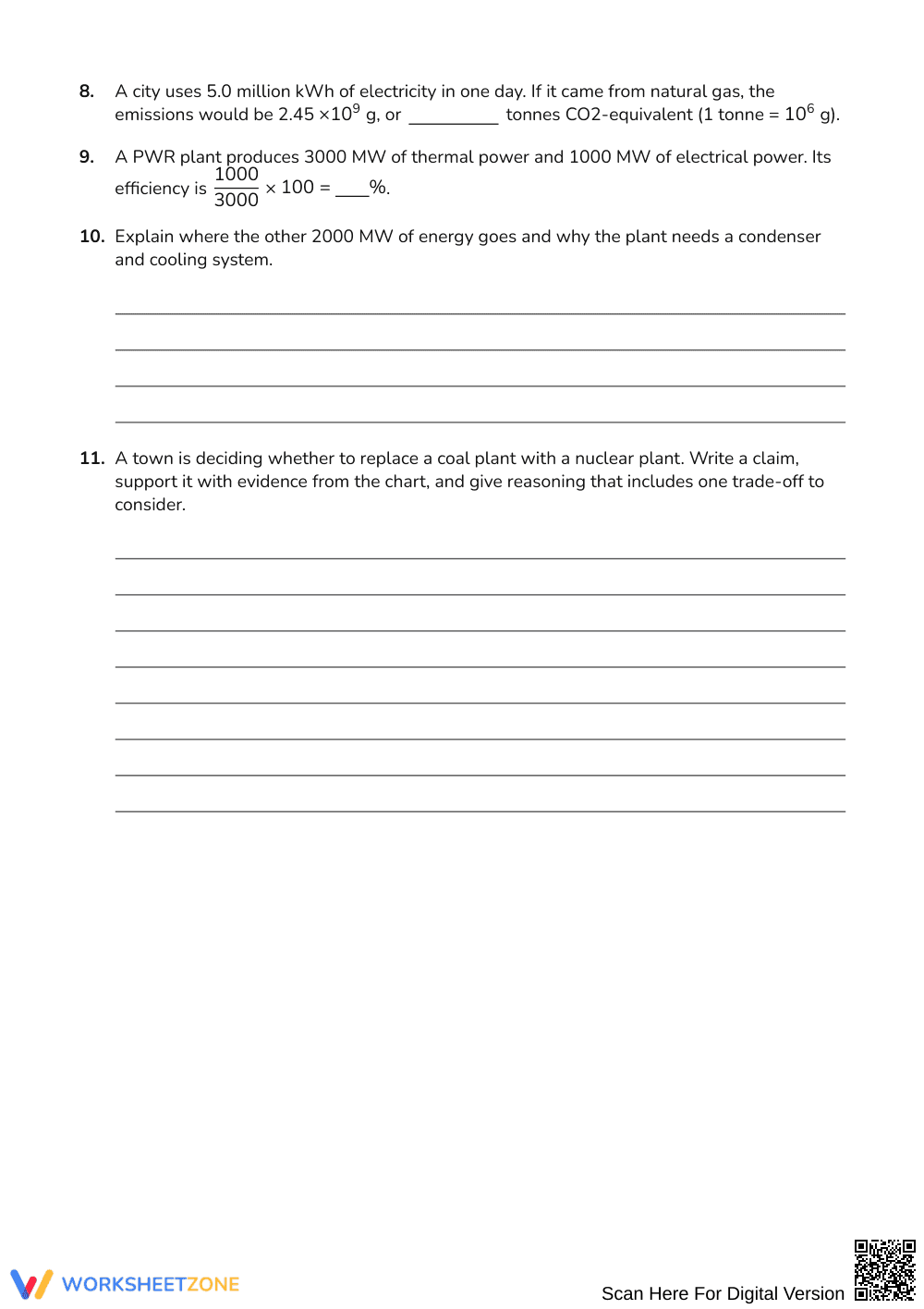
The packet contains 19 varied tasks spread across four printable pages. Part A asks students to interpret a fission‑event diagram and answer short‑answer and multiple‑choice items. Part B provides a pressurized‑water‑reactor schematic for labeling, matching, and explanatory questions. Part C presents real‑world data for calculations, a greenhouse‑gas comparison chart, and a claim‑evidence‑reasoning writing prompt. An answer key on four additional pages gives step‑by‑step solutions.
Skill Progression
- Guided practice (6 problems): students work through a worked example on the fission diagram before answering similar short‑answer items.
- Supported practice (7 problems): a word bank and sentence frames accompany the reactor‑schematic questions, helping learners translate technical terms into explanations.
- Independent practice (6 problems): open‑ended calculations, data‑interpretation, and claim‑evidence‑reasoning tasks require students to apply concepts without scaffolds.
The sequence follows the classic I Do, We Do, You Do release model.
Standards Alignment
` ` The worksheet aligns with typical high‑school nuclear science standards that require students to model nuclear reactions, calculate energy changes using E = Δm c², and evaluate the environmental trade‑offs of different power sources. A supporting standard on scientific argumentation is addressed through the claim‑evidence‑reasoning section. Both standard references can be copied directly into lesson plans, IEP goals, or district curriculum mapping tools.
How to Use It
Use the worksheet as a pre‑assessment before launching the nuclear‑power unit; students’ responses reveal misconceptions about fission, energy conversion, and greenhouse‑gas data, allowing the teacher to target instruction. Alternatively, assign it as a post‑lab synthesis activity after a hands‑on reactor model; the teacher can collect the claim‑evidence‑reasoning pieces for quick formative assessment, noting whether students correctly cite the 12 g CO₂‑eq/kWh figure for nuclear energy. Completion time ranges from 30 to 45 minutes.
Who It’s For
Designed for Grades 9‑12 science classes, the packet supports advanced‑placement, honors, and regular‑track learners. The built‑in scaffolds (worked example, word bank, sentence frames) provide differentiation without separate versions. Pair it with a textbook chapter on nuclear reactions or an anchor chart of the nuclear fuel cycle for a cohesive unit.
This worksheet reflects current high‑school nuclear science expectations, asking students to model fission, perform E = Δm c² calculations, and construct evidence‑based arguments about energy trade‑offs. Research shows that explicit claim‑evidence‑reasoning tasks improve students’ ability to articulate scientific arguments (Fisher & Frey, 2014). By integrating real‑world emission data, the activity also supports data‑literacy goals highlighted in the RAND AIRS 2024 report, which links quantitative analysis practice to higher NAEP science scores. The 19‑item set gives ample practice across three parts: diagram analysis, plant component labeling, and data‑driven argumentation, supporting spaced repetition. Including a claim‑evidence‑reasoning prompt encourages students to synthesize quantitative results with qualitative trade‑off reasoning, a skill emphasized in many state science frameworks. By mirroring the structure of authentic engineering assessments, the worksheet prepares learners for future coursework in physics and environmental science.


