































Essential Nuclear Decay Worksheet | Grades 9-12 Science

Paste this activity's link or code into your existing LMS (Google Classroom, Canvas, Teams, Schoology, Moodle, etc.).
Students can open and work on the activity right away, with no student login required.
You'll still be able to track student progress and results from your teacher account.
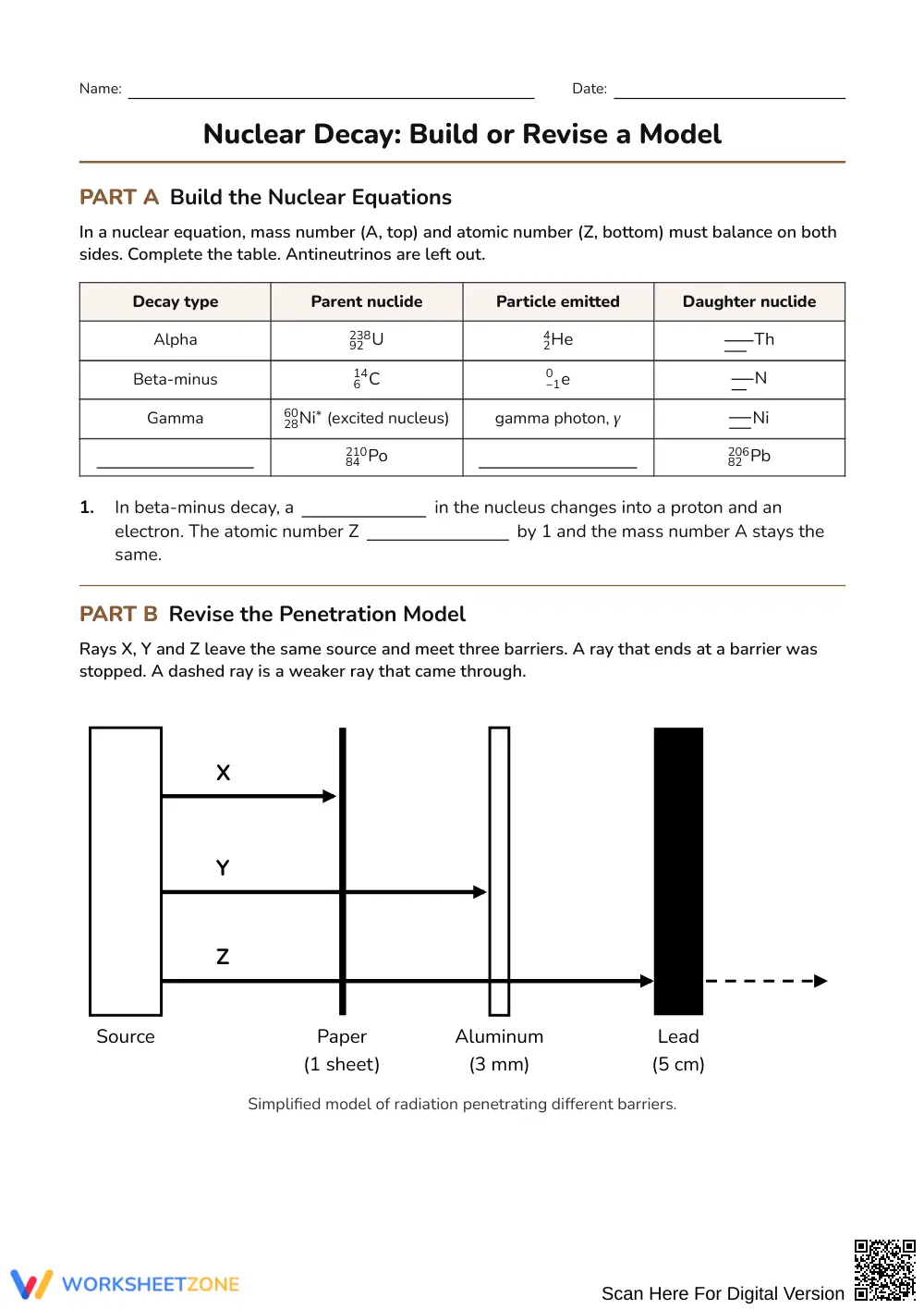
This nuclear decay worksheet guides high school physical science and chemistry students through constructing, evaluating, and revising scientific models of radioactive decay. Students analyze balanced nuclear equations, model radiation penetration through matter, trace multi-step uranium decay series, and interpret graphical decay data to connect subatomic nuclear changes with observable rates and energy transformations.
At a Glance
- Grade: Grades 9–12 · Subject: Science
- Standard: Construct and revise models of nuclear changes, energy release, and decay rates
- Skill Focus: Construct, complete, and revise nuclear decay models
- Format: 4 pages · 30 problems · Answer key included · PDF
- Best For: High school chemistry and physics practice
- Time: 45–60 minutes
What's Inside
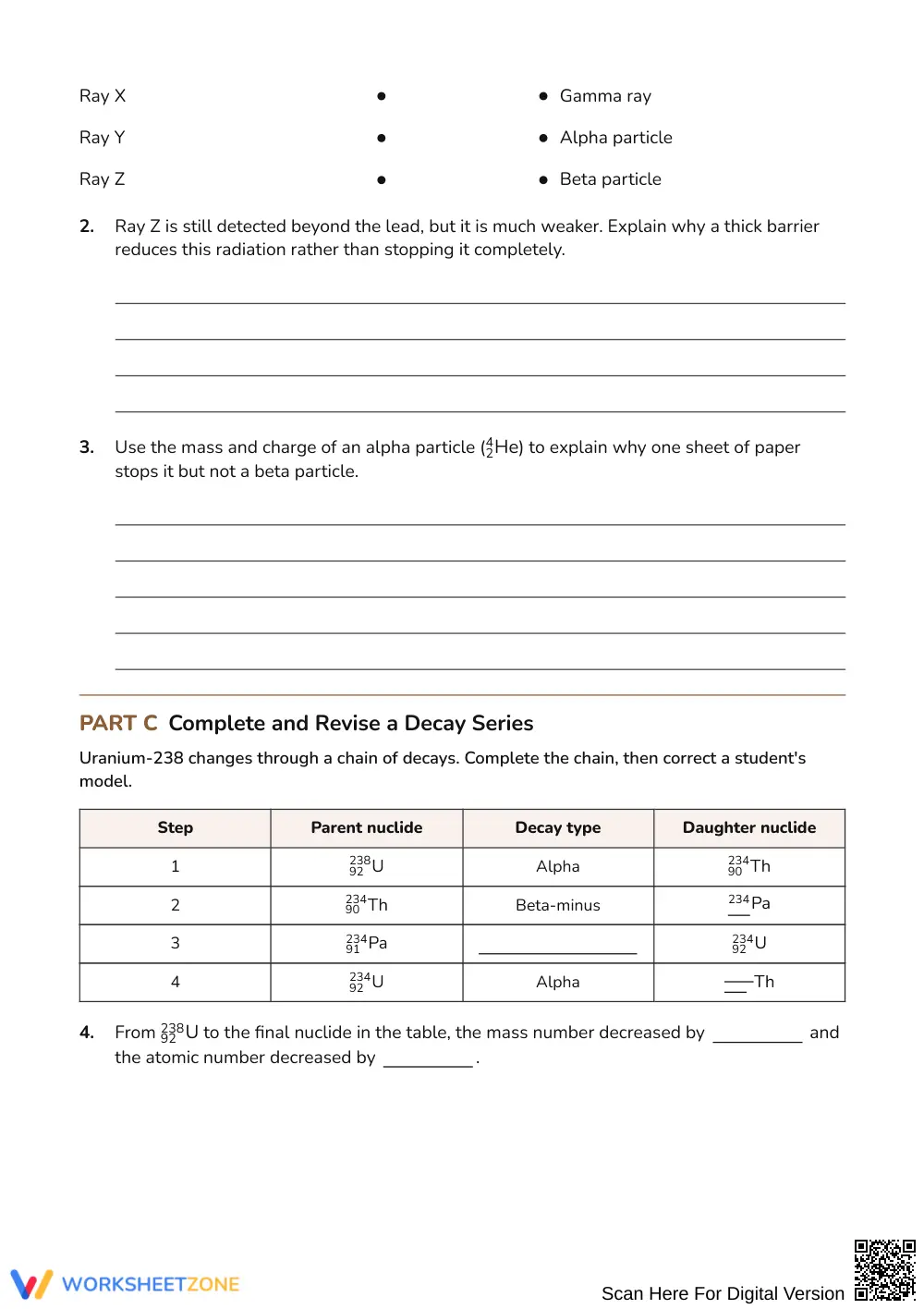
This comprehensive 4-page resource features 30 structured model-based tasks organized into five focused parts. Students complete balanced alpha, beta, and gamma equations, annotate a penetration barrier diagram, diagnose errors in a decay chain, calculate half-lives using graphical decay curves, and explain mass-energy conversions via E = mc² alongside a complete 4-page teacher answer key.
Skill Progression
- Guided practice (Tasks 1–8): Students complete nuclear equations and label radiation penetration diagrams with clear rule-based reminders covering nucleon conservation and particle properties.
- Supported practice (Tasks 9–18): Students trace multi-step decay series, diagnose student misconceptions regarding decay types, and extract half-life values from simulated decay curves.
- Independent practice (Tasks 19–30): Students calculate multi-interval isotope decay, evaluate probability statements for individual nuclei, and construct written arguments linking nuclear stability to mass deficit and thermal independence.
This sequence implements a gradual-release model that moves students from foundational equation balancing to critical model critique and quantitative prediction.
Standards Alignment
This resource aligns with high school physical science standards requiring students to develop models illustrating the composition of the nucleus and the energy released during alpha, beta, and gamma radioactive decay. Supporting standards include interpreting graphical data to determine half-life and applying conservation laws to nuclear reactions. Standard alignment details can be copied directly into lesson plans, IEP goals, or district curriculum mapping tools.
How to Use It
Deploy this worksheet during the core practice phase of a nuclear chemistry unit, following direct instruction on ionizing radiation and decay modes. As students work through Part B and Part C, observe whether they confuse beta emission with electron capture or misapply mass number conservation. The full set takes 45 to 60 minutes and works effectively for paired problem-solving or independent formative assessment.
Who It's For
This activity is designed for high school chemistry, physics, or physical science students studying atomic structure and radioactivity. Scaffolded equations support emerging learners, while model critique tasks provide critical thinking extensions for advanced students. Pair this worksheet directly with a cloud chamber demonstration or an interactive half-life simulation.
According to Fisher & Frey (2014), structured modeling progressions that require students to evaluate, repair, and justify scientific representations produce significantly deeper conceptual mastery than rote formula drills alone. This 4-page science worksheet operationalizes that research by leading students through 30 targeted tasks centered on radioactive decay mechanisms. Rather than merely memorizing decay products, learners actively test radiation penetration models, verify conservation of mass and atomic numbers across alpha and beta transformations, and interpret exponential decay data curves. By confronting common student misconceptions—such as confusing nuclear decay with temperature-dependent chemical kinetics—the tasks make internal nuclear processes visible and logically coherent. The rigorous sequence ensures high school learners build measurable competency in articulating how subatomic rearrangements drive observable nuclear phenomena, providing teachers with actionable evidence of student mastery during formative chemistry or physics assessments.


