




























Views
Downloads


Essential Nuclear Decay Worksheet | Grades 9-12 Science

Paste this activity's link or code into your existing LMS (Google Classroom, Canvas, Teams, Schoology, Moodle, etc.).
Students can open and work on the activity right away, with no student login required.
You'll still be able to track student progress and results from your teacher account.
This high school physical science worksheet engages students in applying nuclear decay concepts to real-world medical technologies, household safety devices, and geochronological dating methods. Learners analyze authentic isotopic decay chains, evaluate biological radiation hazards, interpret diagnostic decay graphs, and craft evidence-based justifications regarding radioactive tracers in clinical medicine.
At a Glance
- Grade: Grades 9–12 · Subject: Science
- Standard: Relate nuclear decay equations, half-lives, and radiation shielding to real-world technologies
- Skill Focus: Nuclear decay application and transfer
- Format: 4 pages · 29 problems · Answer key included · PDF
- Best For: Nuclear chemistry application or unit review
- Time: 45–60 minutes
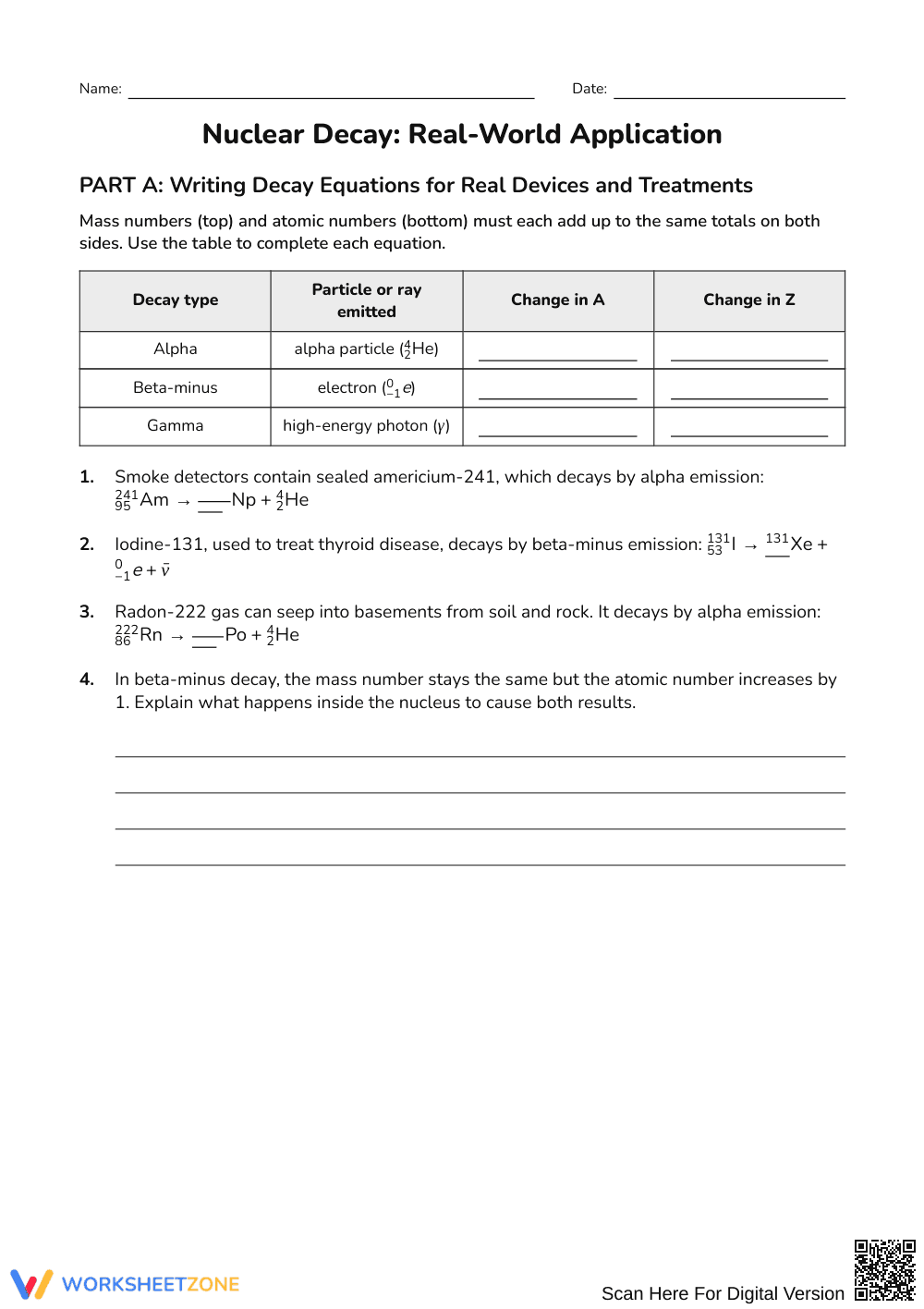
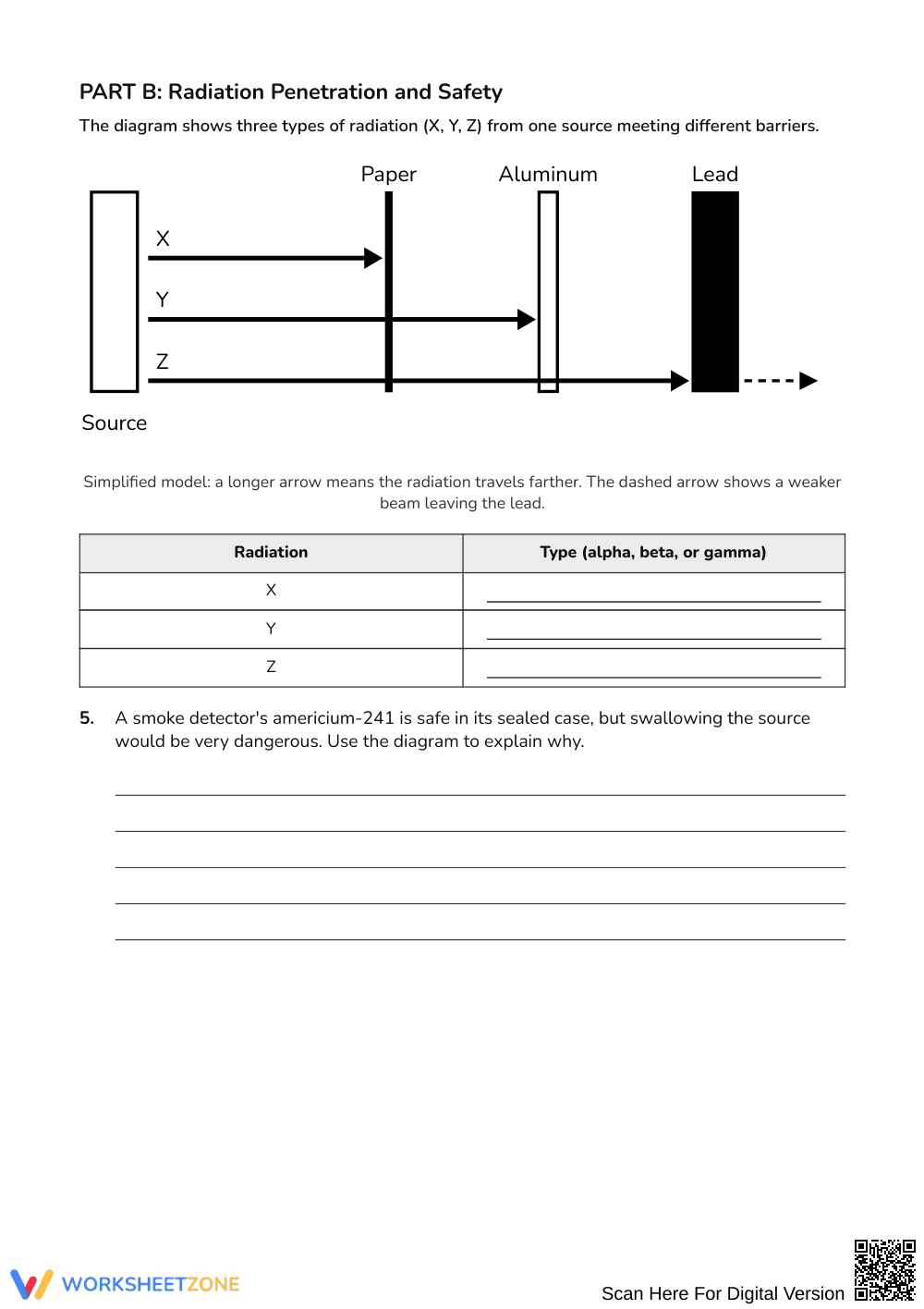
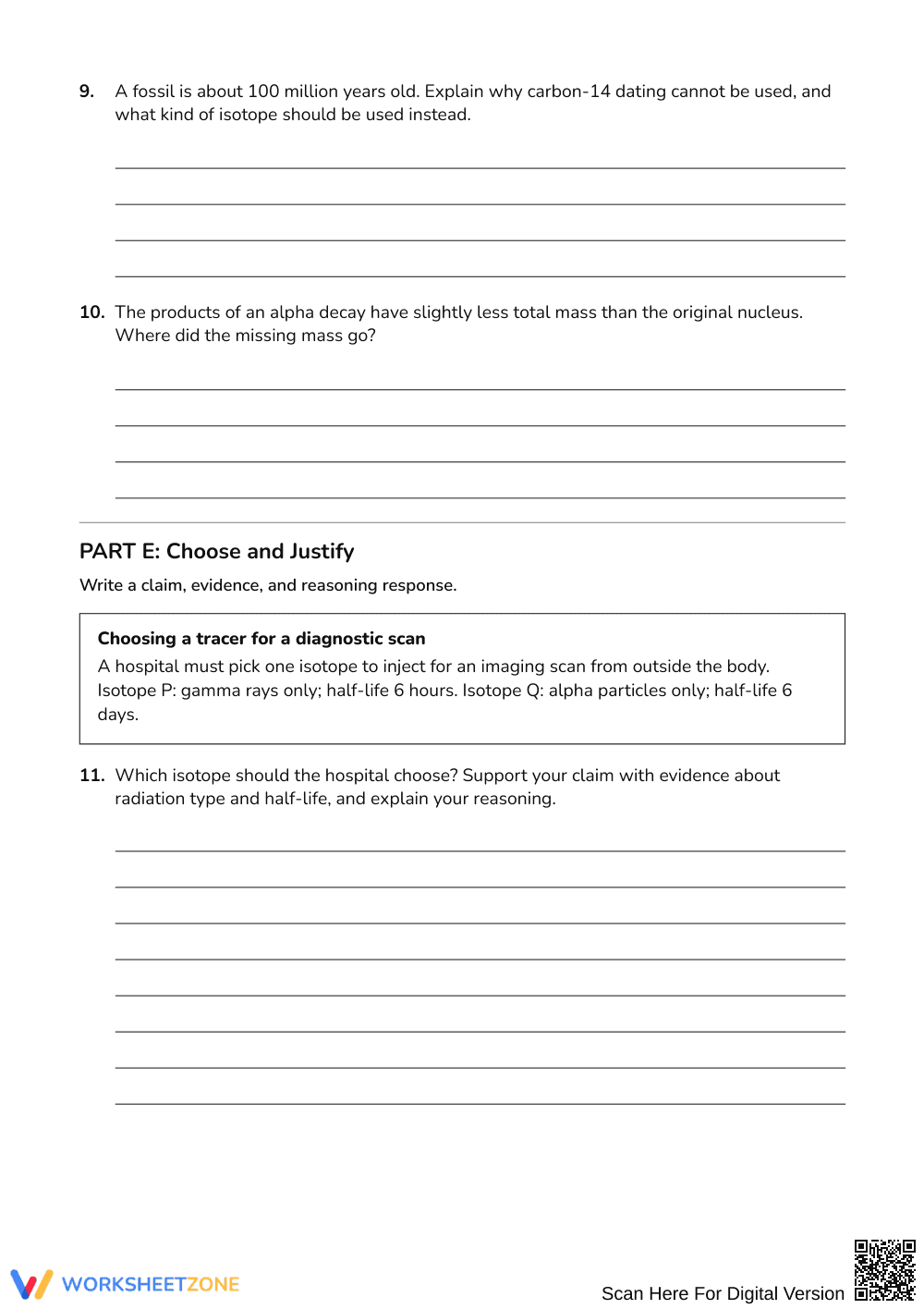
What's Inside: The 4-page student activity contains 29 scaffolded tasks divided across five focused parts. Structural supports include an equation-balancing reference table, a multi-barrier radiation penetration diagram, a half-life activity graph for technetium-99m, radiocarbon data tables, and a claim-evidence-reasoning writing prompt. A complete 4-page answer key provides full mathematical steps, explanations, and model written responses.
Skill Progression
- Guided Practice (Part A): Students use structured reference tables to complete authentic decay equations for americium-241, iodine-131, and radon-222, followed by subatomic structural explanations.
- Supported Practice (Parts B & C): Learners analyze penetrating power across alpha, beta, and gamma emissions in smoke detectors, then calculate remaining activity across 30 hours using technetium-99m decay curves.
- Independent Practice (Parts D & E): Students determine sample ages with carbon-14 dating math, evaluate binding energy mass deficits via Einstein's equation, and author a CER response selecting medical diagnostic tracers.
This sequence reinforces the gradual-release framework, guiding students from direct procedural balancing to autonomous scientific reasoning.
Standards Alignment
This worksheet addresses secondary physical science standards focused on modeling nuclear processes, radioactive decay equations, half-life relationships, and mass-energy equivalence. Students apply conservation of nucleon numbers to technological systems and evaluate the risks and benefits of radioisotopes in environmental and biological settings. Standard codes can be copied directly into lesson plans, IEP goals, or district curriculum mapping tools.
How to Use It
Administer this resource after introducing fundamental nuclear notation, alpha, beta, and gamma emissions, and basic half-life math. During collaborative station rotations, assign specific parts to small groups; observe whether students correctly identify why alpha emitters present severe internal hazards despite minimal external penetration. Expect completion within 45 to 60 minutes.
Who It's For
Designed for general chemistry, honors chemistry, and introductory physics classrooms. Built-in reference tables support developing learners, while multi-step half-life calculations and scientific argumentation challenge advanced students. Pair this activity directly with an interactive half-life simulation or cloud chamber demonstration.
High school science instruction achieves maximum transfer when learners apply core physical laws to tangible medical and technological problems. According to Fisher & Frey (2014), structured transfer tasks that move intentionally from guided nuclear equation balancing to independent argumentation substantially deepen conceptual retention and analytical rigor. Secondary students frequently struggle to connect subatomic interactions with macroscopic clinical observations unless explicit instructional scaffolding connects symbolic notation to concrete contexts. Providing purposeful problem solving scenarios, such as evaluating isotopic diagnostic tracers or calculating radiocarbon decay intervals, enables emerging scientists to develop robust conceptual schemas. Furthermore, incorporating claim, evidence, and reasoning writing tasks prompts teenagers to articulate precise chemical justifications rather than relying on rote memorization. This comprehensive resource directly connects abstract subatomic models with authentic clinical and environmental phenomena across 29 rigorous tasks, fostering durable mathematical confidence and scientific literacy throughout secondary physical science classrooms.


