































Essential Nuclear Decay Worksheet | Grades 9–12 Science

Paste this activity's link or code into your existing LMS (Google Classroom, Canvas, Teams, Schoology, Moodle, etc.).
Students can open and work on the activity right away, with no student login required.
You'll still be able to track student progress and results from your teacher account.
This comprehensive nuclear decay worksheet guides high school physical science and chemistry students through writing nuclear equations, analyzing radiation shielding, evaluating half-life decay curves, and calculating mass-energy equivalence. Students progress from foundational recall of alpha, beta, and gamma radiation to rigorous quantitative predictions and real-world medical and industrial problem-solving.
At a Glance
- Grade: Grades 9–12 · Subject: Science
- Standard:
High School Physical Science— Model nuclear decay processes, radiation penetration, and mass-energy conversion relationships- Skill Focus: Predicting nuclear reactions, half-life calculations, and radiation properties
- Format: 4 pages · 32 problems · Answer key included · PDF
- Best For: Guided practice, unit review, or independent mastery
- Time: 45–60 minutes
What's Inside
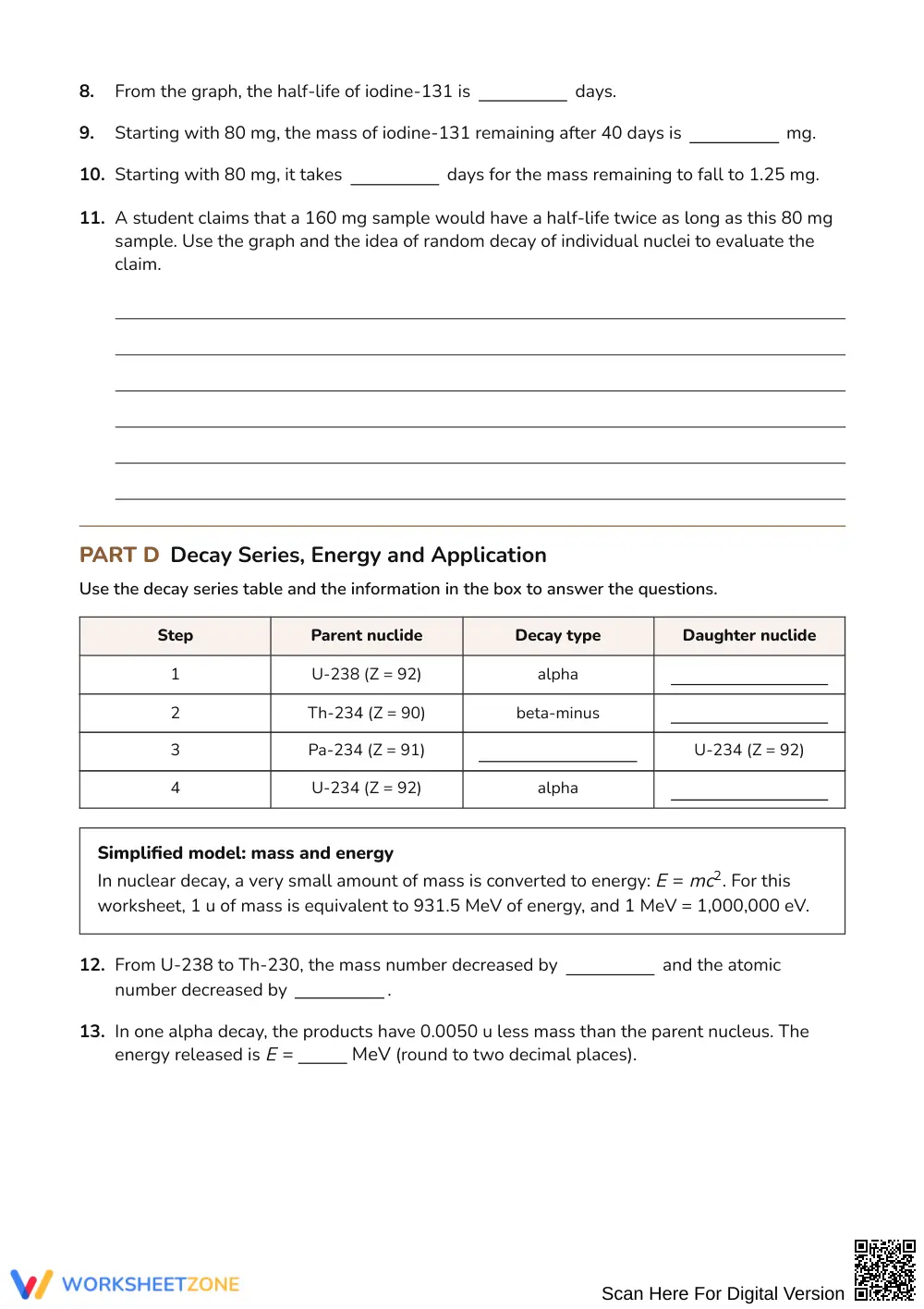
Across 4 structured pages, this resource delivers 32 focused problems spanning four sequential parts. Students interact with summary reference tables, nuclear decay equations, barrier penetration diagrams, iodine-131 decay graphs, and uranium-238 decay series chains. A complete 4-page teacher answer key provides full equation balancing, graph readings, and model written explanations for immediate feedback.
Skill Progression
- Guided practice (Part A, 8 tasks): Establishes foundational rules of mass and atomic number conservation using structured reference tables and scaffolded nuclear decay equations.
- Supported practice (Parts B & C, 14 tasks): Prompts students to analyze barrier penetration diagrams, connect ionizing radiation properties to biological hazards, and interpret graphical decay data to determine half-life values.
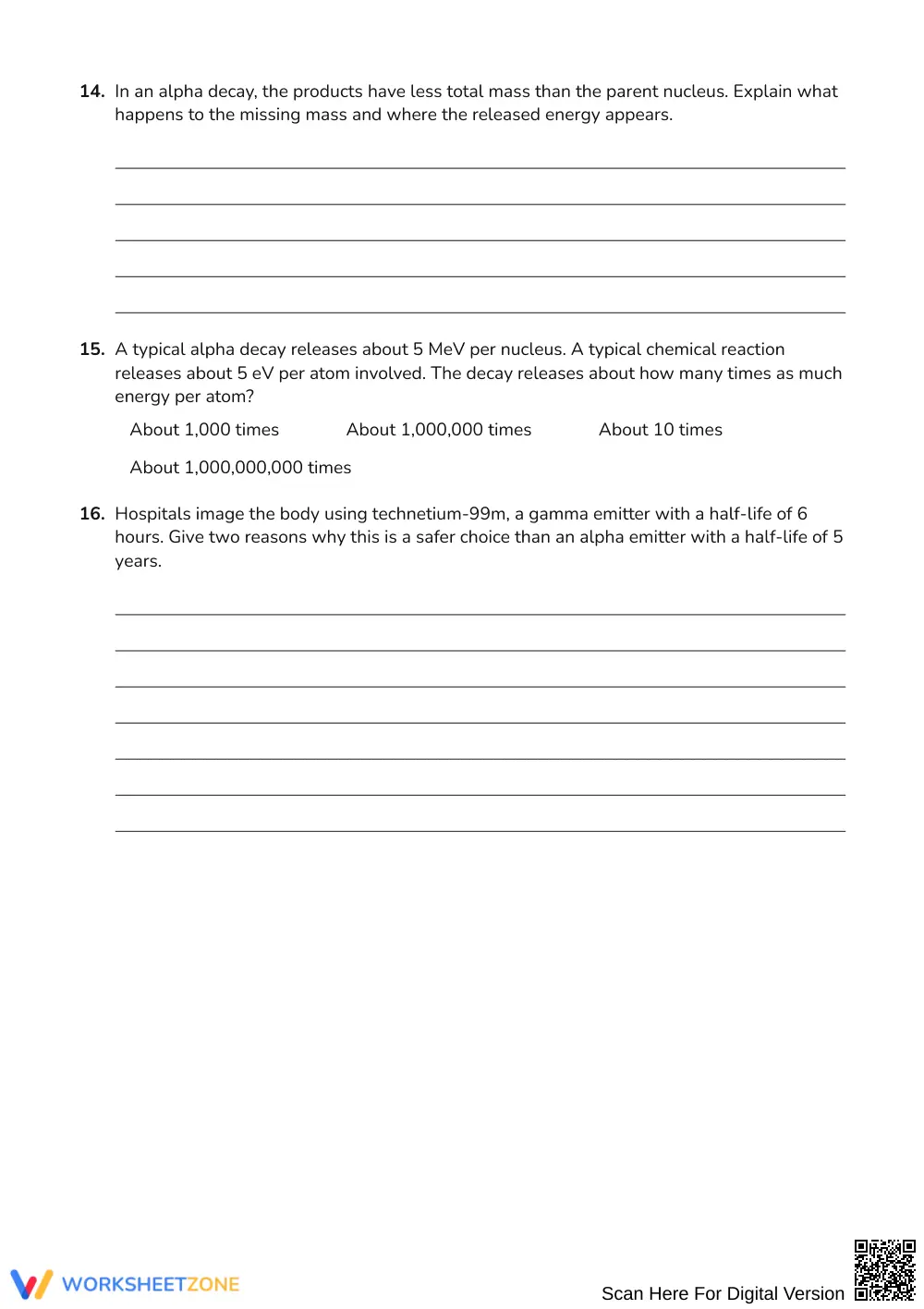
- Independent practice (Part D, 10 tasks): Challenges learners to trace multi-step decay chains, calculate mass defect energy conversion using E = mc², and justify radioisotope selection in medical imaging.
This sequence follows a gradual-release instructional model that transitions learners from rule recall to multi-step scientific justification.
Standards Alignment
This worksheet addresses core high school physical science standards requiring students to develop models illustrating the changes in the composition of the nucleus of the atom and the energy released during the processes of fission, fusion, and radioactive decay. Both standard codes can be copied directly into lesson plans, IEP goals, or district curriculum mapping tools.
How to Use It
Deploy this worksheet after direct instruction on subatomic particles and isotope notation. For formative assessment, examine student responses to the Part C misconception prompt regarding sample mass versus half-life duration to check whether students grasp that decay probability is an inherent nuclear property. The full activity requires approximately 45 to 60 minutes of focused work.
Who It's For
Designed for on-level and honors chemistry or physics students in grades 9 through 12. Teachers can pair this packet with an interactive periodic table or a classroom cloud chamber demonstration to make abstract subatomic events concrete.
According to Fisher & Frey (2014), purposeful scaffolding through the gradual release of responsibility produces measurable gains in complex scientific reasoning. This worksheet operationalizes that framework by moving students systematically through 32 tasks spanning decay equations, half-life data interpretation, and nuclear mass-energy equivalence. High school learners often conflate radiation penetration with biological ionization risk or assume half-life depends on starting sample size; this activity addresses these specific misconceptions directly through qualitative explanations and graph-based problem sets. By embedding explicit mass number and charge conservation rules before requiring independent energy conversion calculations, the four-part layout supports deep conceptual retention across core high school physical science standards.


