




























Views
Downloads


Essential Nuclear Decay Worksheet | Grades 9‑12 Science

Paste this activity's link or code into your existing LMS (Google Classroom, Canvas, Teams, Schoology, Moodle, etc.).
Students can open and work on the activity right away, with no student login required.
You'll still be able to track student progress and results from your teacher account.
Opening
Students master the sequence of nuclear decay by ordering each stage and articulating the changes in mass and atomic numbers. This 4‑page worksheet guides them through radium‑226 and uranium‑238 decay chains, reinforcing conceptual understanding and scientific reasoning in a focused, practice‑rich format.
At a Glance
- Grade: 9‑12 · Subject: Science
- Standard:
— Order decay steps and explain changes in mass and atomic number- Skill Focus: Sequence ordering & explanation
- Format: 4 pages · 38 problems · Answer key included · PDF
- Best For: Review of nuclear chemistry concepts
- Time: 30–45 minutes
What's Inside
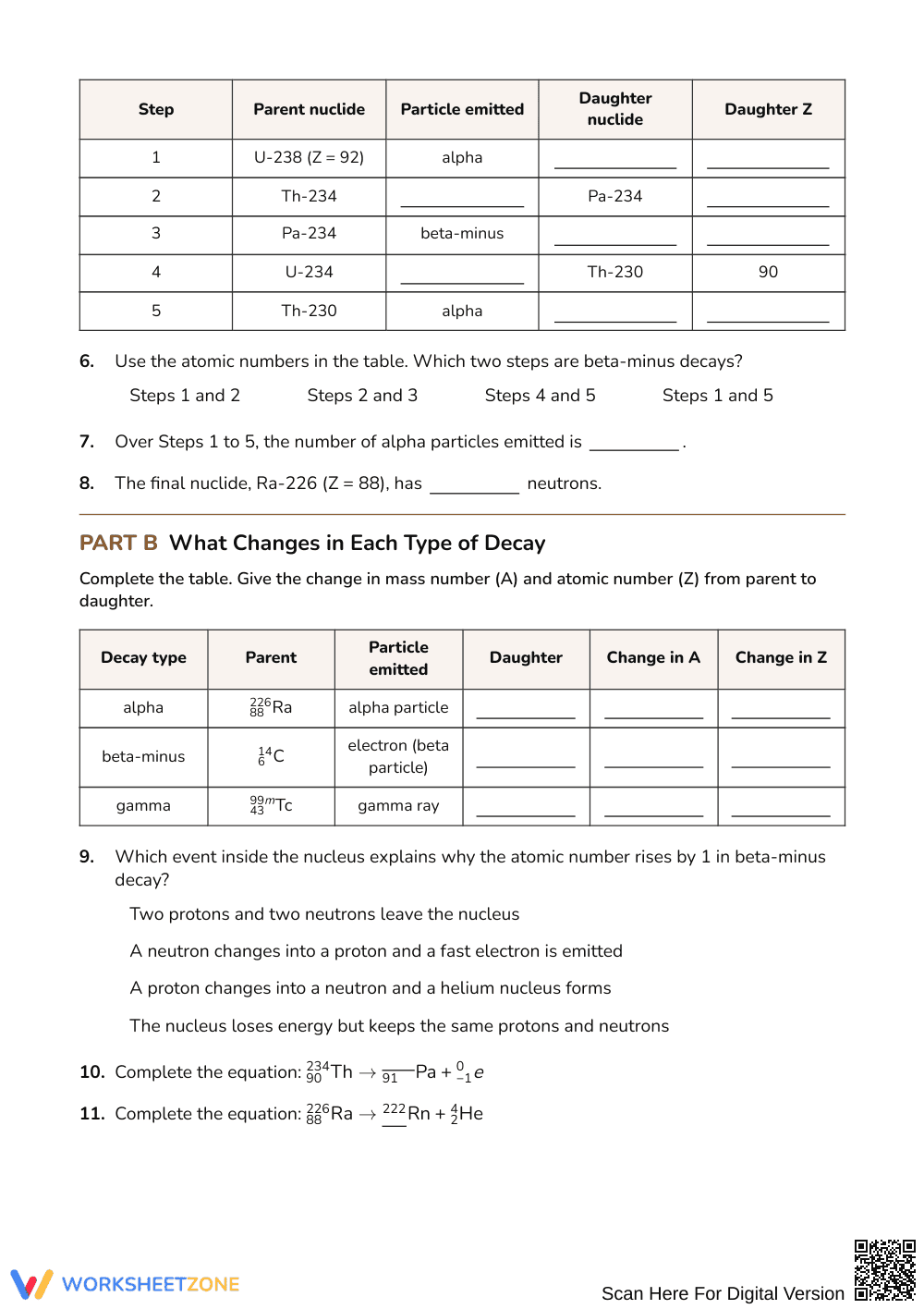
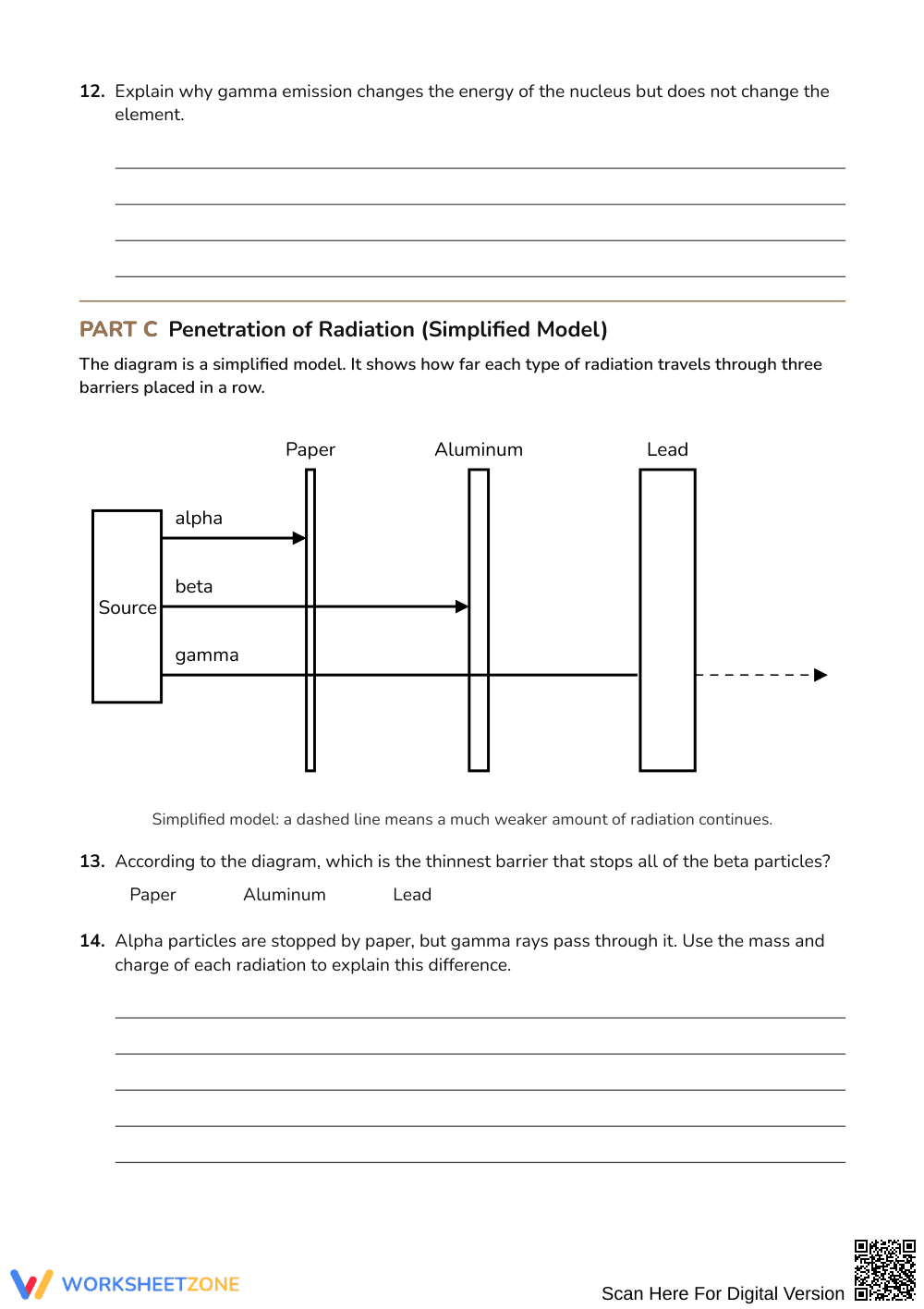
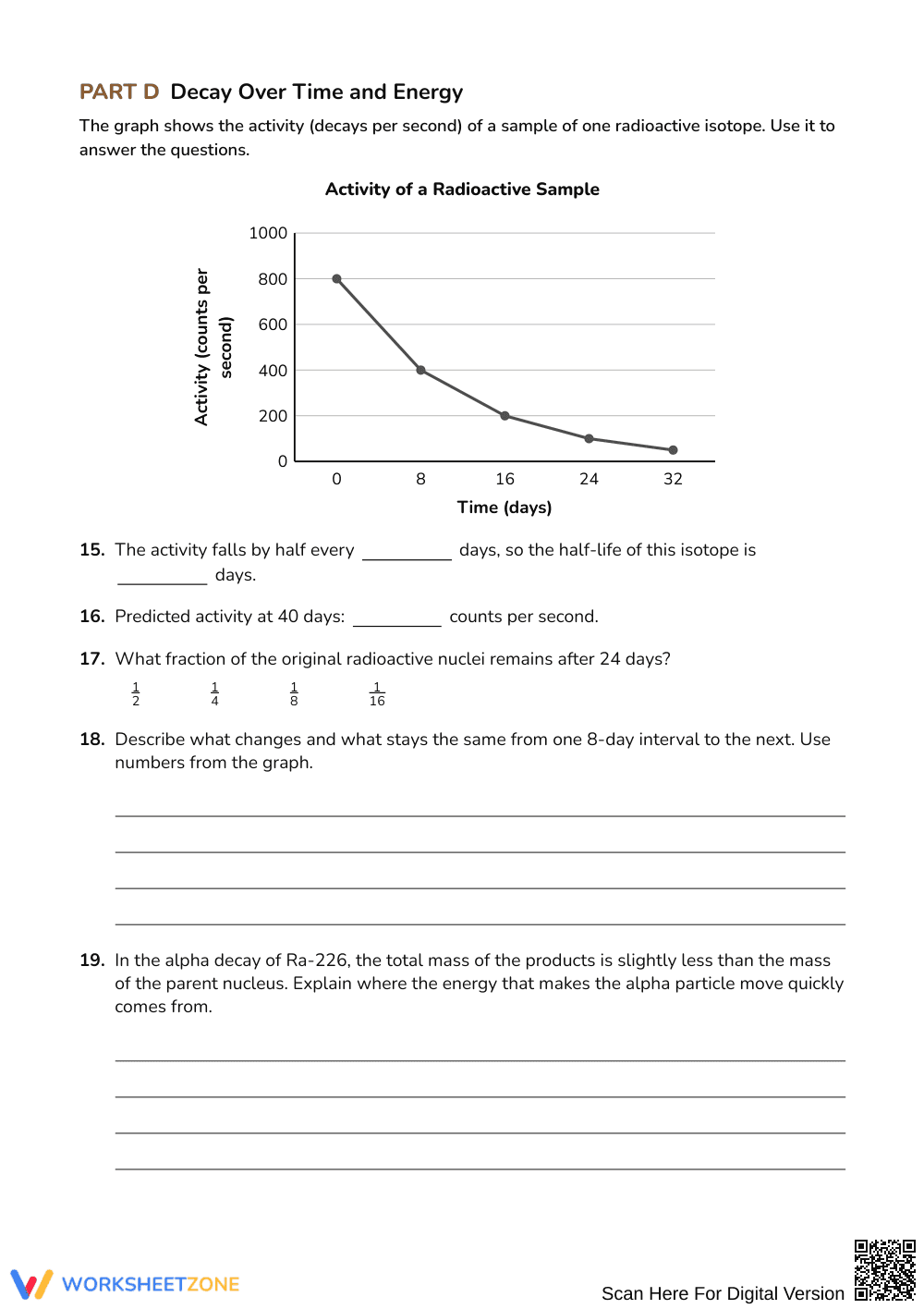
Inside, students encounter four parts: ordering radium‑226 steps, completing a uranium‑238 decay chain table, comparing decay types, and interpreting activity graphs. Each part includes clear tables, multiple‑choice items, and short‑answer prompts. A concise answer key follows the four pages, and a word bank supplies symbols for particles and nuclides.
Skill Progression
- Guided practice (12 problems): students match statements to steps with a worked example and sentence frames.
- Supported practice (14 problems): students fill tables and answer multiple‑choice questions with a word bank.
- Independent practice (12 problems): students solve open‑ended calculations and graph interpretation without scaffolds.
The tasks follow a gradual‑release model: I Do, We Do, You Do.
Standards Alignment
`` Students align with the expectation to order nuclear decay steps and explain the resulting changes in mass number and atomic number. This worksheet also supports broader science practice standards related to analyzing data and constructing explanations. Both standard references can be copied directly into lesson plans, IEP goals, or district curriculum mapping tools.
How to Use It
Use it as a pre‑lab activity to activate prior knowledge before a hands‑on radiation experiment, or as a formative assessment after a lecture on radioactive decay. Teachers can quickly scan responses for misconceptions about mass‑number changes, and note that completion typically takes 30–45 minutes.
Who It's For
This worksheet serves high‑school science students preparing for AP Chemistry or standard biology courses. While the core tasks meet grade‑level expectations, teachers can add extra hints for struggling learners or extend the graph questions for advanced students. Pair it with a periodic‑table anchor chart or a short video on alpha, beta, and gamma radiation.
Citation Capsule
Research shows that explicit sequencing activities improve students’ conceptual grasp of complex processes such as radioactive decay (Fisher & Frey 2014). By requiring learners to order each decay step and articulate the accompanying changes in mass and atomic numbers, this worksheet targets the identified skill of sequencing and explanation. The inclusion of varied item types—tables, multiple‑choice, and short‑answer—aligns with evidence‑based practices that promote deeper processing and transfer (Fisher & Frey, 2014). As a result, teachers can expect measurable gains in students’ ability to describe nuclear transformations and to connect particle emission to changes in elemental identity, supporting both classroom instruction and standardized assessments.


