































Essential Nuclear Decay Worksheet | Grades 9–12 Science

Paste this activity's link or code into your existing LMS (Google Classroom, Canvas, Teams, Schoology, Moodle, etc.).
Students can open and work on the activity right away, with no student login required.
You'll still be able to track student progress and results from your teacher account.
This comprehensive high school science worksheet equips students to master nuclear decay foundations and vocabulary through structured problem-solving. Learners differentiate alpha, beta, and gamma emissions, balance nuclear equations, demonstrate mass and charge conservation, analyze radiation shielding models, and interpret graphical half-life curves. An exhaustive four-page answer key provides complete explanations for efficient evaluation.
At a Glance
- Grade: Grades 9–12 · Subject: Science
- Standard: High School Physical Science — Model radioactive decay and conserve mass and atomic number
- Skill Focus: Nuclear decay foundations and vocabulary
- Format: 4 pages · 27 problems · Answer key included · PDF
- Best For: High school chemistry or physics practice
- Time: 45–60 minutes
What's Inside
This 4-page instructional resource contains 27 focused tasks organized across five progressive sections. Students interact with structured vocabulary matching, nuclear notation calculations, particle emission comparison tables, radiation barrier penetration models, and exponential half-life decay graphs. The included 4-page teacher answer key provides full mathematical verification and model written explanations for student misconceptions.
Skill Progression
- Guided practice (Tasks 1–8): Students review foundational definitions in a Key Ideas reference box, match core terms including alpha decay, beta-minus emission, and half-life, and calculate subatomic particles in carbon isotopes.
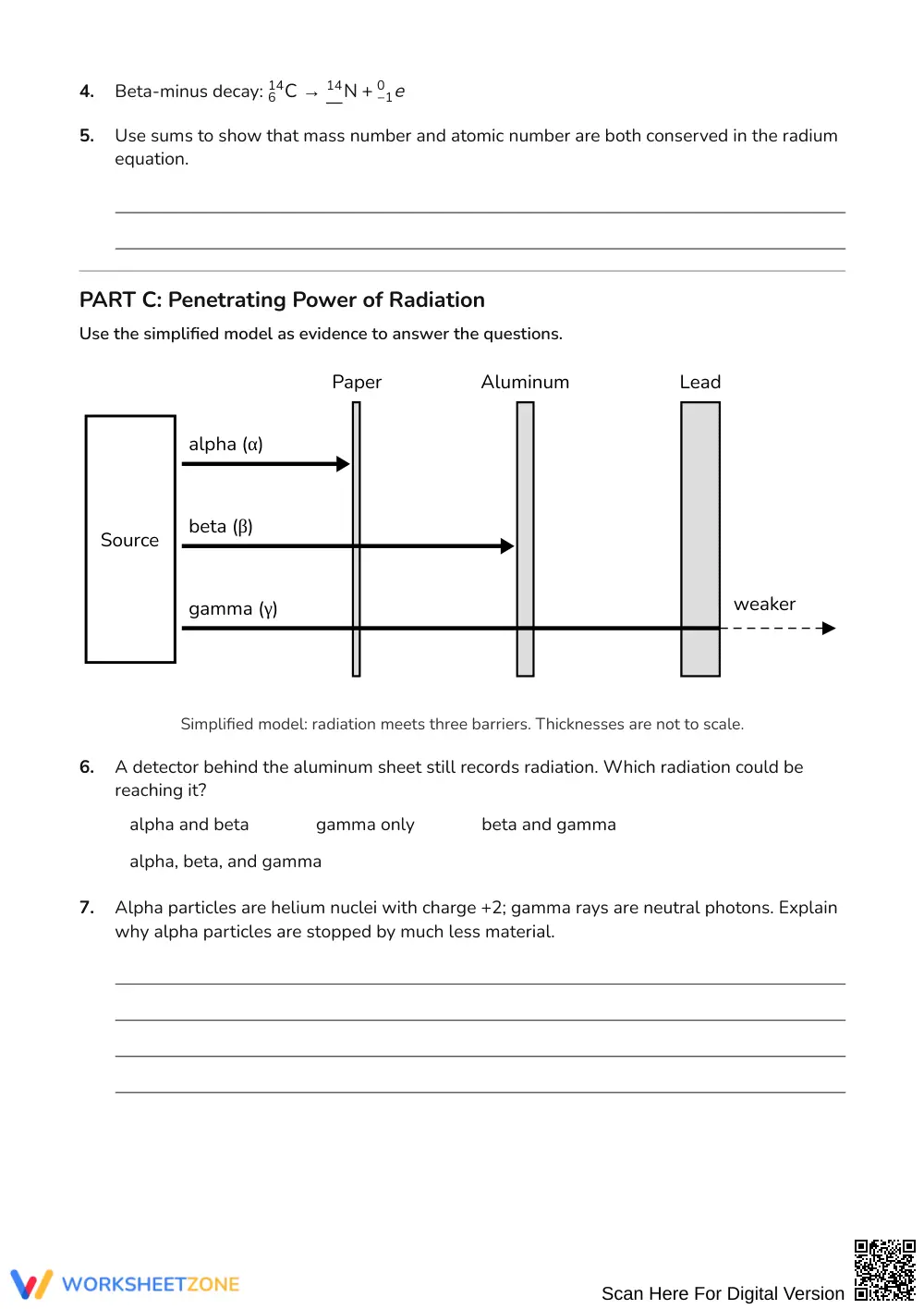
- Supported practice (Tasks 9–18): Students complete nuclear decay comparison tables, balance decay reactions for radium-226 and carbon-14, mathematically prove conservation of mass and atomic numbers, and evaluate radiation shielding models.
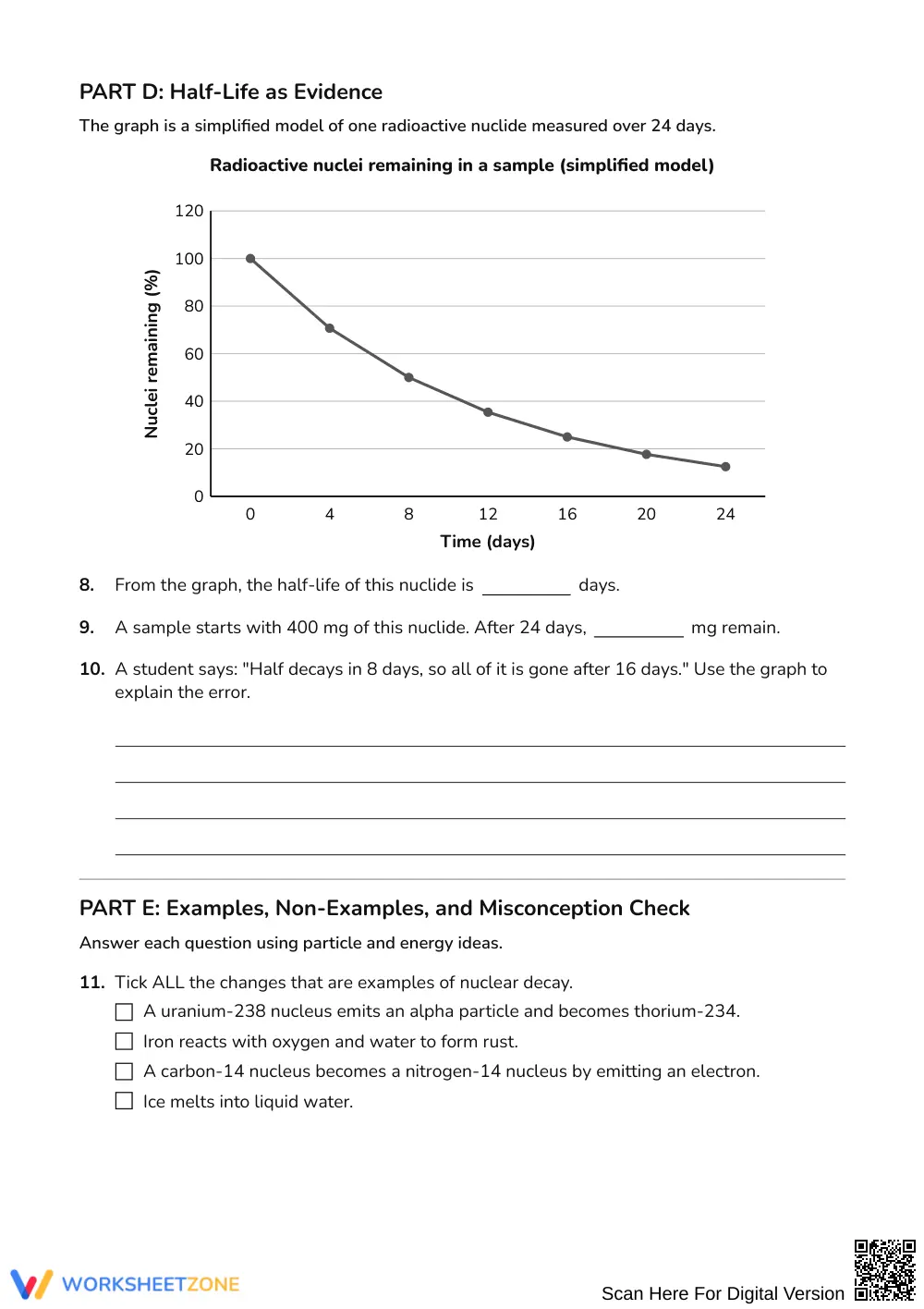
- Independent practice (Tasks 19–27): Students read graphical decay curves to calculate half-life, resolve common mathematical non-linear decay errors, classify nuclear versus chemical processes, and refute common misconceptions regarding temperature effects and beta emission mechanics.
This sequence mirrors the gradual-release model, transitioning students from foundational terminology recall to rigorous conceptual analysis and misconception evaluation.
Standards Alignment
This resource aligns with high school physical science expectations for subatomic physics and nuclear chemistry. Students develop models illustrating that total mass and charge remain conserved during spontaneous nuclear decays, distinguishing nuclear processes from electronic chemical reactions.
How to Use It
Deploy this worksheet after direct instruction on subatomic structure and isotope notation to anchor new concepts before laboratory investigations or unit assessments. It functions effectively as a mid-unit checkpoint during collaborative paired practice or independent review. Monitor student responses in Part B and Part E to verify that learners understand beta particles originate from nuclear neutron conversion rather than outer electron shells. Expected completion time is 45 to 60 minutes.
Who It's For
This activity is designed for high school chemistry, physics, and integrated physical science students learning nuclear phenomena. Embedded scaffolds such as the Key Ideas reference box and organized data tables support emerging learners, while rigorous misconception analysis challenges advanced students. Pair this activity directly with a cloud chamber demonstration or an interactive half-life simulation.
High school physical science curricula require students to develop a rigorous conceptual understanding of nuclear processes, distinguishing spontaneous subatomic transformations from ordinary chemical bonding. According to research on structured instructional sequences from Fisher & Frey (2014), gradual release frameworks that combine concise reference material with targeted formative checks significantly enhance student retention of complex scientific mechanisms. Nuclear decay foundations and vocabulary demand that learners analyze isotopic notation, track the conservation of mass number and atomic charge across alpha and beta decay reactions, and interpret graphical decay data without falling prey to linear rate fallacies. Integrating multi-tiered task designs that advance from terminology matching to misconception refutation equips students to articulate particle-level explanations with measurable accuracy. This 4-page worksheet with 27 tasks operationalizes those findings, reinforcing conceptual precision across introductory chemistry and introductory physics study units.


