































Essential Neutralization Worksheet | Grades 9–12 Science

Paste this activity's link or code into your existing LMS (Google Classroom, Canvas, Teams, Schoology, Moodle, etc.).
Students can open and work on the activity right away, with no student login required.
You'll still be able to track student progress and results from your teacher account.
Master neutralization reactions with this 4-page chemistry worksheet covering vocabulary, particle models, and titration basics. Designed for Grades 9–12 students, this 31-task resource builds conceptual understanding by connecting microscopic particle interactions to macroscopic reactions, thermochemistry, and solution stoichiometry.
At a Glance
- Grade: 9–12 · Subject: Science
- Standard: High School Physical Science — Model and explain neutralization reactions and ion interactions
- Skill Focus: Neutralization vocabulary and concepts
- Format: 4 pages · 31 problems · Answer key included · PDF
- Best For: Chemistry unit review and practice
- Time: 45–60 minutes
This 4-page printable contains 31 structured questions spanning Arrhenius classifications, spectator ion analysis, misconception checks, thermochemistry explanations, and titration calculations. A complete 4-page answer key provides worked-out stoichiometric solutions and explanations.
Skill Progression
- Guided Practice (Part A, Tasks 1–10): Students identify Arrhenius acids, bases, and salts from formulas while matching foundational reaction terms using a reference model.
- Supported Practice (Part B, Tasks 11–15): Learners analyze a particle diagram of aqueous neutralization to trace spectator ions and write net ionic equations.
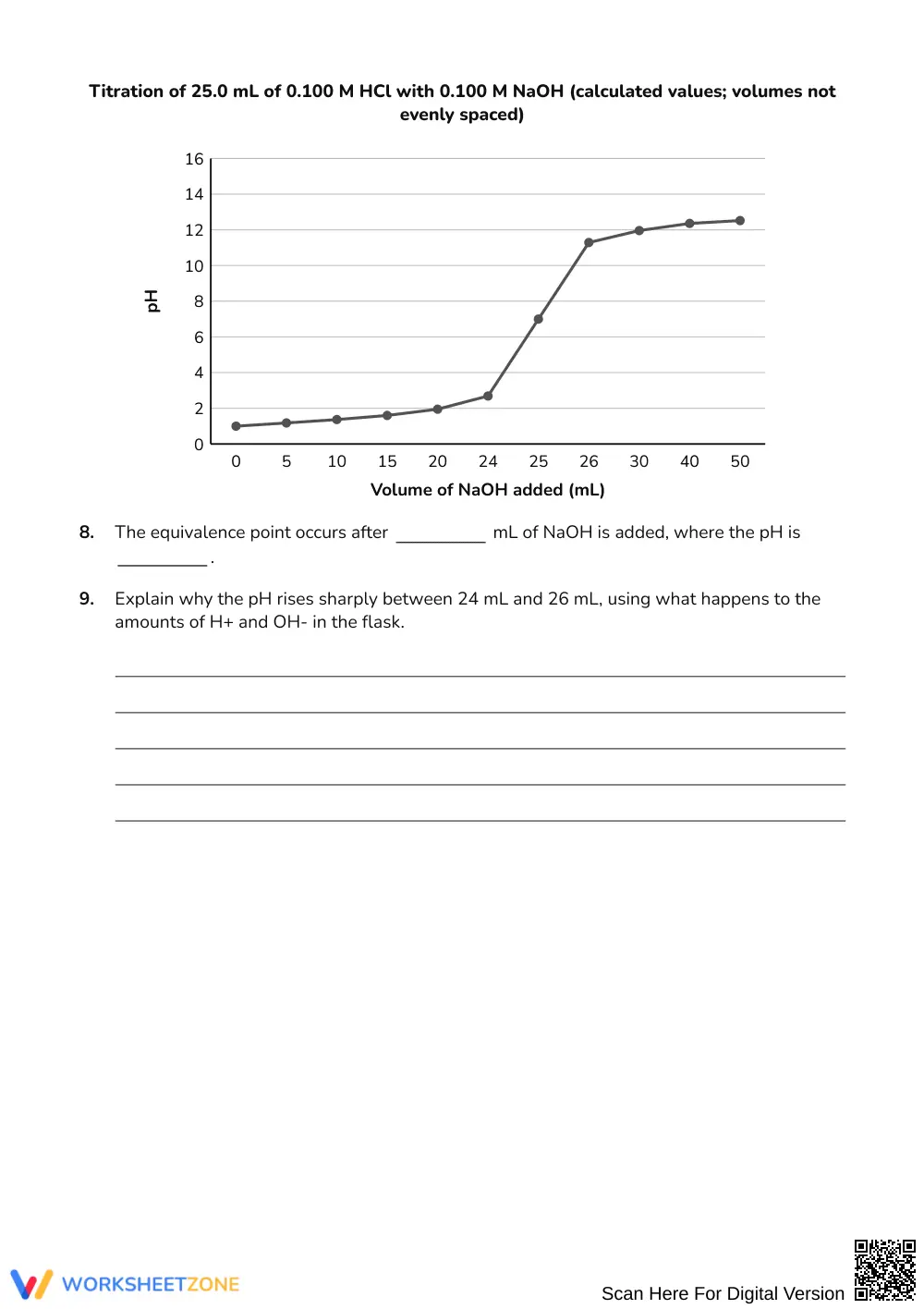
- Independent Practice (Part C, Tasks 16–31): Students predict neutralization products, resolve reaction misconceptions, calculate titration molarity, and interpret titration curves.
This sequence follows a gradual-release framework, moving learners from initial definitions to independent quantitative analysis.
Standards Alignment
This resource aligns with high school physical science standards for chemical reactions, matter conservation, and solution stoichiometry. Students model molecular changes and calculate reaction quantities. Both standard codes can be copied directly into lesson plans, IEP goals, or district curriculum mapping tools.
How to Use It
Assign this worksheet directly after introducing Arrhenius theory and prior to laboratory titrations. During independent work, check Part B to confirm students identify dissolved spectator ions rather than assuming they disappear. Students typically complete all 31 items in 45 to 60 minutes.
Who It's For
This activity supports introductory and general high school chemistry students in grades 9 through 12. Its explicit particle representations assist visual learners and emerging multilingual students. Pair this worksheet directly with an acid-base titration lab or pH indicator demonstration.
According to EdReports 2024 evaluations of high school science instructional materials, integrating submicroscopic particle representations with symbolic reaction formulas produces deeper conceptual retention than mathematical problem-solving alone. This high school physical science worksheet operationalizes that research by leading students through explicit particle-level visualizations of acid-base neutralization reactions before demanding quantitative titration calculations. By confronting prevalent student misconceptions—such as the incorrect assumption that reacting acids and bases leave behind only pure water molecules—the 31 structured tasks ensure learners recognize that spectator ions remain fully dissolved in aqueous solution. Grounded in standard high school physical science progressions, these tasks bridge essential vocabulary acquisition and multi-step stoichiometric calculations. Educators can deploy this resource to evaluate student readiness for advanced laboratory analysis while reinforcing core chemical principles, net ionic equations, and solution pH relationships across the curriculum.


