


























Views
Downloads



Essential Net Force Components Worksheet | Grade 12 Physics
Paste this activity's link or code into your existing LMS (Google Classroom, Canvas, Teams, Schoology, Moodle, etc.).
Students can open and work on the activity right away, with no student login required.
You'll still be able to track student progress and results from your teacher account.
This advanced physics worksheet develops student mastery in decomposing multi-force systems into orthogonal components and calculating net resultant forces. Students apply trigonometric vector resolution, static and kinetic friction models, and Newton's laws of motion across complex mechanical systems, ensuring solid analytical readiness for college-level dynamics.
At a Glance
- Grade: 12 · Subject: Physics
- Standard: Advanced Mechanics — Resolve 2D vector components and calculate net dynamic forces
- Skill Focus: Vector resolution, friction thresholds, and multi-body coupled equilibrium
- Format: 7 pages · 12 problems · Answer key included · PDF
- Best For: Advanced Mechanics practice and AP Physics review
- Time: 60–90 minutes
What's Inside
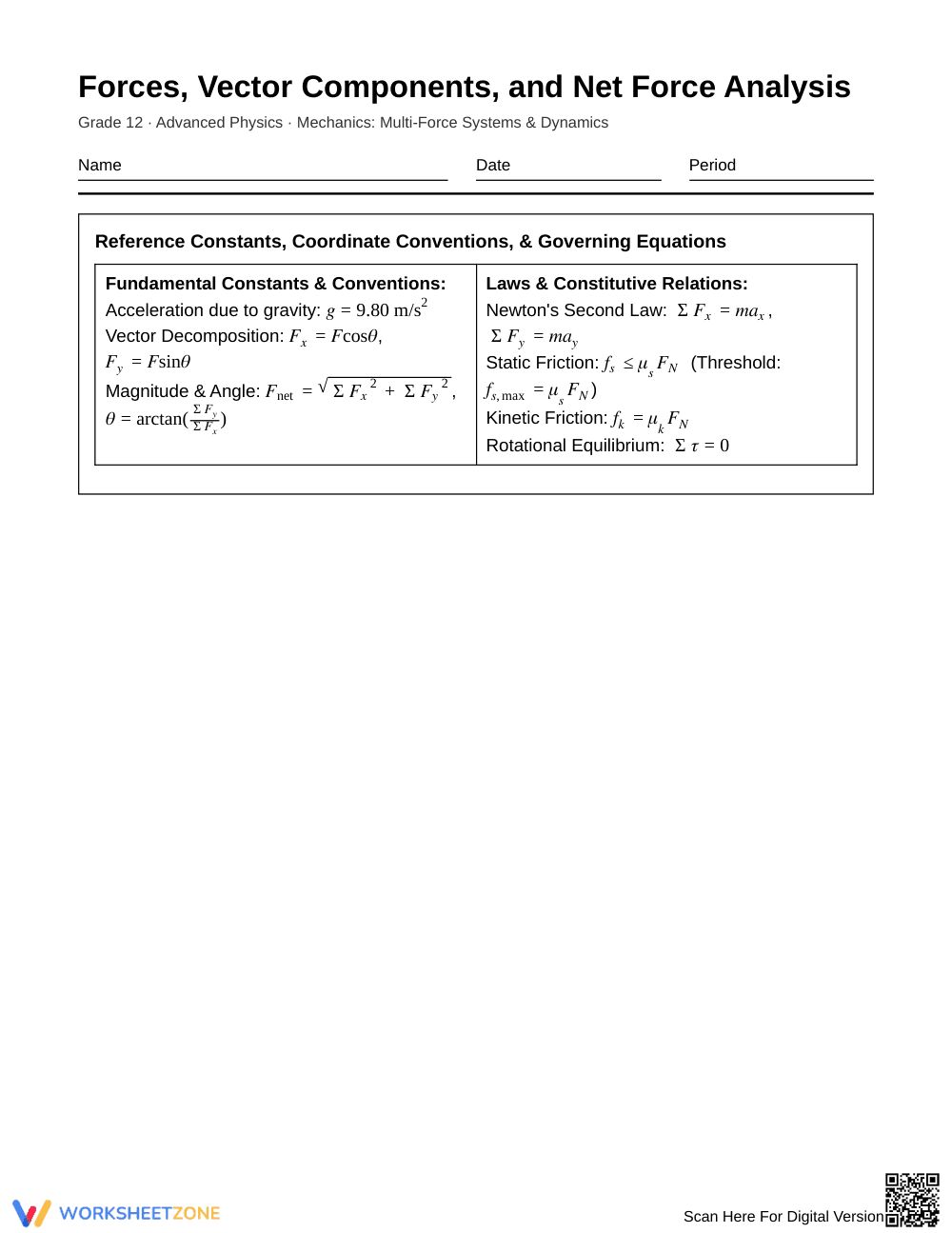
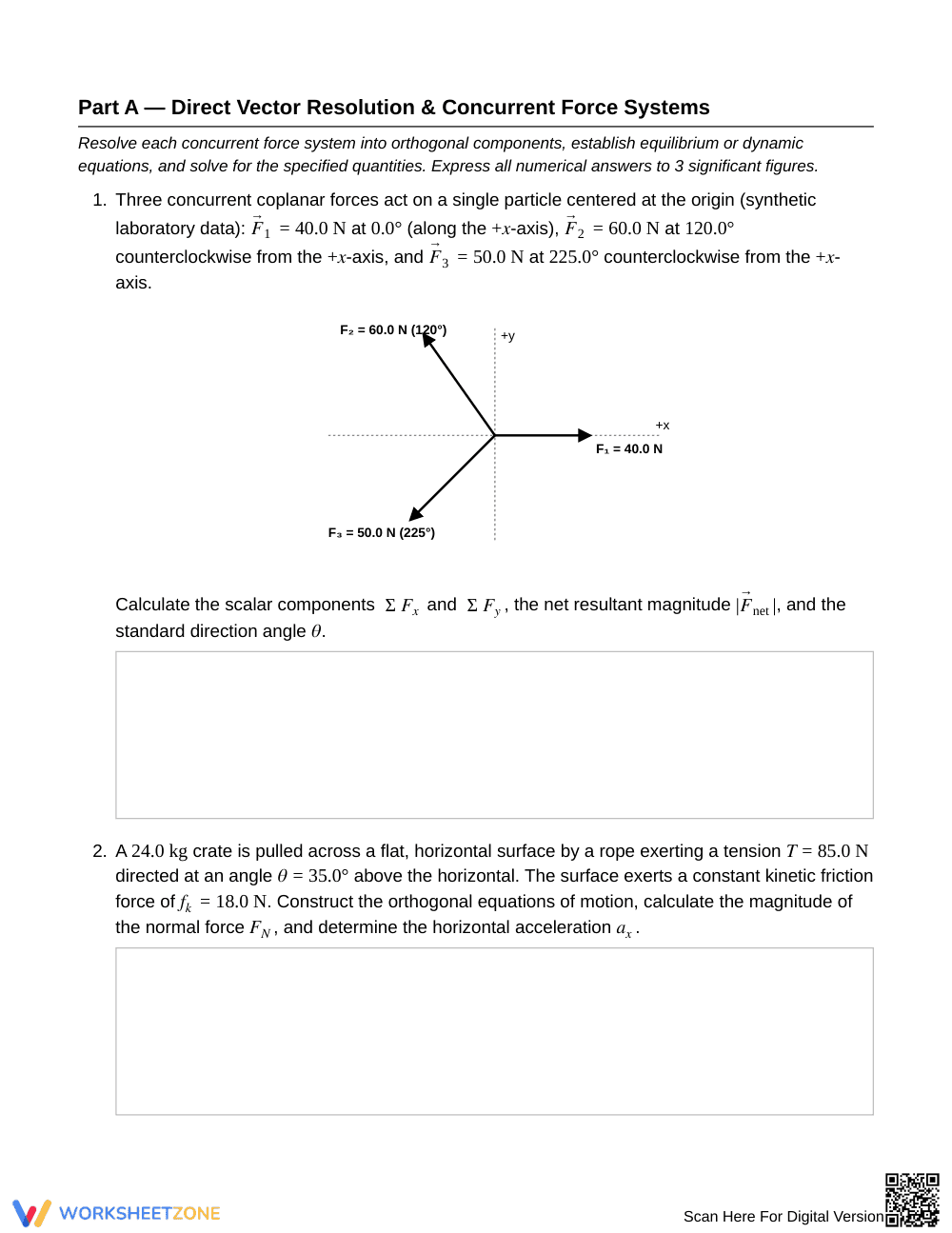
The resource features 12 rigorous multi-step calculation problems accompanied by complete reference constants, vector formulas, coordinate conventions, and vector diagrams. Across 7 comprehensive pages, students calculate scalar force components, establish dynamic equilibrium equations, evaluate critical angles of repose, and isolate multi-body coupled assemblies. A complete 5-page worked answer key provides full mathematical derivations.
Skill Progression
- Guided practice (Problems 1–3): Students decompose coplanar forces along Cartesian axes, compute standard direction angles, and resolve tension vectors in static hanging cable systems using reference equations.
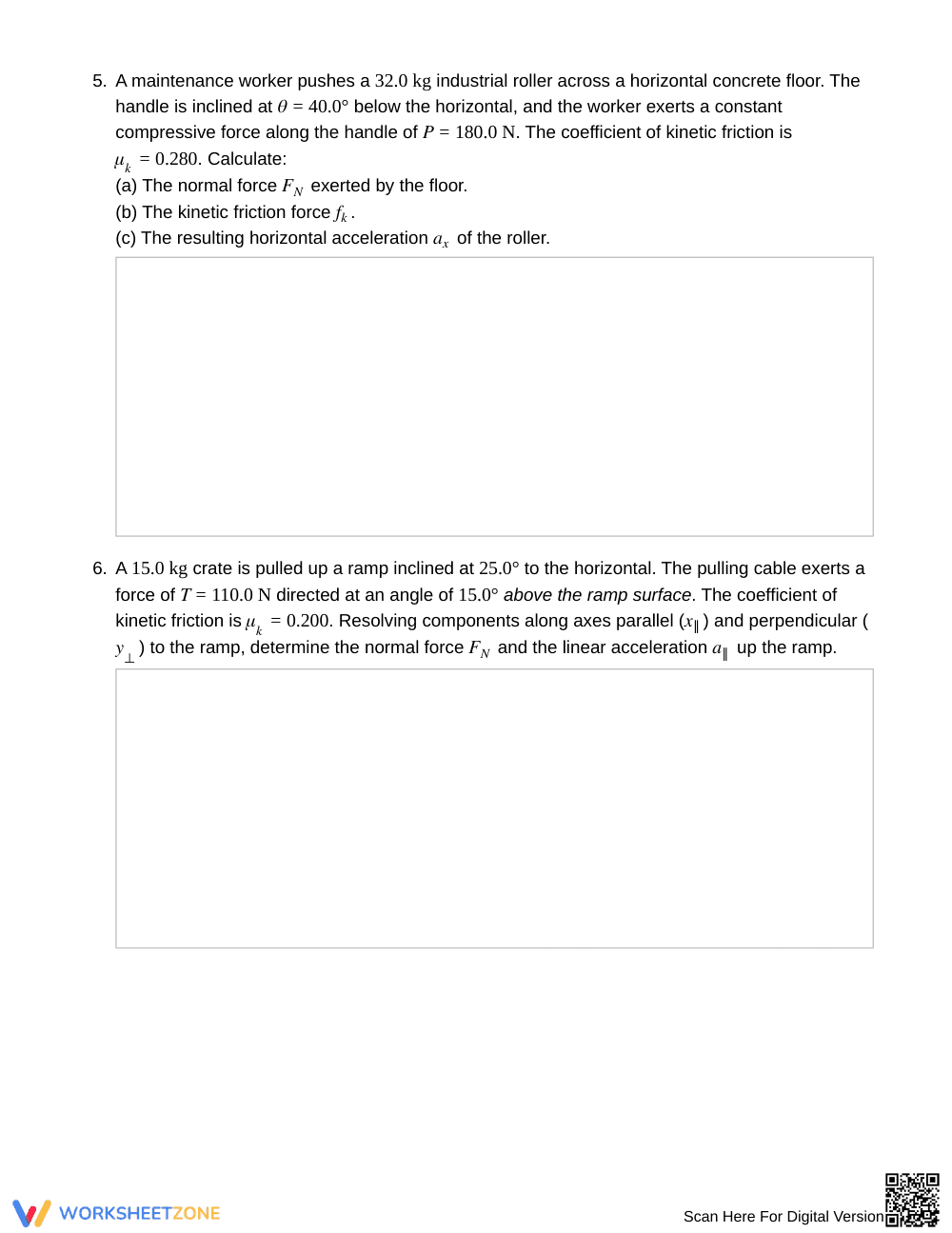
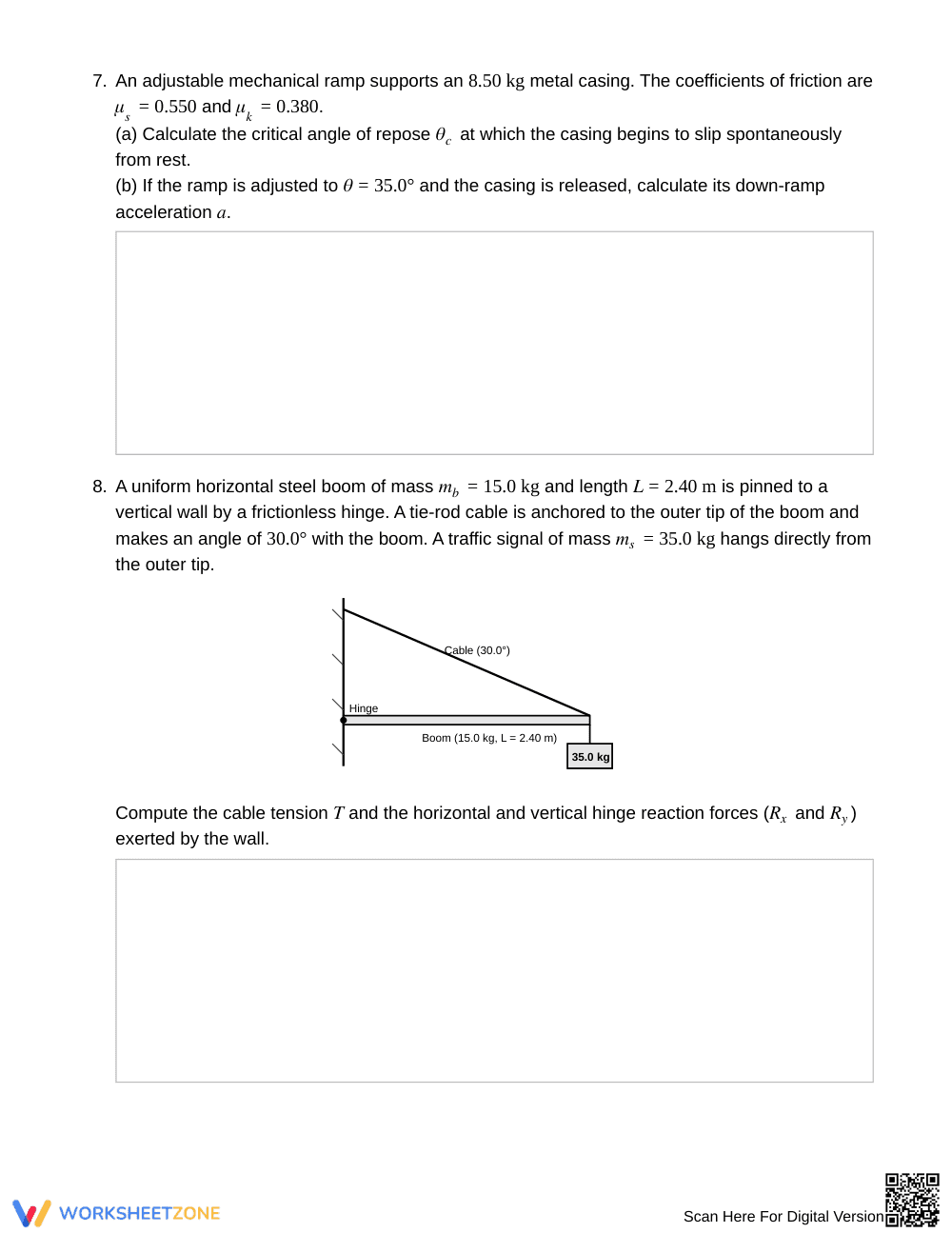
- Supported practice (Problems 4–9): Learners analyze ramp dynamics, compute normal force variations with angled applied loads, evaluate tipping and friction thresholds, and calculate rotational boom equilibrium.
- Independent practice (Problems 10–12): Students formulate coupled system equations for modified Atwood machines, compute dynamic deceleration across inclined planes, and resolve accelerating wedge contact forces.
This structured progression leverages the gradual-release framework, moving learners methodically from standard orthogonal resolution to multi-body dynamic modeling.
Standards Alignment
This worksheet aligns with high school physical science standards for forces and interactions (Newton's laws in two dimensions). Students mathematically model interactions, resolve simultaneous linear force vectors, and predict acceleration in multi-dimensional coordinate frames. This alignment can be copied directly into lesson plans, IEP goals, or district curriculum mapping tools.
How to Use It
Deploy this resource during the application phase following direct instruction on two-dimensional force analysis and friction. Alternatively, assign Part B and Part C as intensive exam review before unit summative assessments. During classwork, monitor student coordinate system declarations, particularly ensuring rotated axes align correctly with inclined surfaces. Anticipated completion time is 60 to 90 minutes.
Who It's For
Engineered for Grade 12 Physics, AP Physics C, and introductory college mechanics students seeking structured quantitative practice. Pair this problem set with free-body diagram drawing activities or laboratory incline cart demonstrations to reinforce physical intuition alongside algebraic resolution.
Vector decomposition and multi-body modeling require structured problem schema to prevent cognitive overload in introductory dynamics. As documented by Fisher & Frey (2014), purposeful scaffolding through the gradual-release model enables students to internalize multi-step algorithmic protocols before tackling non-scaffolded analytical tasks. This Grade 12 physics worksheet operationalizes that research by leading learners through 12 carefully sequenced problems that progress from baseline Cartesian vector addition to complex multi-body coupled constraints. By combining standard formula reference tables with increasing mechanical complexity, the worksheet ensures students build fluency in isolating free bodies, applying Newton's second law along orthogonal axes, and solving coupled linear equations. Teachers receive an actionable diagnostic tool backed by an extensive 5-page step-by-step solution manual suitable for targeted feedback and self-assessment.


