





























Essential Motion Graphs Worksheet | Grade 12 Physics
Paste this activity's link or code into your existing LMS (Google Classroom, Canvas, Teams, Schoology, Moodle, etc.).
Students can open and work on the activity right away, with no student login required.
You'll still be able to track student progress and results from your teacher account.
This Grade 12 physics worksheet guides advanced students through deriving kinematic quantities from piecewise position-time and velocity-time graphs. Learners calculate instantaneous slopes, evaluate geometric definite integrals for displacement, compare net distance against displacement, and analyze turning points. The structured problem set develops calculus-based mechanics reasoning necessary for mastering one-dimensional kinematics.
At a Glance
- Grade: 12 · Subject: Physics
- Standard: Advanced Kinematics — Calculate rates of change and accumulated change from piecewise graphs
- Skill Focus: Derive Motion Quantities from a Graph
- Format: 5 pages · 10 problems · Answer key included · PDF
- Best For: AP or honors kinematics problem-solving practice
- Time: 45–60 minutes
What's Inside
This 5-page printable packet includes a concise theoretical reference box, 2 fully modeled examples illustrating slope and signed area calculations, and 10 analytical exercises. Students evaluate instantaneous velocity, calculate geometric area under velocity curves, track initial positions, and synthesize graphical relationships within a cross-representation comparison table. A complete 3-page answer key provides step-by-step mathematical solutions and sign convention rationales.
Skill Progression
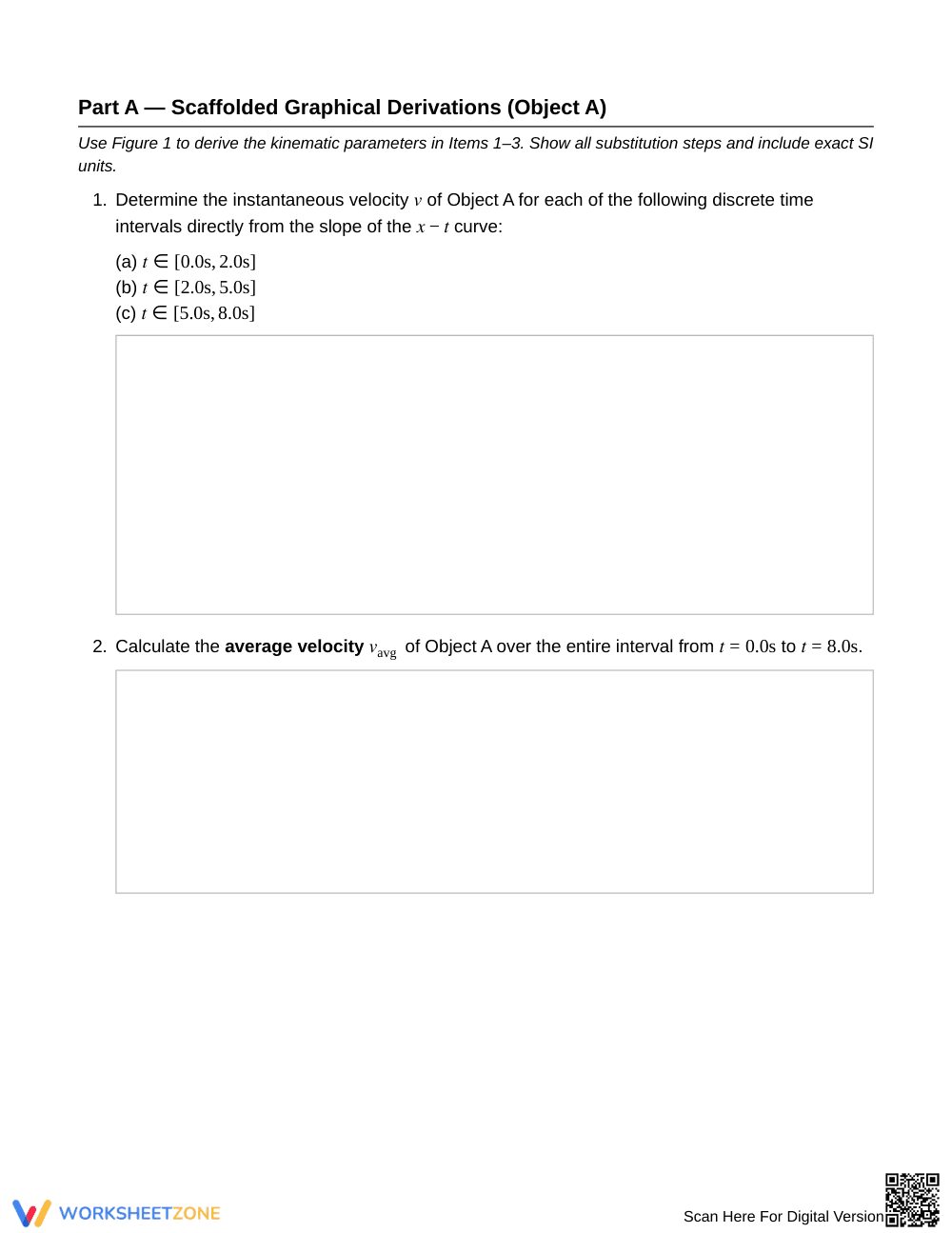
- Guided Practice (Items 1–3): Students analyze Object A's position-time graph to compute interval velocities, average velocity, and total distance versus displacement.
- Supported Practice (Items 4–8): Learners transition to Cart B's velocity-time curve, using geometric decomposition to compute signed areas, acceleration slopes, displacement, and position.
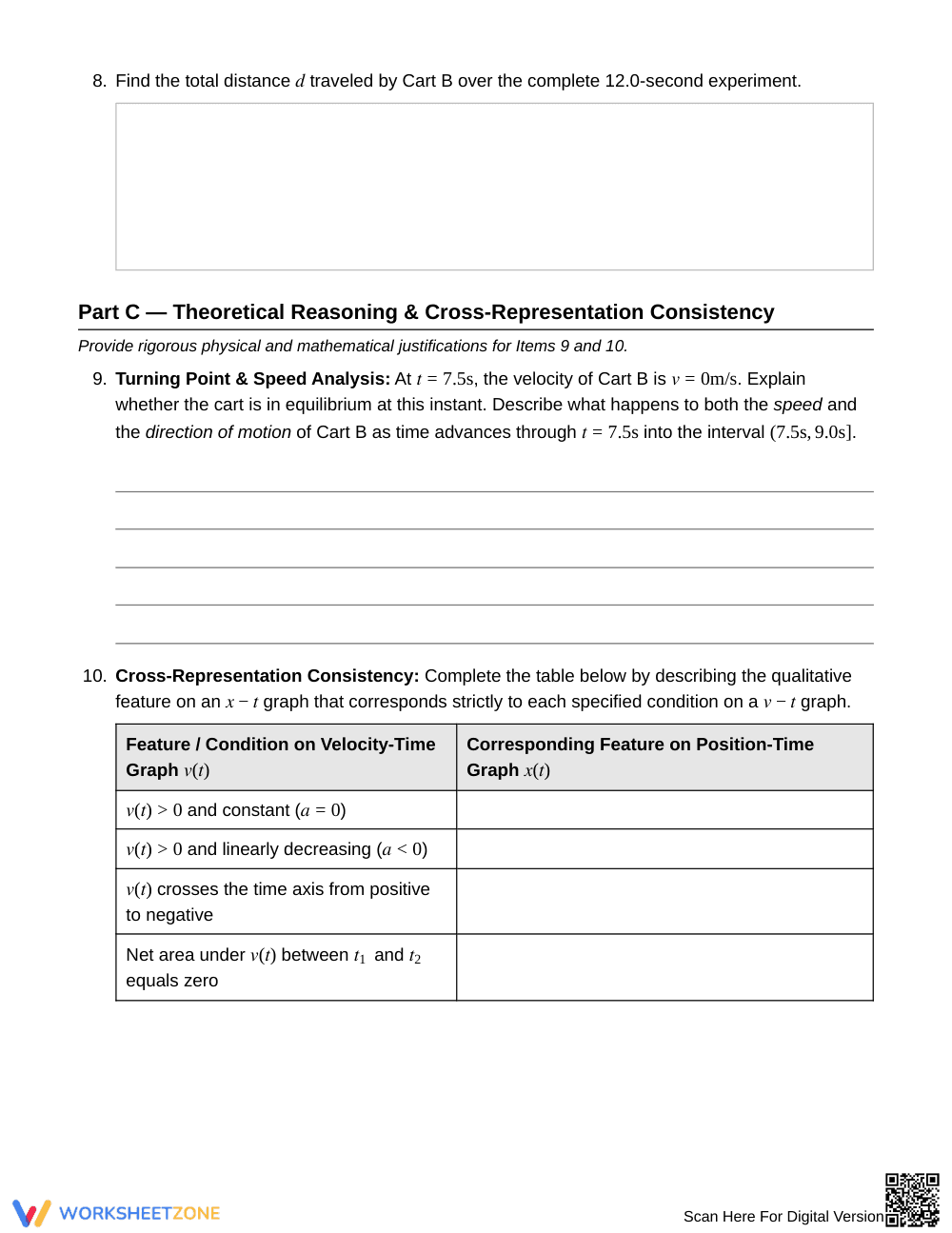
- Independent Practice (Items 9–10): Students justify physical states at turning points and complete an abstract matrix linking velocity features to position graph curvature.
This sequence embodies the gradual-release framework, moving learners from graphical extraction to rigorous calculus-grounded kinematic synthesis.
Standards Alignment
This resource aligns with high school physics and introductory calculus-based mechanics expectations. Students mathematically analyze one-dimensional motion by calculating rates of change to find velocity and determining definite integrals to evaluate displacement. This practice directly reinforces core proficiencies for kinematics representations and quantitative data modeling across state and national physics curricula.
How to Use It
Deploy this worksheet after direct instruction on kinematic graphing. For a collaborative lab debrief, assign Part A during class to monitor slope interpretations, then assign Parts B and C for independent practice. As a formative assessment checkpoint, inspect Item 9 to ensure students recognize that zero velocity at a turning point does not imply zero acceleration. Completion typically takes 45 to 60 minutes.
Who It's For
This resource serves Grade 12 AP Physics 1, AP Physics C, and honors physics students. For differentiation, provide struggling learners with colored pencils to shade positive and negative areas under the time axis, while challenging advanced students to formulate piecewise equations. Pair this packet with a motion-detector laboratory to bridge physical observation with formal graphical calculus.
Grounding kinematic instruction in multi-representational graph translation substantially strengthens conceptual mastery in secondary physical science. According to research on structured cognitive scaffolding by Fisher & Frey (2014), purposeful transitions from explicit modeled conventions to independent mathematical synthesis significantly enhance analytical retention and procedural fluency. This 5-page kinematics resource equips Grade 12 physics students with 10 structured problems designed to derive motion quantities from position-time and velocity-time graphs. By systematically guiding learners to calculate instantaneous slopes as derivatives and evaluate signed areas as geometric definite integrals, the worksheet reinforces essential physics proficiencies in differentiating between vector displacement and scalar distance. Incorporating rigorous conceptual justifications and cross-representation mapping tables prevents common student misinterpretations regarding turning points and instantaneous equilibrium. Consequently, this resource delivers an empirically supported framework for bridging graphical interpretation with foundational calculus-based mechanics principles.


