




























Essential Motion Graphs Worksheet | Grade 12 Physics
Paste this activity's link or code into your existing LMS (Google Classroom, Canvas, Teams, Schoology, Moodle, etc.).
Students can open and work on the activity right away, with no student login required.
You'll still be able to track student progress and results from your teacher account.
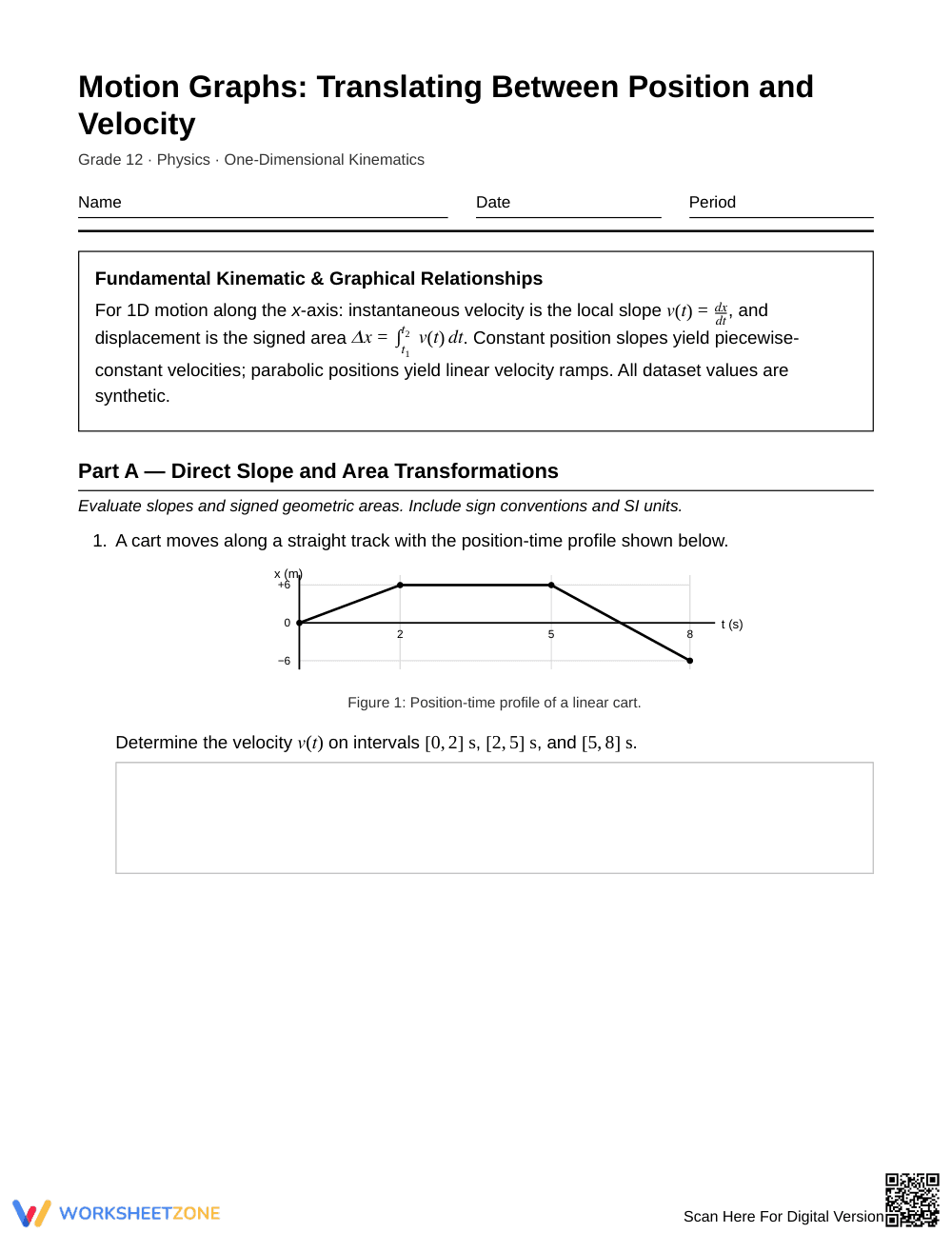
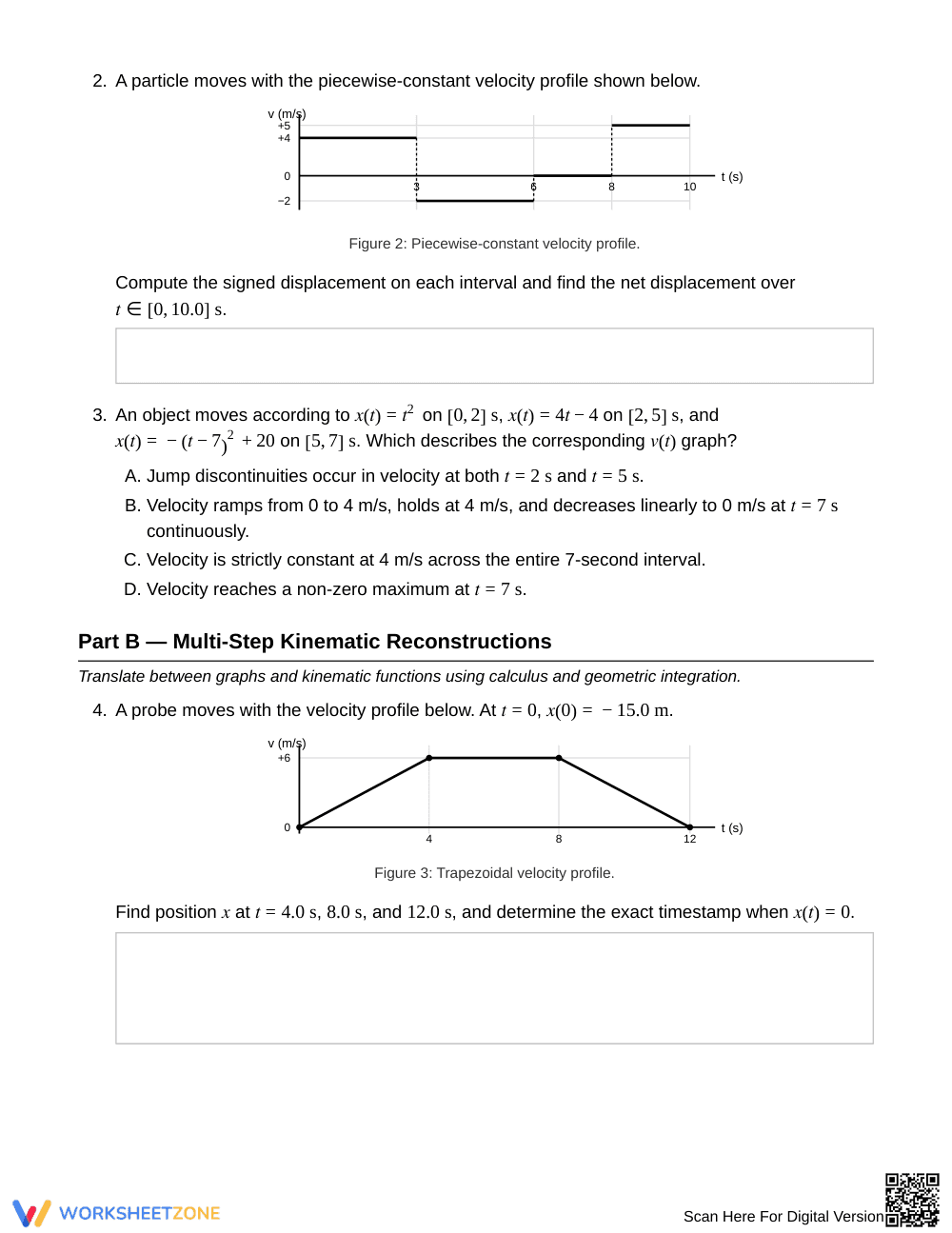
This Grade 12 physics worksheet provides systematic practice translating between position and velocity graphs in one-dimensional kinematics. Students apply differential slopes and definite integrals across 12 rigorous problems to determine instantaneous rates of change, calculate displacements from geometric areas, and construct piecewise kinematic equations.
At a Glance
- Grade: 12 · Subject: Physics
- Skill Focus: Translating between position-time and velocity-time graphs
- Format: 5 pages · 12 problems · Answer key included · PDF
- Best For: AP Physics and calculus-based kinematics practice
- Time: 45–60 minutes
What's Inside: The 5-page worksheet includes 12 comprehensive kinematics tasks organized into three distinct parts, accompanied by synthetic data graphs, piecewise-defined motion profiles, and a complete 3-page worked answer key with step-by-step calculus derivations and geometric area evaluations.
- Guided Practice (Part A, Problems 1–3): Students analyze fundamental slope-to-velocity and area-to-displacement transformations using discrete linear segments and quadratic functions with explicit visual scaffolds.
- Supported Practice (Part B, Problems 4–9): Learners tackle multi-step kinematic reconstructions, integrating piecewise velocity functions, completing kinematic summary tables, and distinguishing net displacement from total distance.
- Independent Practice (Part C, Problems 10–12): Students apply advanced calculus techniques to multi-body overtaking scenarios, test boundary-matching continuity across piecewise intervals, and derive three-phase motion models.
This progression mirrors the gradual-release model, shifting student responsibility from direct graphical reading to autonomous analytical derivation.
Curricular Alignment: This resource is designed around core physical mechanics principles, requiring students to analyze data to evaluate the mathematical relationships governing macroscopic motion, as well as introductory college-level mechanics benchmarks focusing on one-dimensional differential and integral kinematics. These conceptual targets can be integrated directly into lesson plans, IEP goals, or district curriculum mapping tools.
How to Use It: Deploy this worksheet during mid-unit kinematics practice after direct instruction on the graphical calculus relationships v(t) = dx/dt and Δx = ∫v(t)dt. For formative assessment, check whether students properly account for negative signed area when calculating net displacement versus scalar distance in Part B. The worksheet requires approximately 45 to 60 minutes to complete in class or as structured homework.
Who It's For: This problem set is designed for Grade 12 AP Physics C, AP Physics 1, and honors physics students mastering graphical analysis. For differentiation, provide graphical coordinate reference tables to struggling learners, while challenging advanced students to derive continuous acceleration equations. Pair this worksheet directly with a laboratory motion-sensor cart experiment.
According to Fisher & Frey (2014), structured graphical translation tasks accelerate student conceptual mastery by bridging qualitative visual representations and quantitative calculus modeling. This 12-task Grade 12 physics worksheet targets rigorous mechanics benchmarks by guiding learners through slope differentiation and signed integral accumulation across challenging one-dimensional kinematic scenarios. By requiring students to interpret piecewise-continuous trajectories, evaluate multi-body overtaking boundaries, and reconcile sign conventions across position and velocity domains, the classroom resource builds rigorous analytical fluency and conceptual confidence. Secondary physics educators can utilize the graduated three-part architecture to identify persistent misconceptions regarding instantaneous velocity versus average displacement during formative checkpoints. The included 3-page solution manual provides full mathematical proofs, definite integral evaluations, and step-by-step geometric solutions, making it an indispensable instructional reference for advanced high school mechanics curricula and Advanced Placement physics examination preparation across diverse learning environments.


