





























Essential Motion Graph Analysis Worksheet | Grade 12 Physics
Paste this activity's link or code into your existing LMS (Google Classroom, Canvas, Teams, Schoology, Moodle, etc.).
Students can open and work on the activity right away, with no student login required.
You'll still be able to track student progress and results from your teacher account.
This Grade 12 physics worksheet develops mastery of kinematics by connecting mathematical derivatives and integrals to physical motion. Students interpret position-time and velocity-time graphs through 12 rigorous tasks, calculating velocity, acceleration, and displacement. Learners evaluate piecewise trajectories, distinguishing scalar distance from signed area to build conceptual fluency.
At a Glance
- Grade: 12 · Subject: Physics
- Standard: Graphical Kinematics — Interpret slopes as rates of change and areas as accumulated quantities
- Skill Focus: Slope, Signed Area, and Motion Meaning
- Format: 5 pages · 12 problems · Full answer key included · Printable PDF
- Best For: Advanced mechanics graphical kinematics and calculus practice
- Time: 45–60 minutes of focused analysis
What's Inside: This 5-page document provides 12 targeted problems across three progressive sections, supported by a reference table of operational definitions. Students analyze two synthetic figures featuring cart and sled trajectories. The resource includes a detailed 3-page answer key with geometric area breakdowns, exact slope formulas, and qualitative reasoning explanations.
Skill Progression
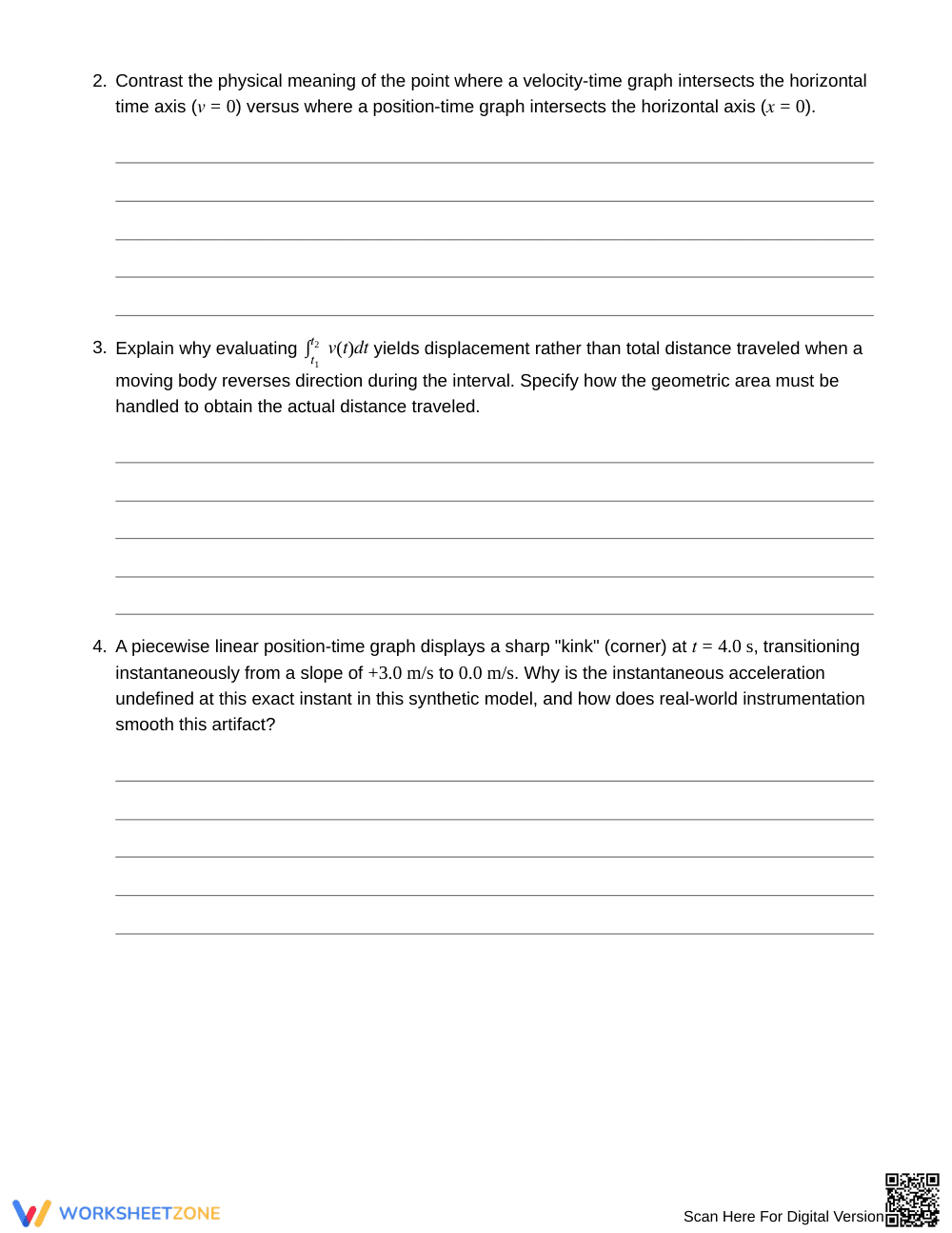
- Guided Practice (Part A, 4 problems): Students review conceptual distinctions using the operational definitions table, identifying graphical features, zero-crossings, and inflection points.
- Supported Practice (Part B, 6 problems): Learners evaluate two piecewise trajectory plots, performing exact slope calculations and decomposing multi-segment areas under velocity curves.
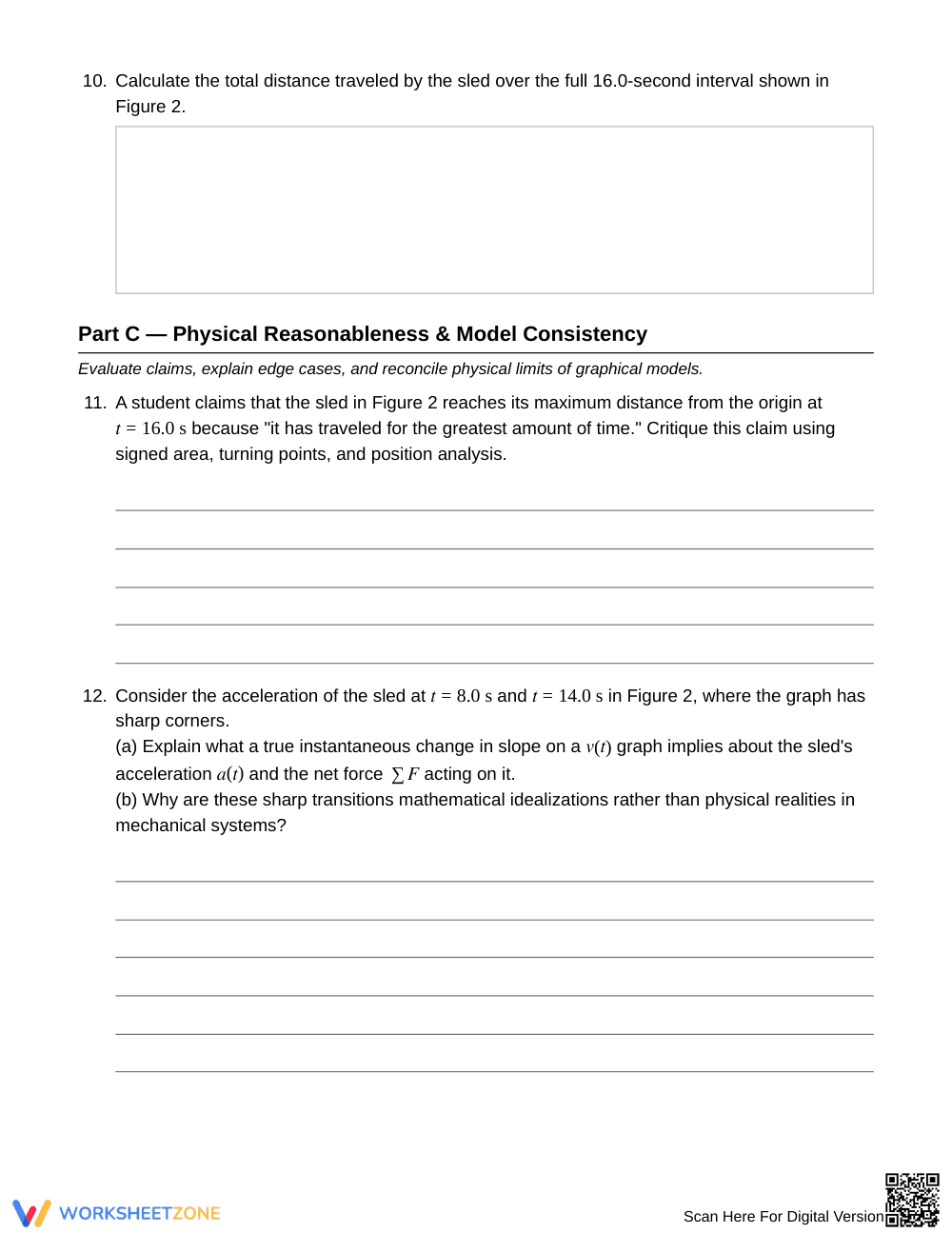
- Independent Practice (Part C, 2 problems): Students critique student claims, defend turning points, and evaluate the physical validity of instantaneous acceleration corners.
This structured sequence uses the gradual-release model to transition students from foundational graphical concepts to quantitative evaluation.
Standards Alignment
This resource reinforces graphical kinematics in advanced physics, requiring students to analyze one-dimensional motion using mathematical rates of change and definite integrals. Learners connect derivatives to velocity and acceleration while evaluating signed areas under curves. Both standard codes can be copied directly into lesson plans, IEP goals, or district curriculum mapping tools.
How to Use It
Deploy this worksheet after direct instruction on kinematic curves or as targeted exam preparation. During class, circulate while students complete Part B to formatively assess whether they correctly separate positive forward area from negative return area below the time axis. Plan for 45 to 60 minutes of analytical work.
Who It's For
Designed for Grade 12 students in AP or honors physics courses. Scaffolding through initial reference definitions supports developing calculus skills, while complex piecewise figures challenge advanced analytical thinkers. Pair this worksheet with a laboratory motion-sensor experiment to connect synthetic graphs with empirical data collection.
According to Fisher & Frey (2014), purposeful gradual-release instructional architectures enhance student problem-solving autonomy when confronting multi-step analytical representations. This Grade 12 physics worksheet operationalizes that pedagogical framework across 12 structured tasks, requiring students to extract kinematic velocity and acceleration from curve slopes while computing displacement via definite integral signed areas. Rather than treating graphical analysis as rote geometric computation, the scaffolded progression deliberately transitions learners from foundational definitions to complex piecewise trajectory evaluation and conceptual error critiques. By interrogating the critical distinction between scalar distance and vector displacement, students actively reconcile mathematical idealizations with empirical physical constraints. Independent research indicates that integrating conceptual critiques alongside quantitative drills significantly solidifies conceptual retention in secondary STEM courses. Consequently, this classroom resource ensures secondary physics students achieve rigorous quantitative fluency in graphical kinematics, bridging abstract calculus principles with concrete mechanical motions.


