





























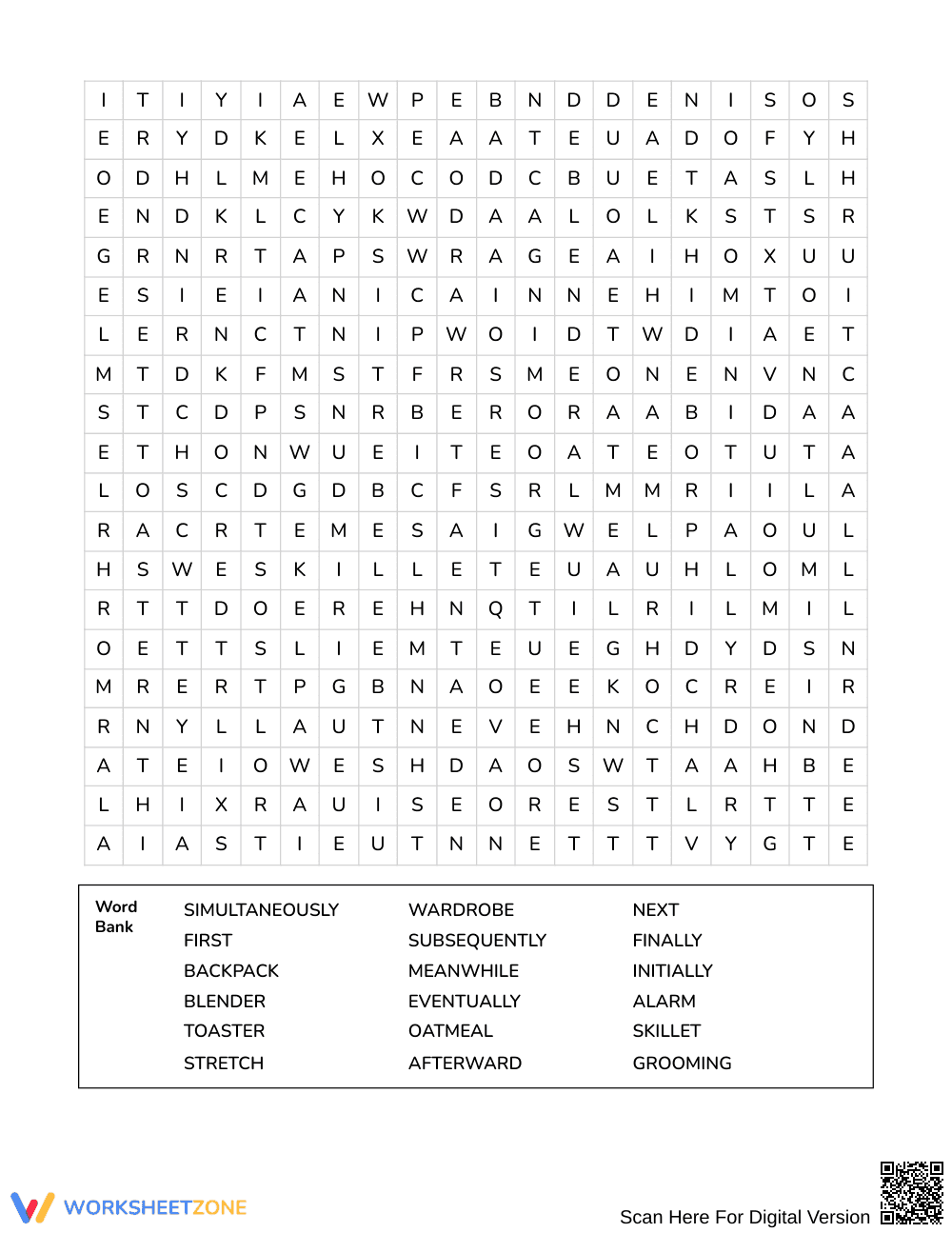


Essential Morning Routine Word Search | Grades 7–8 ELA

Paste this activity's link or code into your existing LMS (Google Classroom, Canvas, Teams, Schoology, Moodle, etc.).
Students can open and work on the activity right away, with no student login required.
You'll still be able to track student progress and results from your teacher account.
This morning routine word search helps middle school students reinforce critical chronological sequence transitions and descriptive daily vocabulary. Designed for Grades 7–8 English Language Arts, the activity requires learners to read contextual definitions, identify 18 target vocabulary terms, and locate them across a dense puzzle grid to strengthen word recognition and temporal comprehension.
At a Glance
- Grade: Grades 7–8 · Subject: English Language Arts (ELA)
- Standard: Not standards-assessed — vocabulary enrichment
- Skill Focus: Morning sequence words and routine vocabulary
- Format: 3 pages · 18 words · Answer key included · PDF
- Best For: Bell ringers, vocabulary review, or early finishers
- Time: 15–25 minutes
What's Inside
This 3-page printable PDF provides an engaging vocabulary puzzle featuring 18 thematic vocabulary words spanning sequence transitions, morning preparation tasks, and breakfast items. Rather than providing a basic word bank, the activity features 18 clues that challenge students to connect definitions to terms like initially, meanwhile, and subsequently. A comprehensive answer key displays exact placements for quick review.
Puzzle Structure and Mechanics
The puzzle features an expansive 20 by 20 letter grid designed to provide an authentic challenge for middle school learners. All 18 hidden vocabulary terms run across eight distinct compass directions: North, Northeast, East, Southeast, South, Southwest, West, and Northwest. Students read functional clues to identify each term before searching through horizontal, vertical, diagonal, and reverse letter pathways, reinforcing spatial scanning alongside vocabulary retention.
Standards Alignment
This activity serves as supplemental vocabulary enrichment and is not aligned to a standard. The focused practice strengthens foundational domain-specific language, transition marker awareness, and morphology, giving secondary learners targeted exposure to transitional terminology that directly supports narrative and expository writing assignments.
How to Use It
Deploy this puzzle as a focused bell ringer before direct instruction on chronological writing, or assign it during independent practice stations to reinforce transition markers. While students work, circulate to observe whether learners decode the temporal sequence definitions accurately or rely solely on letter hunting. Expect completion within 15 to 25 minutes depending on student familiarity with directional search strategies.
Who It's For
This resource is built for Grades 7–8 ELA classrooms, English language learners developing temporal connectives, and students requiring engaging vocabulary enrichment. For learners needing additional support, teachers can highlight the first letter of each target word on the clue list. Pair this activity naturally with a chronological paragraph-writing lesson or a narrative transition anchor chart.
Developing fluency with chronological sequence transitions and descriptive academic vocabulary provides upper-middle school students with essential linguistic scaffolds for complex reading and composition. Explicit engagement with transitional words such as initially, simultaneously, and subsequently enhances students' awareness of cohesive ties within complex informational and narrative texts. Research from Fisher & Frey (2014) emphasizes that intentional vocabulary practice combined with active processing accelerates domain-specific language acquisition and strengthens reading comprehension across secondary content areas. By challenging students to resolve precise definitional clues before locating 18 vocabulary targets across an eight-directional 20 by 20 grid, this activity unites semantic understanding with cognitive pattern recognition. Secondary educators can utilize this targeted word search to build syntactic confidence, reinforce transition markers, and enrich everyday descriptive vocabularies without unnecessary instructional overhead.


