




























Essential Molarity Worksheet | Grade 11 Chemistry
Paste this activity's link or code into your existing LMS (Google Classroom, Canvas, Teams, Schoology, Moodle, etc.).
Students can open and work on the activity right away, with no student login required.
You'll still be able to track student progress and results from your teacher account.
This Grade 11 chemistry worksheet provides focused practice calculating molar concentration, finding required solute mass, and applying dilution equations. Students master the relationships connecting solute moles, solution volume, and molarity through conceptual questions, numerical calculations, and laboratory error analysis to prepare for advanced chemistry coursework.
At a Glance
- Grade: 11 · Subject: Chemistry
- Standard: Solutions Chemistry — Calculate solution concentration using molarity and dilution equations
- Skill Focus: Molarity & Dilution: Molarity and Solution Volume
- Format: 5 pages · 12 problems · Answer key included · PDF
- Best For: Quantitative chemistry practice and lab preparation
- Time: 40–50 minutes
What's Inside
This 5-page printable packet contains 12 multi-part chemistry tasks organized into three distinct parts. The opening page provides a formula box with molarity and dilution equations alongside molar masses for six common reagents. Students complete three pages of conceptual distinctions, calculations, and experimental evaluations, accompanied by a complete 2-page teacher answer key displaying full mathematical setups and significant figures.
Skill Progression
- Guided practice (Tasks 1–4): Scaffolds foundational concepts by distinguishing solute from solvent, comparing molarity to molar amount, explaining volumetric glassware procedures, and identifying invariant quantities during dilution.
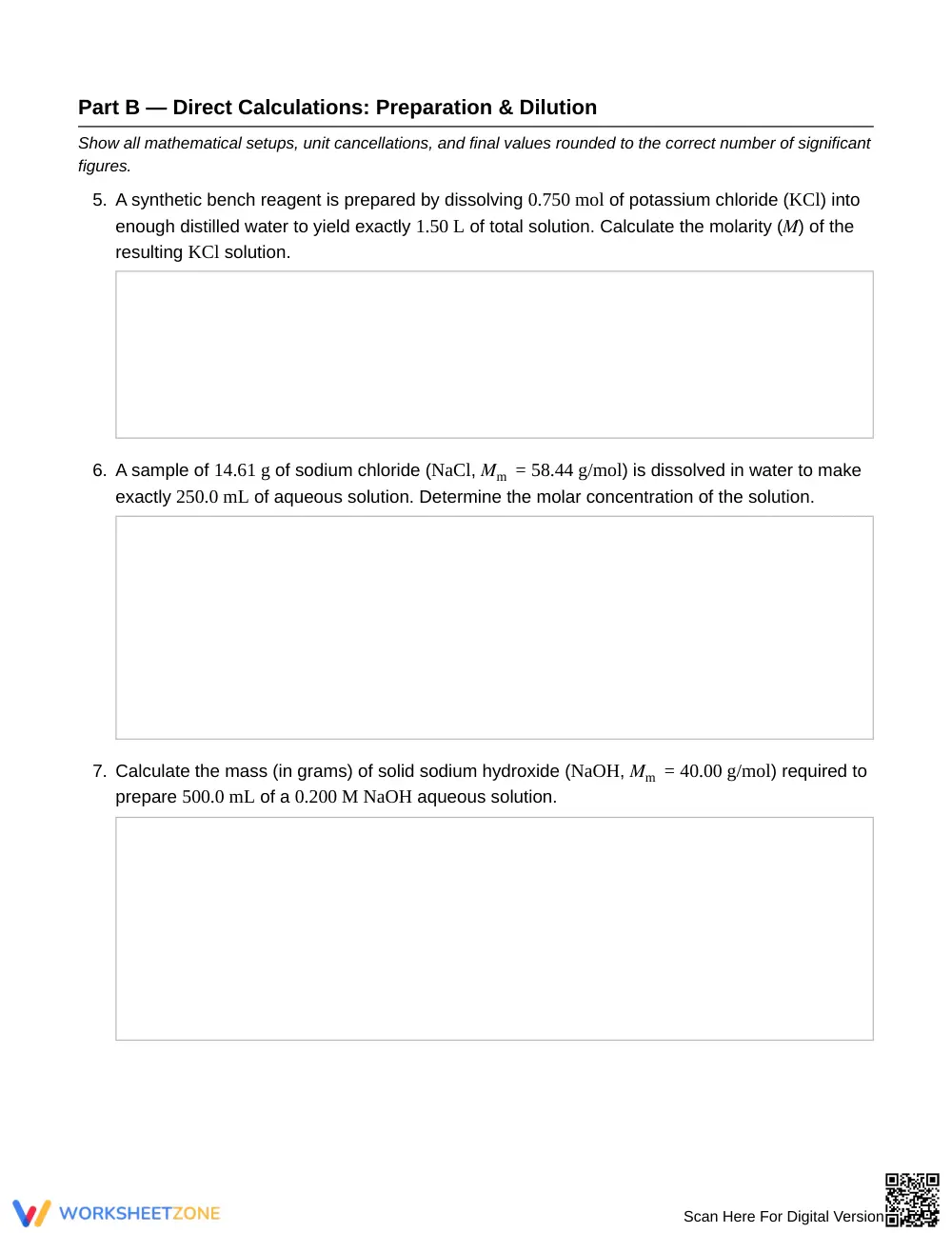
- Supported practice (Tasks 5–10): Applies the molarity formula and dilution equation ($M_1V_1 = M_2V_2$) to calculate concentrations, required masses, and aliquot volumes using provided molar masses.
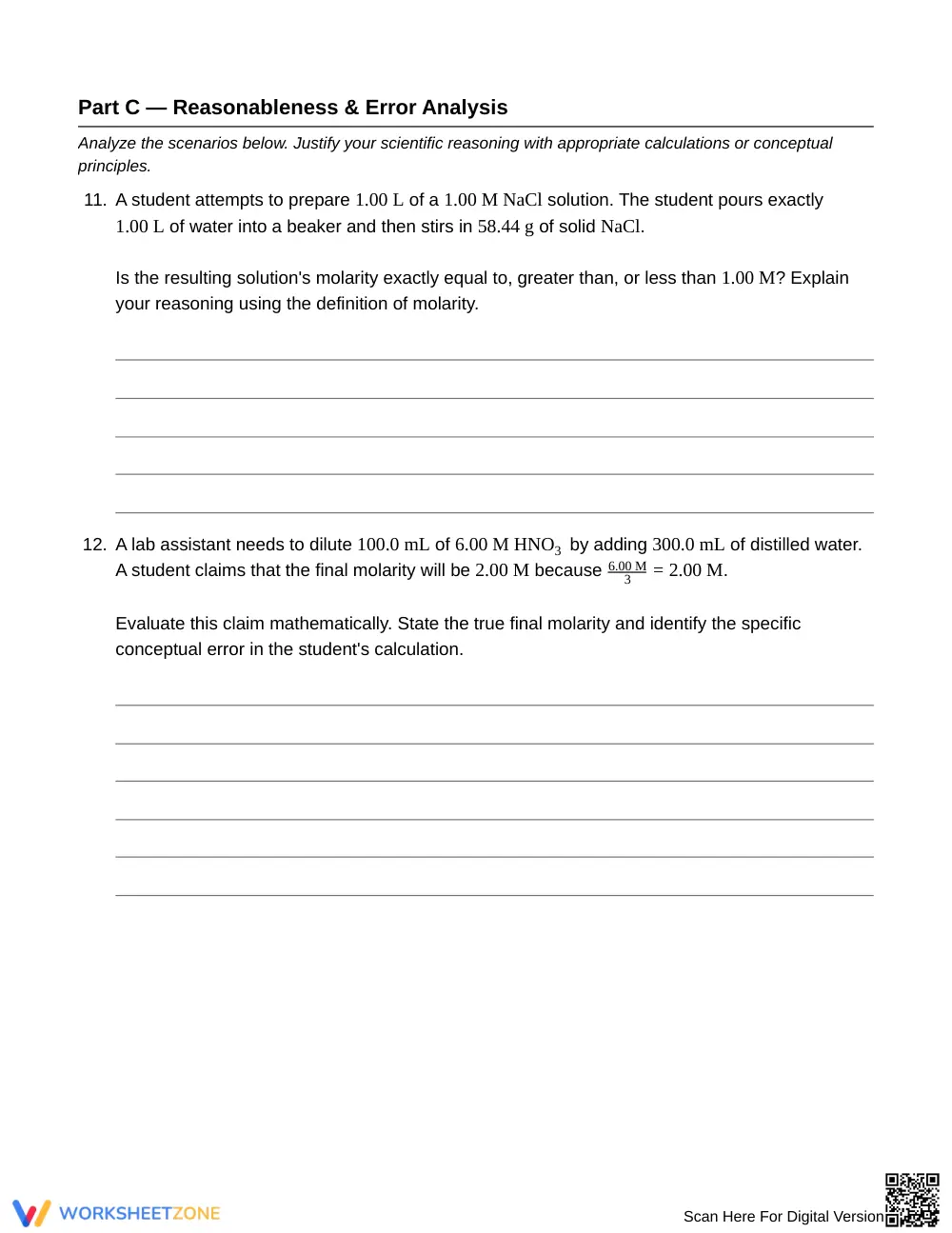
- Independent practice (Tasks 11–12): Demands critical error analysis by evaluating additive volume assumptions and diagnosing student mathematical mistakes in laboratory scenarios.
This sequence follows a gradual-release framework, guiding students from core concepts to autonomous quantitative problem-solving.
Standards Alignment
This resource aligns with high school chemistry expectations for solution concentration and stoichiometry. Students quantify concentration in moles per liter and calculate dilution volumes. Supporting standards address measurement precision and laboratory preparation. Both standard codes can be copied directly into lesson plans, IEP goals, or district curriculum mapping tools.
How to Use It
Assign this worksheet immediately following direct instruction on concentration formulas or as a pre-lab before aqueous solution preparation. During individual work, observe Part C to check whether students realize adding solid solute changes total solution volume beyond the pure solvent. Most students will complete the 12 problems within 40 to 50 minutes.
Who It's For
This practice set serves Grade 11 general and honors chemistry students mastering aqueous stoichiometry. Provide formula sheets for students needing calculation scaffolds, or assign Part C as an extension for advanced learners. Pair this worksheet with a volumetric flask demonstration.
According to research by Fisher & Frey (2014), structured instructional progressions that shift cognitive load from conceptual modeling to independent error analysis significantly enhance student problem-solving accuracy in secondary science. This Grade 11 chemistry resource targets high school solutions chemistry by teaching students to calculate solution concentration using molarity and dilution equations across 12 targeted tasks. Learners progress systematically through foundational solution terminology, multi-step mass-to-volume stoichiometry calculations, and authentic laboratory troubleshooting scenarios. By integrating explicit physical constants and formula definitions with gradual-release problem tiers, the material directly addresses persistent student misconceptions regarding solvent volume displacement and solute conservation during dilution procedures. Educators utilizing this 5-page printable instructional packet receive verified calculation setups, unit cancellations, and complete answer explanations suitable for classroom guided practice, laboratory readiness evaluations, and comprehensive unit mastery checks in high school chemistry curricula.


