


























Views
Downloads


Essential Modeling Conics Worksheet | Grade 11 Algebra II
Paste this activity's link or code into your existing LMS (Google Classroom, Canvas, Teams, Schoology, Moodle, etc.).
Students can open and work on the activity right away, with no student login required.
You'll still be able to track student progress and results from your teacher account.
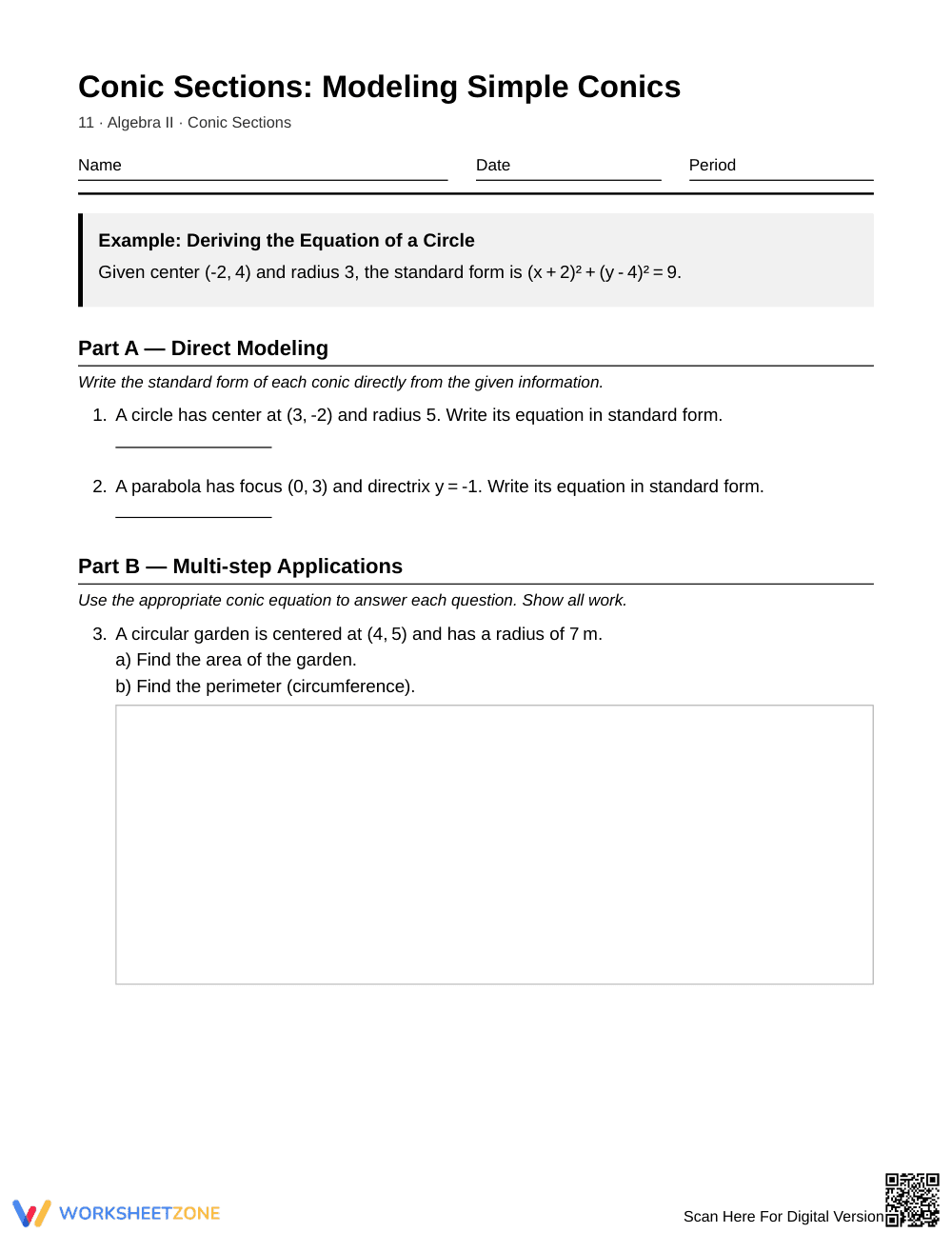
This high school worksheet gives students structured mathematical practice in modeling conic sections including circles, parabolas, ellipses, and hyperbolas. Learners translate geometric descriptions, boundary parameters, and real-world scenarios into standard-form equations while analyzing spatial constraints to verify algebraic solutions.
At a Glance
- Grade: 11 · Subject: Algebra II
- Standard: Model real-world geometric contexts using algebraic conic section equations
- Skill Focus: Model a Simple Conic Shape
- Format: 4 pages · 10 problems · Answer key included · PDF
- Best For: High school guided practice and review
- Time: 40–50 minutes
What's Inside
The four-page printable resource includes 10 multi-part analytical problems arranged in distinct cognitive tiers. It opens with an instructional worked example demonstrating circle derivation, moves through standard equation writing and contextual applications, and finishes with coordinate boundary verification alongside a comprehensive one-page answer key.
Skill Progression
- Guided Practice (Part A, 2 tasks): Direct equation modeling from basic geometric parameters such as center-radius pairs and focus-directrix lines, supported by an introductory circle reference example.
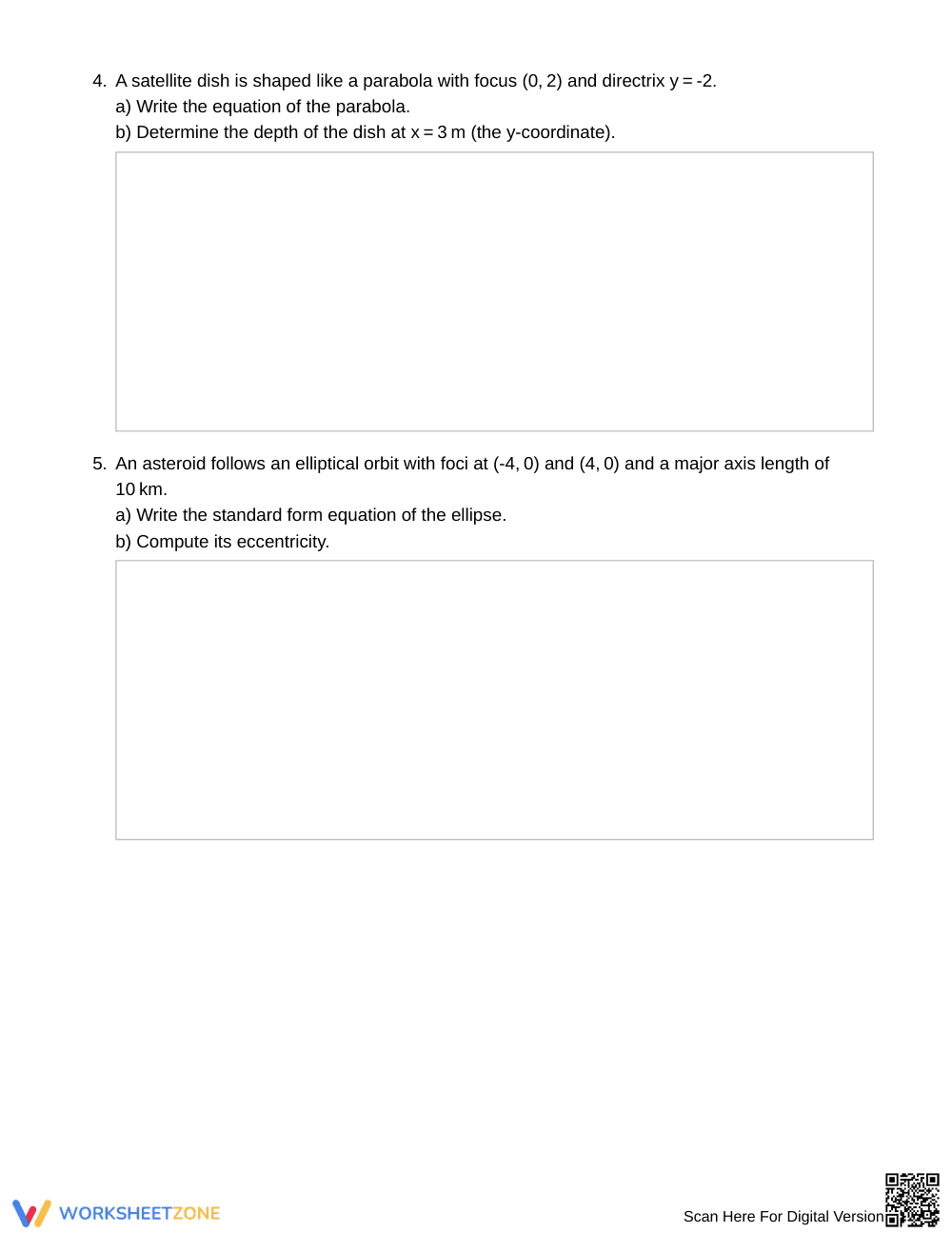
- Supported Practice (Part B, 6 tasks): Multi-step real-world application problems involving orbital ellipses, satellite dishes, circular perimeters, and hyperbolic radio signals requiring intermediate geometric calculations.
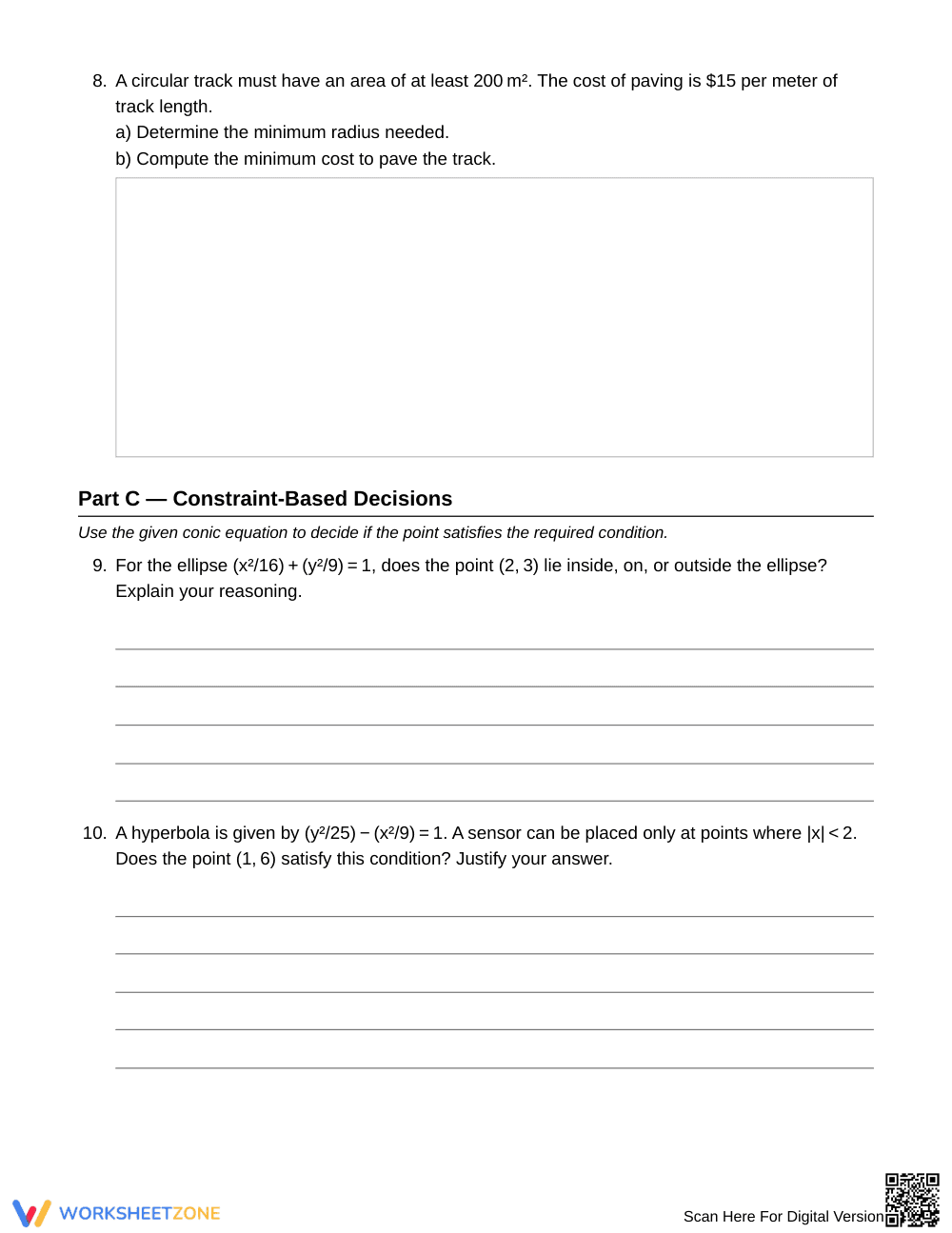
- Independent Practice (Part C, 2 tasks): Constraint-based decision making where learners test coordinate inequalities against given conic equations to classify interior and exterior regions.
This structured layout follows a gradual-release model, shifting student responsibility from direct algebraic substitution to complex contextual modeling.
Standards Alignment
This worksheet aligns directly with high school Algebra II and conceptual modeling frameworks for quadratic relations and analytic geometry. Students derive conic equations given foci, directrices, or vertices and use algebraic models to solve engineering and geometric optimization problems. These modeling objectives can be copied directly into lesson plans, IEP goals, or district curriculum mapping tools.
How to Use It
Deploy this activity after direct instruction on the standard forms of circles, parabolas, ellipses, and hyperbolas. It serves effectively as paired collaborative practice during class or as an independent summative review before a unit assessment. As a formative assessment observation tip, check whether students correctly distinguish between constant sum (ellipse) and constant difference (hyperbola) distance conditions in Part B. Expected student completion time is 40 to 50 minutes.
Who It's For
This activity is designed for Grade 11 Algebra II and Pre-Calculus students developing proficiency in analytic geometry. It offers clear scaffolding for learners transitioning from basic graphing to contextual modeling and pairs naturally with graphic organizer reference sheets or dynamic graphing software demos.
Secondary mathematics research published by Fisher & Frey (2014) demonstrates that structured gradual-release frameworks significantly enhance student retention when mastering advanced spatial concepts like conic sections. By moving systematically from isolated parameter identification to complex multi-step real-world applications and region testing, students develop durable schema for quadratic relations. The 10 problems in this resource reinforce core modeling competencies across circles, parabolas, ellipses, and hyperbolas, ensuring learners bridge conceptual geometry and algebraic computation effectively. Providing worked examples alongside authentic contextual constraints supports high-level problem-solving across secondary mathematics curricula.


