































Essential Model a Path Worksheet | Grade 12 Precalculus

Paste this activity's link or code into your existing LMS (Google Classroom, Canvas, Teams, Schoology, Moodle, etc.).
Students can open and work on the activity right away, with no student login required.
You'll still be able to track student progress and results from your teacher account.
Students will master the skill of modeling a simple moving path by translating real‑world motion scenarios into parametric and polar equations, then extracting key trajectory information. This worksheet guides them through direct modeling, multi‑step applications, and constraint‑based decisions, culminating in confident path analysis.
At a Glance
- Grade: 12 · Subject: Precalculus
- Standard:
— Model moving paths using parametric and polar equations; students develop equations that describe circular, linear, and spiral motions- Skill Focus: Model a Simple Moving Path
- Format: 5 pages · 10 problems · Answer key included · PDF
- Best For: Advanced trajectory modeling practice; suitable for enrichment labs or AP‑level review
- Time: 30–45 minutes
What's Inside
The packet spans five pages and contains ten rigorously sequenced problems. Each section supplies a concise worked example, a formula reference box, and a word bank for common trigonometric and exponential terms. An answer key on two pages provides step‑by‑step solutions for teacher verification.
Skill Progression
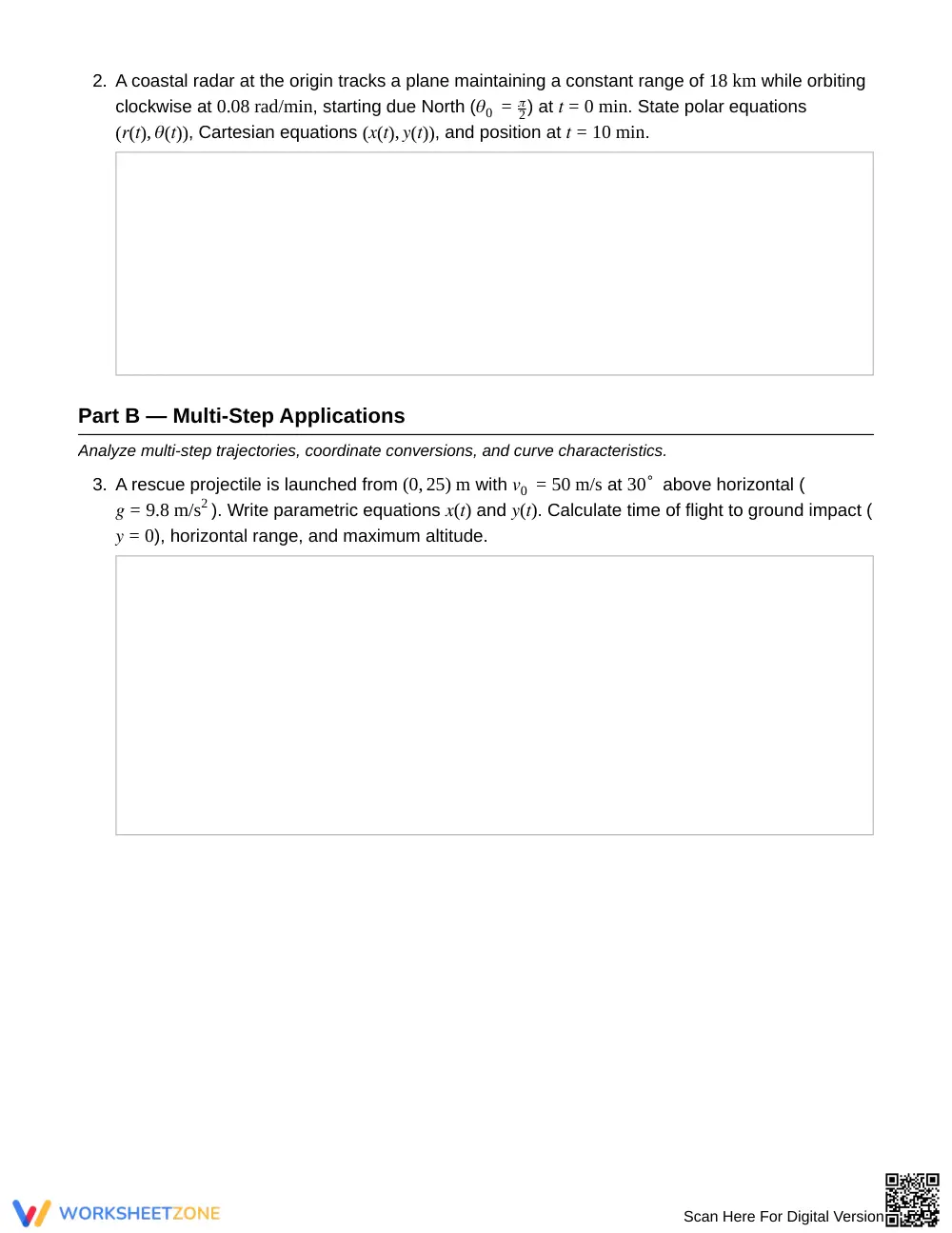
- Guided practice (3 problems): students follow a detailed worked example to set up parametric equations for linear motion, with scaffolding prompts and a formula sheet.
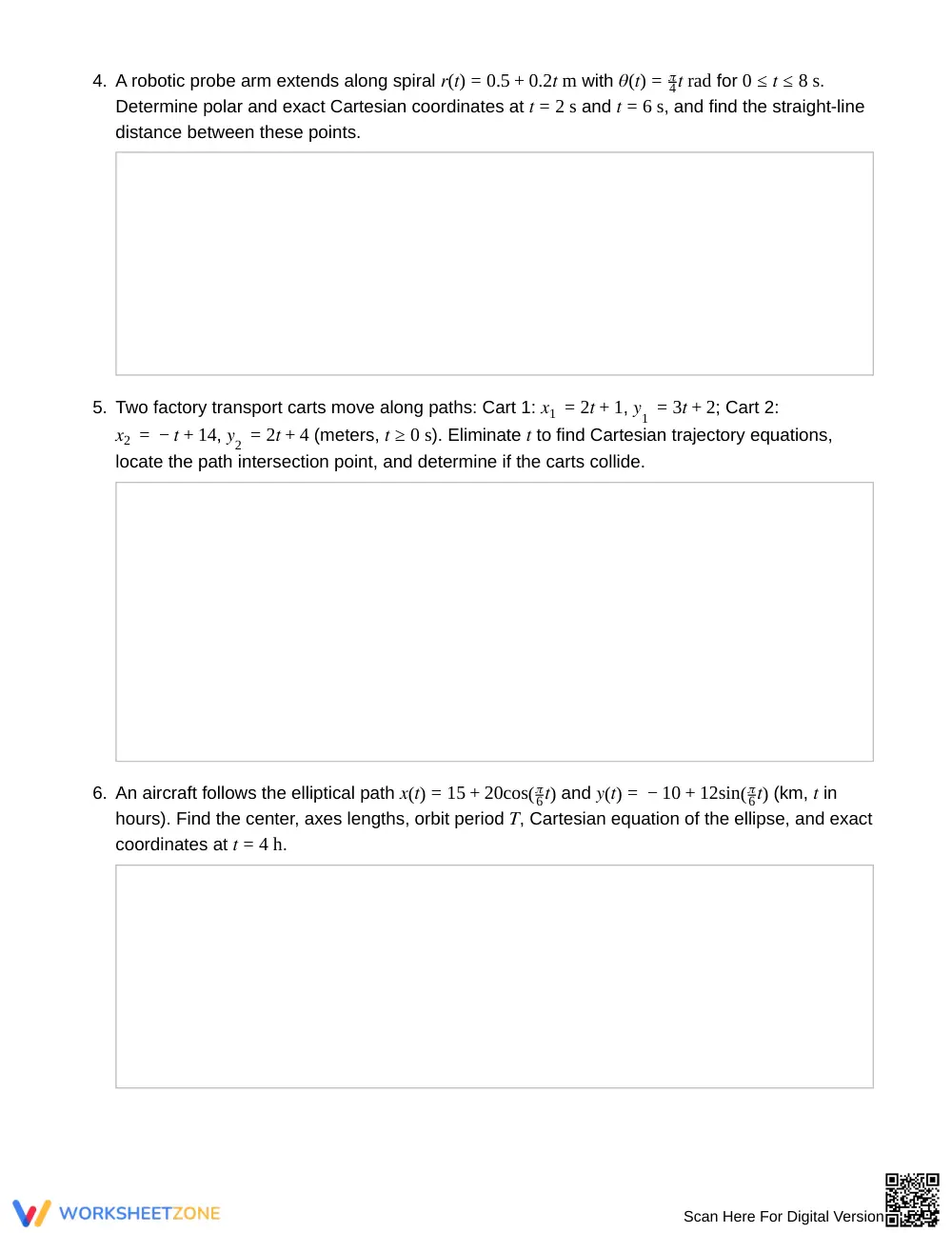
- Supported practice (4 problems): learners complete multi‑step applications such as projectile motion and spiral paths, using sentence frames and a word bank to reduce cognitive load.
- Independent practice (3 problems): students tackle constraint‑based scenarios requiring elimination of parameters and distance‑minimization calculations, demonstrating full mastery. The progression follows the classic I Do, We Do, You Do release model.
Standards Alignment
` ` This worksheet aligns with typical Precalculus standards that require students to construct and analyze parametric and polar representations of motion. It also supports broader mathematical practice standards emphasizing modeling and problem solving. Both standard codes can be copied directly into lesson plans, IEP goals, or district curriculum mapping tools.
How to Use It
Use Case 1 – Pre‑lesson enrichment: After introducing parametric equations, assign the Direct Modeling problems as a quick‑fire activity to reinforce formula derivation; observe student accuracy on the first three items as a formative check. Use Case 2 – Post‑instruction assessment: Deploy the Constraint‑Based Decisions section as a summative task during review week; students work independently while the teacher circulates, noting any misconceptions about distance functions. Each session typically requires 30–45 minutes.
Who It's For
Designed for Grade 12 Precalculus students preparing for AP exams or college‑level calculus, the worksheet challenges those comfortable with algebraic manipulation and trigonometry. While the core problems suit advanced learners, the built‑in scaffolds allow struggling students to access the material with minimal support. Pair it with a video tutorial on polar‑to‑Cartesian conversion or an anchor chart of common motion formulas for seamless integration.
Research shows that explicit modeling practice enhances students’ ability to transfer mathematical concepts to real‑world contexts (Fisher & Frey, 2014). This worksheet embodies that principle by guiding learners through authentic motion scenarios, from linear drone flights to spiral robotic arms, and requiring them to construct and interpret both parametric and polar equations. The structured progression—from guided examples to independent constraint analysis—mirrors the gradual‑release framework proven to boost conceptual understanding. By integrating worked examples, sentence frames, and a concise formula bank, the tasks reduce extraneous load while preserving cognitive challenge, aligning with the recommendations of the National Council of Teachers of Mathematics for effective modeling instruction. Educators can confidently assign this resource to deepen students’ procedural fluency and analytical reasoning in preparation for high‑stakes assessments. Overall, the activities support deeper engagement with vector‑valued functions and prepare students for college‑level differential equations.


