































Essential Meaning of Variables Worksheet | Grade 6 Math

Paste this activity's link or code into your existing LMS (Google Classroom, Canvas, Teams, Schoology, Moodle, etc.).
Students can open and work on the activity right away, with no student login required.
You'll still be able to track student progress and results from your teacher account.
This rigorous Grade 6 worksheet helps students conceptualize and defend how variables function in algebraic expressions. Rather than simply evaluating numbers, learners write mathematical justifications distinguishing between unknown fixed quantities, varying quantities, and constrained domains across 8 rich real-world modeling scenarios.
At a Glance
- Grade: 6 · Subject: Math
- Standard:
6.EE.B.6— Use variables to represent numbers and write expressions in real-world problems- Skill Focus: Justify the Meaning of a Variable
- Format: 5 pages · 8 problems · Answer key included · PDF
- Best For: Conceptual understanding and written mathematical justification
- Time: 40–50 minutes
What's Inside
The 5-page printable resource includes a foundational core concepts reference box defining variables, domains, coefficients, and constants. Students analyze 8 multi-part word problems organized into mathematical claim evaluations, modeling explanations, and domain counterexamples, supported by a 4-page detailed answer key with complete written explanations.
Skill Progression
- Guided Practice (Part A, Problems 1–2): Students critique student claims to distinguish variables representing discrete counts from terms representing total product costs.
- Supported Practice (Part B, Problems 3–6): Learners construct justifications explaining why specific coefficients, multi-variable terms, and operations accurately model real situations like book weights and banquet profits.
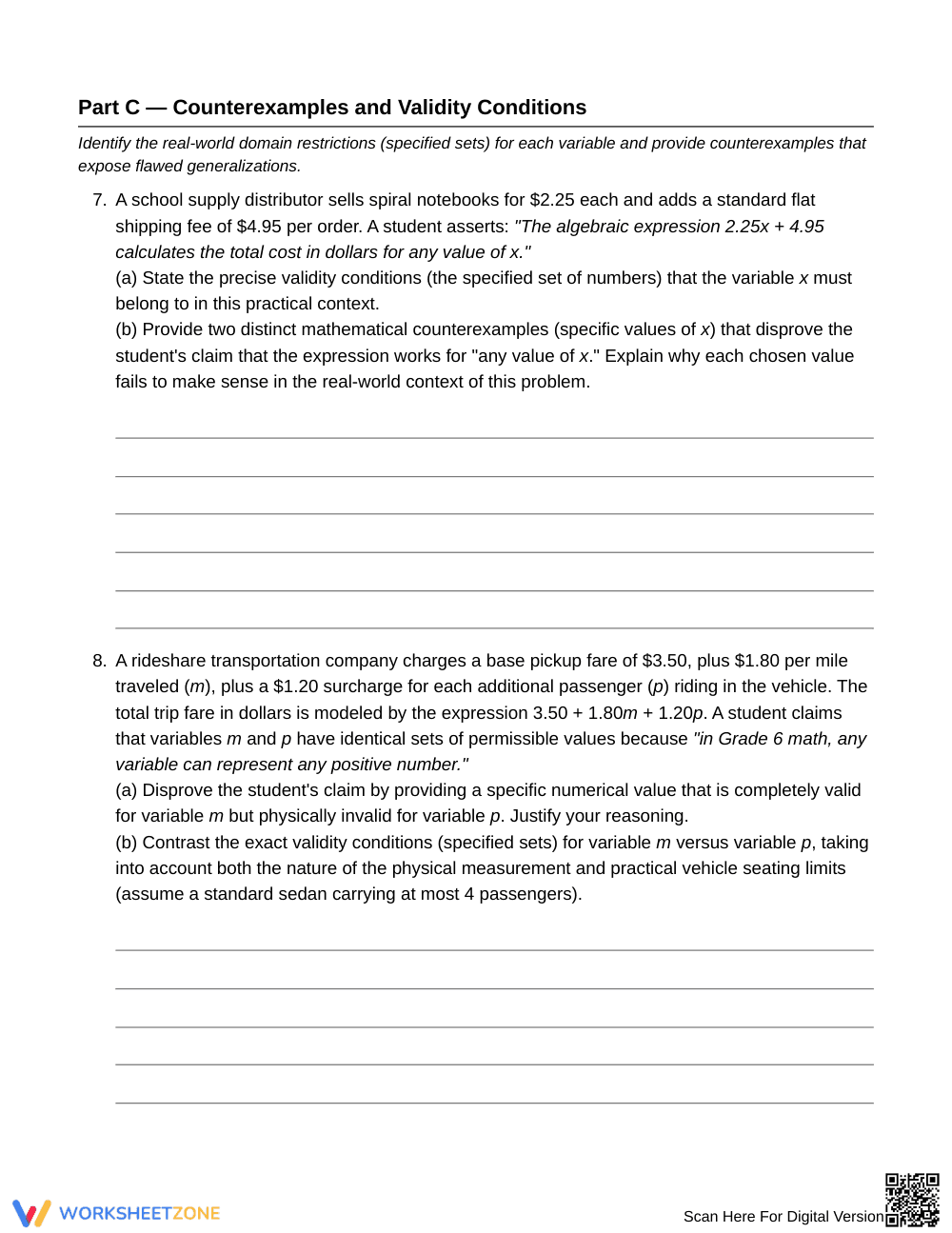
- Independent Practice (Part C, Problems 7–8): Students identify domain boundaries and generate mathematical counterexamples exposing invalid generalizations about variable sets.
This structured progression follows the gradual-release framework, moving learners from analyzing flawed reasoning to independently defining validity conditions.
Standards Alignment
This worksheet directly aligns with 6.EE.B.6: Use variables to represent numbers and write expressions when solving a real-world or mathematical problem; understand that a variable can represent an unknown number, or, depending on the purpose at hand, any number in a specified set. Both standard codes can be copied directly into lesson plans, IEP goals, or district curriculum mapping tools.
How to Use It
Deploy this activity after direct instruction on algebraic modeling to transition students from mechanical calculation to written mathematical discourse. For formative assessment, examine whether students identify correct measurement units when defining variables in Part B. The complete 8-task assignment takes approximately 40 to 50 minutes of instructional time.
Who It's For
This resource serves general education Grade 6 math classrooms, advanced Grade 5 students, and Grade 7 intervention groups needing conceptual reinforcement. Pair this worksheet with an anchor chart illustrating unknown fixed values versus varying quantities.
According to Fisher & Frey (2014), engaging students in structured written justifications deepens conceptual retention and bridges procedural fluency with mathematical reasoning. Standard 6.EE.B.6 requires Grade 6 learners to understand that a variable represents either a single unknown number or any value across a specified domain. By prompting middle school students to analyze authentic modeling contexts—including flat fees, unit rates, and vehicle passenger constraints—this instructional resource cultivates precise academic vocabulary. Students actively evaluate common algebraic misconceptions, distinguish coefficients from standalone constants, and determine valid domain boundaries through counterexamples. The included 4-page exemplar key provides model written responses that establish clear benchmarks for mathematical communication, supporting both tier-one classroom instruction and targeted small-group intervention.


