































Essential Mapping Constraints Worksheet | Grade 10 Geometry

Paste this activity's link or code into your existing LMS (Google Classroom, Canvas, Teams, Schoology, Moodle, etc.).
Students can open and work on the activity right away, with no student login required.
You'll still be able to track student progress and results from your teacher account.
This Grade 10 Geometry worksheet develops students' ability to construct and verify rigid-motion mappings under strict geometric constraints. High school learners analyze coordinate transformations, evaluate given claims, and justify whether single motions or composite sequences map congruent figures onto one another while satisfying prescribed conditions.
At a Glance
- Grade: 10 · Subject: Geometry
- Standard:
HSG-CO.A.5— Specify sequences of transformations carrying one figure onto another- Skill Focus: Constrained rigid-motion mappings and transformations
- Format: 5 pages · 6 problems · Answer key included · PDF
- Best For: Independent practice and transformation mastery
- Time: 45–60 minutes
What's Inside
This 5-page printable geometry resource contains 6 multi-step transformation tasks distributed across coordinate grids and geometric figures. Students evaluate student claims, calculate rotation angles with fixed centers, construct glide reflections along sloped lines, and compose transformation sequences. A comprehensive 4-page step-by-step answer key provides complete coordinate verifications and sample justification paragraphs.
Skill Progression
- Guided practice (Problems 1–2): Structured coordinate tasks where students verify reflection sequences and determine rotation angles about fixed centers using orientation arguments.
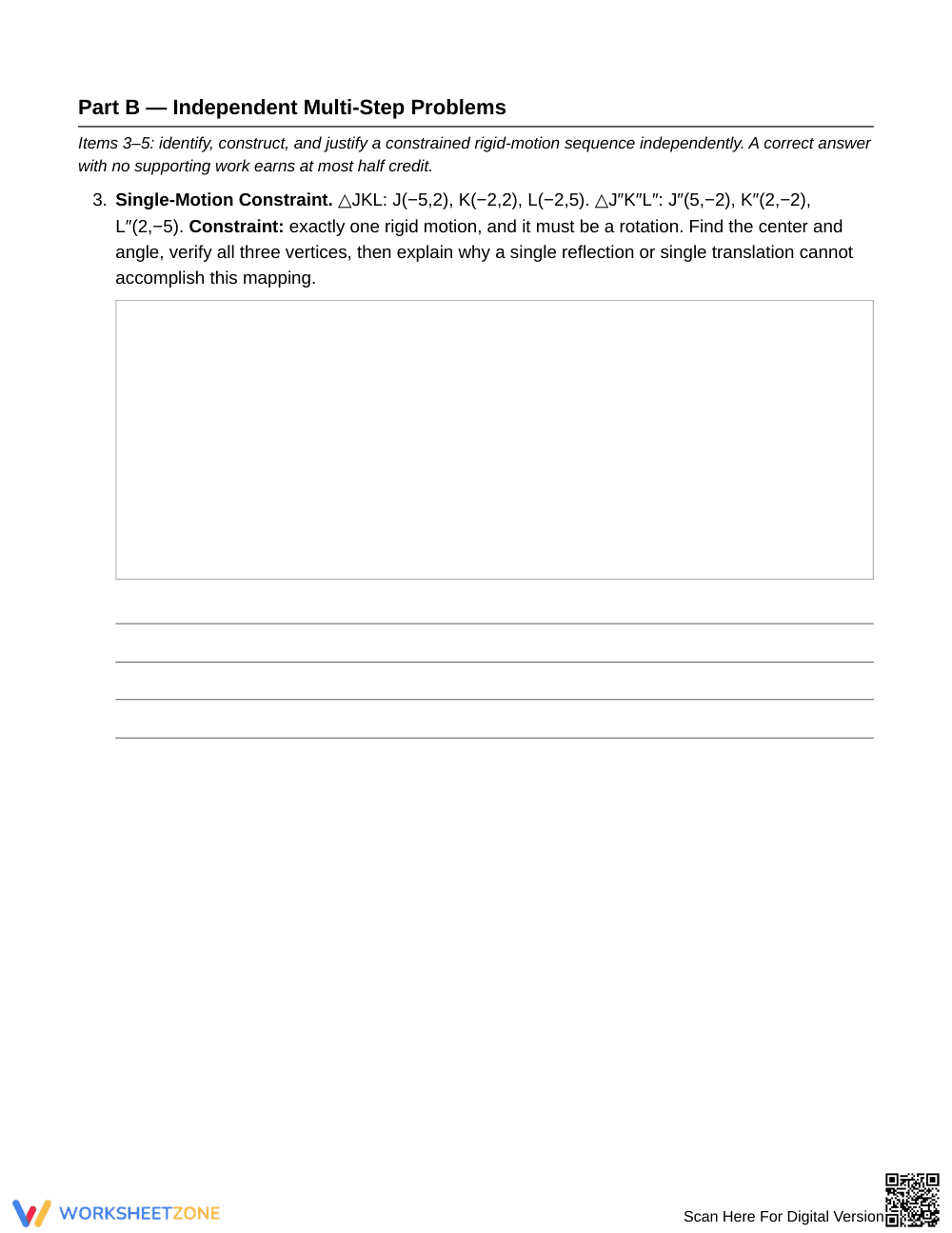
- Supported practice (Problems 3–5): Multi-step independent tasks requiring students to identify single-motion rotations, explore line-order combinations, and construct glide reflections.
- Independent practice (Problem 6): A formal construction and justification task requiring students to write a paragraph-length mathematical proof of transformation uniqueness.
This scaffolded progression adheres to the gradual-release instructional model, transitioning students smoothly from guided coordinate analysis to rigorous independent mathematical justification.
Standards Alignment
This resource aligns directly with standard `HSG-CO.A.5`: Given a geometric figure and a rotation, reflection, or translation, draw the transformed figure and specify a sequence of transformations that will carry a given figure onto another. It also supports foundational congruence concepts defined in `HSG-CO.B.6`. Both standard codes can be copied directly into lesson plans, IEP goals, or district curriculum mapping tools.
How to Use It
Deploy this worksheet after direct instruction on rigid transformations or during mid-unit review to deepen analytical reasoning. Have students work in pairs on Part A before shifting to solo problem-solving on Parts B and C. Formative assessment tip: Check student orientation explanations in Item 2 to verify they distinguish between rotations and reflections. Expected completion time is 45 to 60 minutes.
Who It's For
This resource is designed for Grade 10 Geometry students mastering transformation geometry, congruence proofs, and coordinate geometry. It offers built-in scaffolding for learners needing structured prompts while providing rigorous proof demands for advanced students. Pair this activity with an interactive dynamic geometry demonstration or a transformation coordinate rule summary chart.
High school geometry students frequently struggle to connect algebraic coordinate rules with formal geometric proofs of transformation uniqueness. According to Fisher & Frey (2014), structured instructional scaffolds that transition from guided analysis to independent construction significantly enhance procedural fluency and spatial reasoning. This Grade 10 Geometry worksheet directly targets standard `HSG-CO.A.5`, asking learners to draw, specify, and mathematically justify rigid motions under strict geometric constraints. Through 6 multi-step problems across 5 pages, students calculate precise rotation angles, determine valid lines of reflection, evaluate composition orders, and prove the uniqueness of transformation mappings. By demanding both coordinate calculations and written paragraph justifications, the resource ensures students move beyond passive graphing into active conceptual mastery, preparing them for advanced congruence proofs and standardized assessments.


